


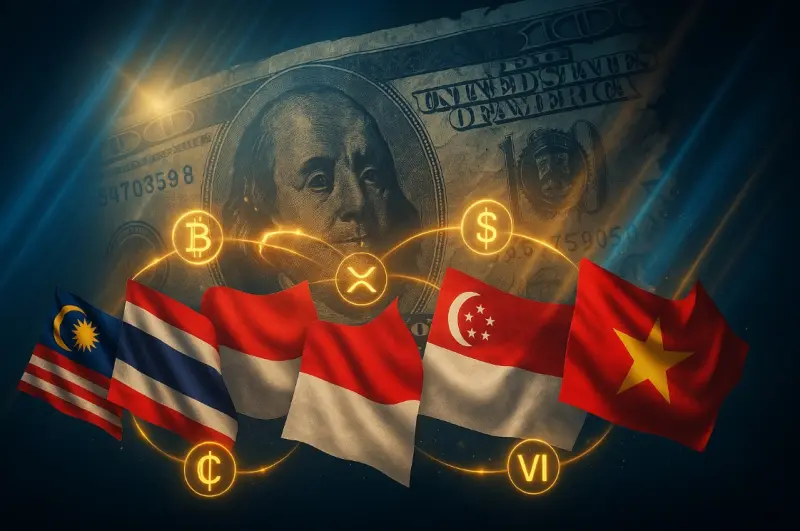
De-Dollarization in Motion
De-Dollarization in Motion
By Mehmet Enes Beşer
For decades, Southeast Asian economies have been plugged into a system controlled by the U.S. dollar. In trade settlements and sovereign reserves, in cross-border investments and financial benchmarks, the dollar was not just a currency—it was the linchpin of regional economic integration. But now, across the region—Jakarta to Kuala Lumpur, Bangkok to Manila—stealthy but determined steps are being taken to disentangle the region from that dependence. Though the dollar’s grip remains firm, a profound shift is underway. And though it may be early days, the implications for the United States and the future of global finance are far from trivial.
The causes of this regional shift are multifarious, but they all coalesce around a growing sense of strategic imperative. The immediate cause has been the weaponization of the dollar in global politics—its application in sanctions, its linkage to unstable U.S. monetary policy, and the systemic threat it poses to emerging economies. As the Federal Reserve initiated aggressive interest rate hikes to tackle inflation, Southeast Asian currencies were facing gigantic pressure. Sovereign debt burdens rose, inflationary shocks were passed on, and central banks were beholden to decisions in Washington. For countries interested in financial sovereignty, this volatility has been a danger and a warning.
Southeast Asian countries, in their turn, are not launching headline-grabbing anti-dollar crusades. Instead, they are pursuing more low-key and pragmatic methods. Local currency bilateral settlements are gaining ground. Indonesia and Malaysia are restarting local currency settlement facilities. Thailand and China have deepened their yuan-clearing facilities. Singapore is experimenting with dollar-free blockchain-based cross-border payment facilities. Even the Philippines, which has traditionally been more aligned with the U.S. financial system, has begun to show openness to the diversification of currency usage in trade.
All these developments are not having a one-time character. They are part of a broader recalibration in Asia, where regional central banks and institutions are moving towards monetary multipolarity. ASEAN’s regional currency swap facility, the Chiang Mai Initiative Multilateralization (CMIM), once symbolic, is now being considered as an actual buffer against external shocks. Meanwhile, China’s renminbi is increasingly in use, not yet as a reserve currency in full, but as a vehicle for payment and settlement of trade and energy. The roll-out of China’s Cross-Border Interbank Payment System (CIPS), and pilot implementations of a central bank digital currency (e-CNY), give Southeast Asian nations new tools to diversify risk while still being part of world trade.
For the United States, the region’s de-dollarization trend should be troubling—not because it portends imminent collapse, but because it erodes the pillars of long-term monetary power. Dollar hegemony has accorded the U.S. not only economic benefits—such as cheaper borrowing and robust cross-border demand for its debt—but also geopolitical clout. When Southeast Asia, a region long rooted in the U.S.-led order, begins hedging against the dollar, it is not merely a question of economic prudence but strategic rethinking. Faith in the dollar is being reassessed, and such faith is not so readily restored once destroyed.
Washington’s challenge is compounded by its increasingly transactional approach to the region. Trade negotiations are stalled, defense obligations are viewed with diminishing trust, and economic engagement has been eclipsed by security-oriented rhetoric. Though China’s regional role is expanding not just in terms of infrastructure or diplomacy but finance as well. Chinese banks are increasingly active in Southeast Asia, Chinese payment systems are gaining traction in domestic markets, and the yuan is increasingly prominent in long-term monetary cooperation discussions.
However, Southeast Asia is not looking away from the U.S. dollar out of love for some other power. Its leaders are pragmatic. They care about toughness, autonomy, and options. The dollar is still part of that equation—but not the exclusive one. In fact, the most explicit message from the region is not a message of discontinuity, but of reform. If America wishes to preserve the privileged position of the dollar, it will have to be mindful of the limits of inertia. It cannot rely on the historical prestige of the dollar or the size of its markets. It must reinvest in the global South as a partner, not a patron.
The muted rebellion of the region against the dollar is not one of rejection—it’s a recalibration. It’s not driven by ideology, but a pragmatic assessment of risk in a rapidly changing world. The longer Washington chooses to ignore these signals, the stronger dollar alternatives get. Once normalization gains momentum, it could become much more difficult to turn around than most people in the West appreciate.
The days of unquestioned dollar hegemony have yet to pass. But in Southeast Asia, the ground beneath it is beginning to shift—and America would do well to listen before the rumbling becomes shaking.