


Emancipation will come from the working class’s capacity to articulate its own materialist and sovereign project.
Emancipation will come from the working class’s capacity to articulate its own materialist and sovereign project.
By Yenny Betancur Gutiérrez*
The 2026 elections in Colombia reflect a structural crisis of sovereignty, marked by identity fragmentation, the influence of international actors, and the weakness of the State to control its territory, economy, and institutions.
Analyzing the political reality of Colombia in the context of the 2026 parliamentary elections demands a profound perspective. Colombia is not a sovereign state; it is an anemic political body, a battleground of geopolitical interests and identity struggles. If the state does not control its territory, guarantee its economy, and legitimize its institutions, it simply ceases to exist as such and becomes an administrative colony, as is currently the case with the Argentine people and their libertarian leaders, who have decided to auction off their territory, and as has happened for over 200 years in most of our Spanish-speaking brother countries.
The leadership of Iván Cepeda in Congress and his projection toward the presidency, along with Aida Quilcué’s projection toward the vice presidency, represent the consolidation of the “extravagant left“, understood from the perspective of Political and Philosophical Materialism, in Colombia. This current has replaced the struggle for national sovereignty, industrialization, and control of the means of production with an agenda of fragmented identities, reformism, abstract ethics, and “human rights” understood from a “globalist” perspective in the bourgeois liberal capitalist sense, used to impose the current prevailing economic model and to justify interventions in sovereign states.
The “Total Peace” proposal that Cepeda intends to continue, building upon the project of Gustavo Petro’s government, is a metaphysical idea. In reality, only a relative peace would be possible, and even then, only under the hegemony of the State, by transforming material conditions. Therefore, this plan is not a mechanism for order, but rather a form of state dismantling. By negotiating symmetrically with criminal and paramilitary structures, the State relinquishes its very essence as the monopoly on legitimate violence and territorial control. Integrating guerrillas, paramilitaries, and criminal gangs into an institutional framework does not eliminate the structural conditions that produce violence (dispossession, inequality, dependence on transnational capital). Therefore, even if open warfare is reduced, total peace cannot be achieved.
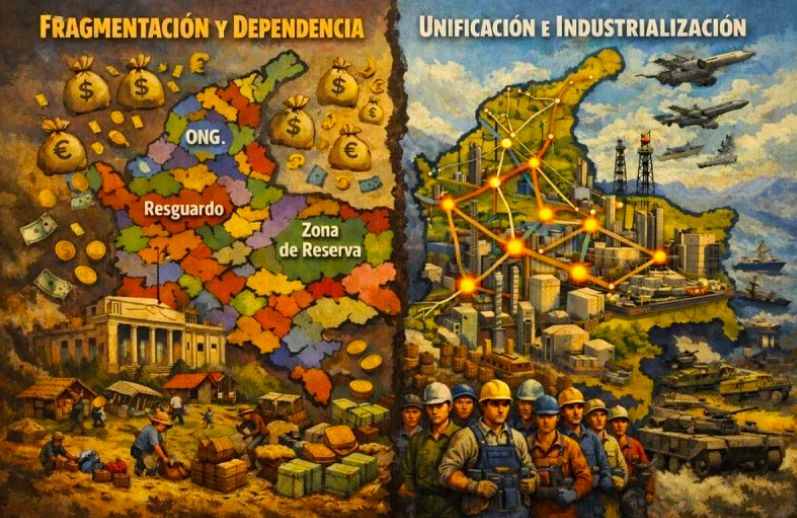
A potential government under this influence would deepen the country’s Balkanization, where sovereignty is fragmented under the pretext of “transitional justice” and “reparations.” In this scenario, Colombian workers are left unprotected, as there is no longer a strong state to discipline the exploiter or the criminal; only a human rights bureaucracy remains, managing the misery.
At the heart of this fragmentation is the funded indigenism, which represents the main impediment to a real insubordination of the working class.
According to Santiago Armesilla, the replacement of the category of “social class” with that of “ethnicity” is capitalism’s greatest success in the 21st century. The massive economic support received by Indigenous movements, coming from both the national budget and multilateral organizations like the World Bank and the Inter-American Development Bank, creates a kind of identity aristocracy. This flow of capital injects resources into reservations and autonomous territories that operate under their own laws, fracturing national unity. Workers, both urban and rural, perceive Indigenous people not as comrades in struggle, but as competitors who enjoy funded territorial privileges. This ensures that social discontent never coalesces into a large-scale nationalist project, but instead dissolves into particular disputes over land and subsidies. However, in addition to these Indigenous identity politics, multiple cultural, ethnic, gender, and religious identity categories are promoted and supported, generating ideological fragmentation and neutralizing the unity and subordination of the working class.
This divisive structure is supported by a network of influence in which the Open Society Foundations (OSF) plays a decisive role. OSF funding of environmental and indigenous rights NGOs constitutes what can be described as human rights imperialism or ecological imperialism. By injecting capital into groups that use legal activism to block strategic mining, energy, and infrastructure projects, Colombia is prevented from developing the material resources necessary for its own defense and industrialization. Under the pretext of radical environmental protection and compliance with agreements like the Escazú Agreement, developed powers, through these foundations, manage to keep developing countries in a state of productive paralysis. This is a hybrid war where tanks are not used, but rather lawyers and activists to cripple the state’s capacity for planning.
Faced with this advance, the Colombian right wing has proven incapable of articulating a sovereign defense. The fragmentation between Paloma Valencia’s blind legalism, Abelardo de la Espriella‘s populist aestheticism, and Juan Daniel Oviedo’s technocracy reveals the complete absence of a national-popular project. Thus, Valencia propels herself onto institutions already captured by external agendas, with a history of corruption and state terrorism; De la Espriella offers the spectacle of force without a productive base; and Oviedo represents the vision of a country transformed into a mere administrative unit at the service of capital. These representatives of the right wing embody the defense of liberal capitalism and subordination to the predatory imperialist hegemon of North America and its allies, reinforcing Colombia’s structural dependence on the geopolitical stage. This weakness and extreme political and social polarization is manifested in the crisis of legitimacy of the electoral system and the distrust generated by the alteration of the E14 forms, symptoms of a State that has lost the capacity to guarantee its own transparency and internal order.
Colombia faces the potential disappearance of itself as an effective political unit. If the course is not corrected through sovereign insubordination, the country’s fate is to become a collection of protectorates managed by international NGOs and criminal gangs, while the population remains divided into identity-based factions . The only viable solution is the recovery of the idea of nationhood: expelling the influence of foreign foundations from state decision-making, dissolving autonomies based on ethnicity and other forms of identity politics in favor of a single citizenship, and launching a centralized industrialization plan that puts strategic resources at the service of national power. Only in this way can Colombia cease to be a pawn in the geopolitical auction and become an actor with its own will on the international stage.
In conclusion, the 2026 parliamentary elections in Colombia reflect not only an electoral dispute but also a structural crisis of hegemony. The vice-presidential ticket of Cepeda and Quilcué introduces an indigenous component that, while symbolically powerful, is limited by coaptation, since funding indigenous movements strengthens their visibility but neutralizes their potential for insubordination. On the geopolitical chessboard, Colombia remains a contested arena where the working class faces the historic task of overcoming fragmentation and building autonomous power. Emancipation will not come from moderating pacts or external funding, but from the working class’s capacity to articulate its own materialist and sovereign project, capable of confronting the structures of capital.
Yenny Betancur Gutiérrez* Columnist for the website laiberofonia.com
This article was originally published on the website laiberofonia.com
Cover photo: laiberofonia.com