


Repeating History from Hungary to Taiwan
Repeating History from Hungary to Taiwan
First published on the website “mavivatan.com”
The year 1956 stands as one of the major breaking points in modern geopolitics. The Suez Crisis began on July 19, 1956, when the United States withdrew financing for the Aswan Dam in Egypt. It escalated on July 26, when Egypt’s revolutionary leader Gamal Abdel Nasser nationalized the Suez Canal. Britain and France perceived this as a direct threat to their interests. In reality, it was finance capital that panicked, as the canal was a critical artery of global trade.
Israel was the trigger of the 1956 Suez intervention
After Nasser became president in 1954, the British Navy withdrew from Egypt but retained the right to return in case of crisis. Britain did not accept a complete loss of control. Nasser’s move was therefore seen as both a strategic and symbolic threat.
Diplomatic efforts between August and October 1956 failed. On October 22–24, Britain, France, and Israel agreed on a secret amphibious plan at Sèvres near Paris. Israel was not an auxiliary actor but the operational spearhead. Since Britain and France lacked international legitimacy to directly attack Egypt, Israel initiated the war by attacking Sinai on October 29, 1956. Britain and France then intervened under the pretext of separating the parties and securing the canal.
It also should be noted that Israel became a de facto nuclear power around 1967, although it has never officially acknowledged it. The foundations of this capability were laid in the late 1950s, directly following the 1956 Suez Crisis. That crisis created a strategic alignment between Israel and France. Seeking to counter Gamal Abdel Nasser’s effect in Algeria, France agreed to provide Israel with critical nuclear assistance, including the Dimona reactor and the technological basis for plutonium production. At the same time, Israel drew a key lesson from the crisis that great powers, including the United States, could not be relied upon for ultimate security. This combination—French technology transfer and a deepened sense of strategic isolation—pushed Israel toward developing an independent nuclear deterrent. In this sense, the Suez Crisis was not just a regional conflict; it was the decisive turning point that enabled Israel’s emergence as a nuclear power.
Academic studies and memoirs clearly show that Israel consciously assumed the role of first aggressor and enabled the military start of the 1956 operation. The crisis was not a spontaneous tripartite conflict but a coordinated intervention, with Israeli geopolitics at its core. Israel entered Sinai on October 29, Britain and France launched airstrikes on October 31, and landings took place in Port Said on November 5th – 6th.
Eisenhower’s Reaction
U.S. President Dwight Eisenhower strongly opposed the intervention, which had been carried out without informing him. He believed it weakened the Western bloc and pushed newly independent states toward the Soviet Union. Prime Minister Anthony Eden initially resisted, expecting military success.
The U.S. applied financial pressure by restricting oil supplies and blocking IMF support. The British pound came under severe strain. As a result, a ceasefire was declared on November 6th. Britain and France withdrew in December, and Israel left Sinai by March 1957. Within days, Britain’s imperial power effectively collapsed—not militarily, but financially under U.S. pressure.
Hungary and Soviet Opportunity
At the same time, the anti-communist uprising in Hungary, which began on October 23rd , 1956, created a strategic opportunity for the Soviet Union. Prime Minister Imre Nagy introduced reforms, moved toward a multi-party system, and declared Hungary’s withdrawal from the Warsaw Pact.
On November 4th, just before the Anglo-French landing in Port Said, Soviet forces entered Budapest with massive force and crushed the uprising. Nagy was later executed. While the United Nations focused on Suez, the Hungarian crisis was pushed into the background. The divided West could not respond effectively.
This simultaneity revealed a fundamental geopolitical truth: fractures in one theater create opportunities in another. Eisenhower was particularly angered by this outcome. Britain had the military capacity to continue but lacked the financial capability. On January 9th, 1957, Eden resigned.
The Decline of Britain
Britain’s collapse was gradual. In the 19th century, sterling dominated global trade. By the early 20th century, the United States had surpassed Britain in production. Two world wars left London heavily indebted.
Although the Royal Navy remained powerful in 1945, it rapidly declined due to economic constraints and dependence on the U.S. By 1956, it could no longer act independently. Britain withdrew east of Suez by 1971, handing over strategic positions to the U.S. Navy and ending its global maritime dominance.
Today is Yesterday: The Hormuz Crisis
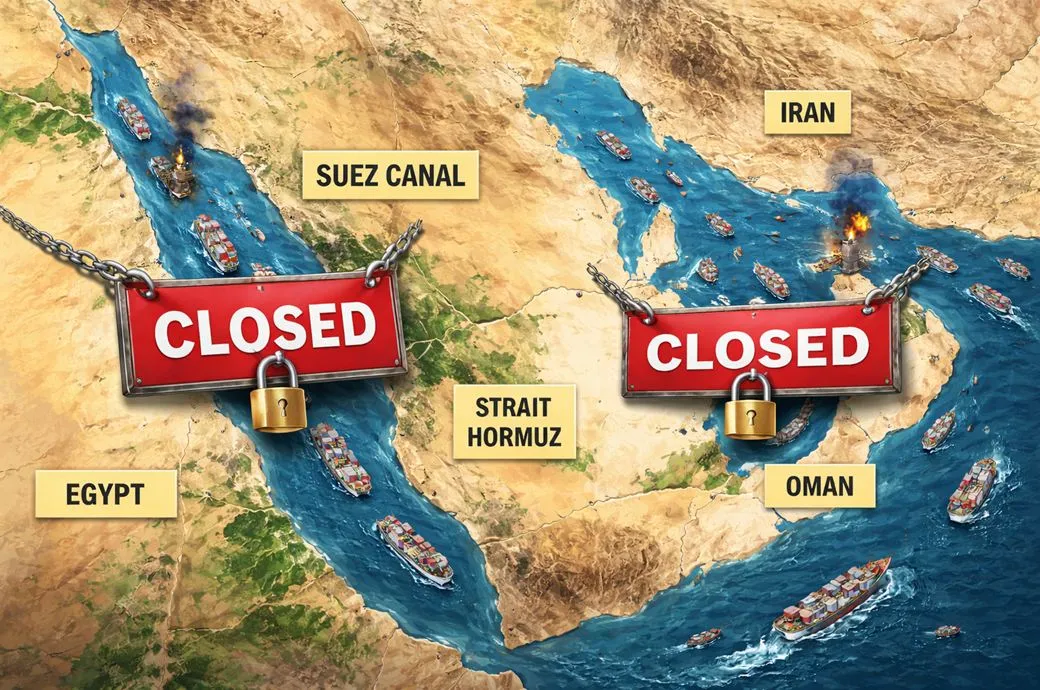
Seventy years later, a similar systemic rupture is emerging in the Hormuz-centered crisis of March 2026. As the Gulf war enters its fourth week, the Strait of Hormuz is effectively blocked. The cost of the war for the United States has exceeded $30 billion.
Normally, around 140 ships transit daily. Now only a handful can pass. This chokepoint carries roughly 20% of global oil trade. Disruptions have triggered a physical supply crisis.
Energy prices are rising sharply, affecting fertilizer, agriculture, industry, and semiconductor production. Food security risks are emerging rapidly.
The U.S. released 172 million barrels from its Strategic Petroleum Reserve on March 15th , reducing reserves to around 243 million barrels. With daily consumption of about 20 million barrels, this covers only roughly 12 days. In 2009, reserves stood at 727 million barrels.
At the same time, the U.S. faces budget crises and rising debt exceeding $40 trillion. Annual interest payments approach $1 trillion. A $200 billion additional defense request highlights the unsustainability of this trajectory. The inability to pass domestic budgets while expanding external military commitments reflects deep institutional imbalance.
Meanwhile, China and Gulf states are reducing holdings of U.S. bonds, signaling erosion of the dollar’s reserve status—mirroring Britain’s earlier decline.
The Declining U.S. Navy
The real power of the USA is the dollar and its navy. However, both are weakening today. Its military capacity in the field is not enough to reverse the picture in Hormuz. Although the two aircraft carrier strike groups have a psychological effect, they cannot have a material effect. The USS Abraham Lincoln aircraft carrier group cannot approach the shores due to Iran’s intense missile and UCAV threat. The problems do not end with the USS Gerald R. Ford aircraft carrier, which is kept off the coast of Saudi Arabia due to the Houthi risk in Bab el-Mandeb in the Red Sea. The fire on the ship, which lasted for 30 hours, was hidden from the public. The ship is returning to Crete, where it came for investigations and repairs.
In the Pacific, the USS Ronald Reagan aircraft carrier is under maintenance, the USS Tripoli and the 31st MEU above it have been departed from the area, and at least four destroyers have been shifted to other mission areas. For this reason, the number of surface ships of the USA that are constantly operating in the Pacific has fallen to critical levels. This table clearly shows that the USA, which has 292 ships (233 combatants) but only 104 ships (75 combatants) ready for active combat as of 2026, is unable to transfer sustainable forces on two fronts at the same time. 31. The Marine Corps is made up of about 2.500 personnel and is far from producing deterrence against a country like Iran, with a population of close to 85 million people, with a wide geographical depth. On the other hand, the 11th Marine Corps, which departed from San Diego on March 20, 2026, will reach the Gulf only 3 weeks later. Even if both marines unite, the military impact will be extremely low, on the contrary, American losses will be higher than estimates.
On the other hand, the fact that there was no strong response to Washington’s call to NATO and Asian allies to “send ships to the Gulf” to open Hormuz shows that this transformation has begun. At this point, the basic truth of international relations is once again revealed, states do not have permanent friends, they have permanent interests. All these developments confirm Colin Powell’s warning for Iraq in 2002 on a global scale: “You break it, you own it.” If you disrupt an order with brute force, you also have to take responsibility for the chaos that ensues. The crisis in Hormuz today shows that this principle now operates on a global scale.
Western Pacific and Taiwan Crisis Potential
The Hormuz crisis hits the Indo-Pacific region the most today. Energy importers such as Australia, Japan and South Korea will be hit hard, while exporters such as Russia will benefit from higher prices. The crisis provides Russia with a profit of 150 million dollars a day with the lifting of Trump sanctions. On the other hand, countries whose energy security is shaken will quickly turn to the search for new alliances.
The development that makes this picture even more critical is taking place on the Korean Peninsula. At a time when the USA is shifting THAAD and Patriot elements from South Korea to the Middle East, North Korea has carried out new ballistic missile tests in the last week. In addition, it is considered that cruise missiles fired from newly commissioned destroyer-class platforms may have the capacity to carry nuclear warheads. These developments indicate that the US missile defense umbrella in the Pacific is weakening and the regional deterrence architecture has become fragile. According to the news published in the Financial Times newspaper on March 21, 2026, it is reminded that the intensive use of Tomahawk cruise missiles and air defense interceptors (Patriot, SM-series) in West Asian operations is also necessary to defend Taiwan and attack Chinese forces at the beginning of the conflict, warning that the production capacity of the USA is limited and ammunition completion may take months or years.
As a result, China’s pressure on Taiwan is not only driven by its own capacity, but also by the loss of attention and resources from the United States. The USA has sought balance on different fronts at the same time. While the Trump administration is trying to produce a success story through Cuba, China is constantly increasing military pressure around Taiwan. In the second week of March 2026, more than 40 warplanes and more than 10 naval elements operated around Taiwan in just 24 hours. This is not a temporary exercise, but a permanent doctrine of containment. When the Soviets intervened in Hungary in 1956, the West could not respond.
The model that China is implementing around Taiwan today may have a similar result. However, this time the difference is greater. China is not only a military power, but also a system-building actor in the fields of production, trade and finance. As of 2025, it has the world’s largest numerical navy and its weight in global production accelerates this transformation. In 1956, the United States was the rising hegemon, Britain was the declining power, and the Soviets were the regional hard power. In 2026, China is the rising hegemon candidate, the USA is the current hegemon, and Taiwan is the new Hungary. However, this time hegemony will not be transferred within relatives. The Suez Crisis brought the end of Britain.
The Hormuz Crisis could create a similar rupture for the USA. Because this time there is a power that is ready to take over the system not only militarily, but also economically and financially. In 1956, the USA was ready, today China is ready. Therefore, Suez was the end, and Hormuz could be the beginning of a new era.
As a result, the world is passing through a new threshold. Energy, security, transportation corridors and economic balances are being broken at the same time. Israel and the USA stand out as the initiators of this process. It is no longer possible to talk about the dream of the USA, India and Israel, the IMEC Economic Corridor, the Abraham Accords, the Peace Committee for Gaza for a very long time. Finance capital flees from uncontrolled war. The region will quickly move away from investment and prosperity. Stopping the war is not possible only with Iran’s resistance. What is decisive is the pressure that rational states will put on the USA and Israel.
As a matter of fact, the cautious attitude of Europe, Japan and South Korea and their no to Trump’s request for a warship show that this crisis has difficulty in producing global legitimacy. If the process is not restrained, this period will go down in history as a chain of global economic and social turmoil rather than a long-lasting regional war. The Trump administration’s halt to escalation is no longer a choice, but a necessity for global stability. Israel, which has a population of 9 million, has triggered the process that will affect the fate of 8 billion people by using a power like the USA. The misfortune is that there are few rational people in the USA who are aware of this situation.
Recommendations for Türkiye
Türkiye must adopt active neutrality. The integrity of Iran is critical; its collapse would trigger regional instability affecting Türkiye directly.
Türkiye should maintain balanced diplomacy, avoid escalation, and prepare for energy and food security risks. It must not be drawn into the war under any circumstances.
Strategically, Türkiye should prioritize national interests over NATO obligations. Military readiness must remain high, especially in the Aegean and Eastern Mediterranean.
A layered air defense system must be rapidly established. Command-control structures should be decentralized to ensure resilience.
Digital dependence on foreign systems must be reduced through national solutions. Finally, Türkiye should act with strategic balance, leveraging international law while avoiding alignment with destabilizing policies.
Türkiye remained neutral in World War II and must show similar strategic patience today.