



We will present some tips that provide elements of analysis on the war between the United States and Israel against Iran and certain consequences that could arise from it:
- First, it’s important to put the economic and energy situation in the United States into context. In 2023, according to the U.S. Energy Information Administration (EIA), the country had 46.4 billion barrels of proven oil reserves. The United States consumes approximately 20.5 million barrels daily and produces 14 million, resulting in a deficit of 6.5 million barrels per day. This is what it must import. As a result, current imports account for roughly 30 to 35% of total consumption. Canada is the largest supplier, representing 60% of all imports. Mexico ranks second with 7% of total imports. Saudi Arabia accounts for 5%, Iraq 4%, other OPEC countries 8%, and other non-OPEC countries 16%. If this spending continues (there is no information to suggest otherwise), the US will have reserves for six years and two months. This explains Washington’s aggressive approach to occupying—by any means necessary—the producing countries in anticipation of the looming crisis. The world’s largest reserves are located in Venezuela (300 billion barrels); Saudi Arabia (more than 260 billion barrels); and then Iran, Canada, Iraq, the United Arab Emirates, Kuwait, Russia, and Libya. The United States ranks only eighth globally in reserves. Looking at these countries, one can understand the extent of Trump’s aggressiveness. Although he has said that the increase in oil prices benefits the United States, the truth is that if we calculate that it must buy 6.5 million barrels a day that are costing around $100 each, it must spend about $650 million daily to sustain the consumerist lifestyle of its population.
- Let’s now look at the economic situation. The Bureau of Economic Analysis (BEA), an agency of the U.S. Department of Commerce that provides economic statistics, including the country’s gross domestic product, announced that growth in the last quarter of 2025 was actually 0.7%, contrary to the 1.4% that had been announced. In technical terms, this is called a downward adjustment. Personal consumption expenditures were revised from an annualized 2.5% to just 2%. This significant correction comes precisely from a downward revision of consumer spending, the true engine of the U.S. economy, which makes the 4.4% growth of the previous quarter (which Trump boasted about extensively) a complete anomaly. In any case, the situation points to a clear deterioration in the labor market, which would justify further interest rate cuts by the Federal Reserve, especially as the Iran conflict has complicated everything, threatening to bring inflationary pressures back into the spotlight. The data indicates a decline in exports, consumer spending, government spending, and investment, although imports fell less than expected. Thus, the previously reported 2.4% annualized decline in personal consumption has been reduced to 2%, which is significant because it represents nearly 70% of the US economy. A conclusive correction is also presented, from -5.1% to -5.8% in the government spending category, a figure that had already been lower due to the government shutdown that affected employees for more than 40 days last fall. It is now estimated that this deficit was somewhat larger. Some might say that these numbers are just a reflection of a particular situation, but experts point to a structural flaw in the US economy based on high consumption and a global warmongering policy that seems unsustainable.
- Now let’s consider the current situation. The war in Iran has fractured Trump’s main political support base. The MAGA group, the foundation of his electoral victory, has been erupting in the wake of the declaration of war and its disastrous handling. The latest development in this area is the resignation of Joe Kent, director of the National Counterterrorism Center and second-in-command at the Office of the Director of National Intelligence. This could be considered the most decisive public manifestation of the internal crisis within the agency that formed the backbone of the political movement that brought Trump to the presidency. Kent’s denunciation, more than his resignation itself, has resonated enormously with the public, even though it is still too early to gauge its consequences. Kent asserted that there was no imminent threat to the country from Iran, adding that the White House has been swayed by the pressures and lies of Netanyahu and his influential groups, who have “deceived” the president, leading him astray from what was once his guiding principle in politics: America First. This complaint adds to those already filed by former Georgia congresswoman Marjorie Taylor Greene; Steve Bannon, former strongman of the first Trump administration, who fears a “hemorrhage of support” for Republicans in the November midterm elections; former television host and now podcaster Megyn Kelly; influencer Candace Owens; white supremacist Nick Fuentes; Curt Mills, editor of The American Conservative , a magazine founded by Republican critics of the Iraq War who believe it will destroy the foundations of Trumpism; and, most notably, journalist Tucker Carlson, once a staunch Trump apologist and now disgraced for his criticism of the president’s international policies.
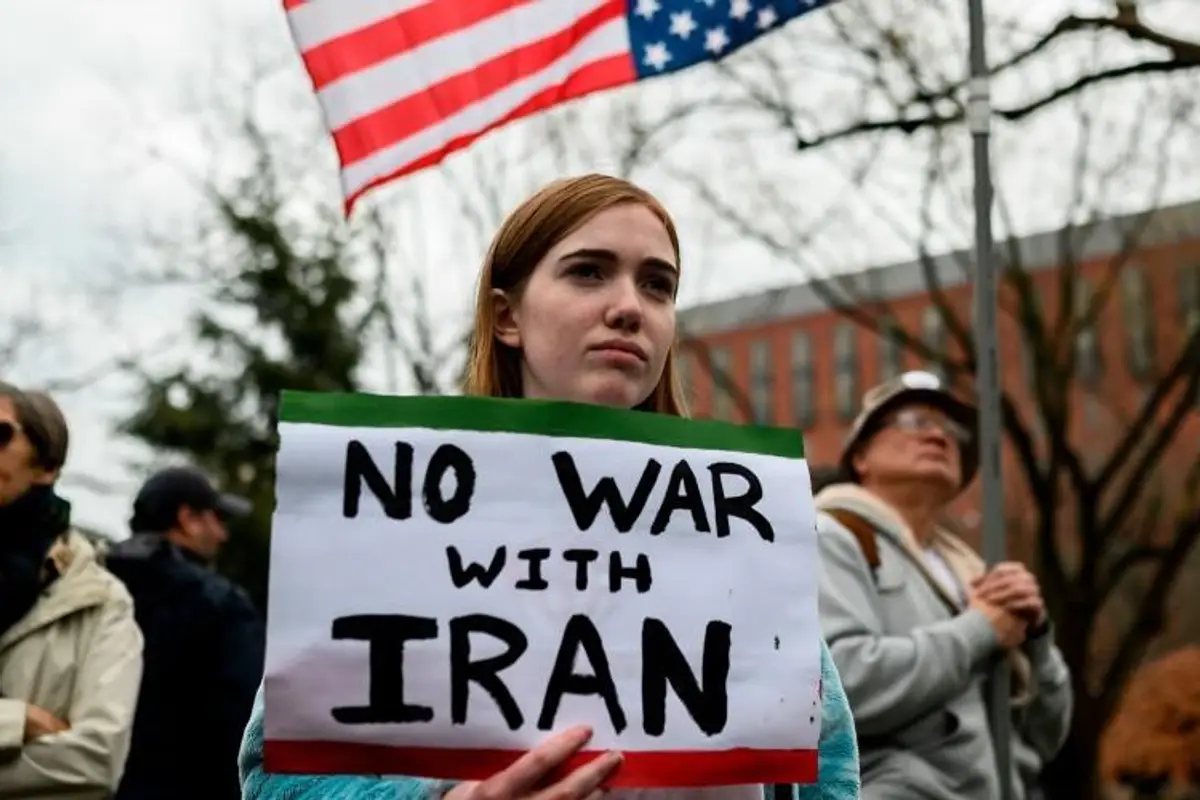
- The Iran war is the most unpopular in the United States in the last seven decades. It has less public support than any other war waged by Washington during that period. It is rejected even by some in Congress who represent the most aggressive and interventionist positions in recent U.S. history. It is also rejected by the most recalcitrant Washington hawks, such as John Bolton, and neoconservative figures like Robert Kagan and Bill Kristol, who seem to have taken the government hostage and yet still reject Trump’s war decision. In this context, two polls, one from Quinnipiac University, show that 53% of registered voters oppose the war and 40% support it, while another by Reuters-Ipsos indicates that 43% of Americans disapprove and 29% approve of the conflict. Similarly, 51% of voters say that the United States is less safe today, compared to only 29% who believe the opposite. This is a key piece of data in the lead-up to the November elections.
- Amid the US and Israeli aggression against Iran, several Arab countries allied with Washington, which host US military bases, have been affected by missile and drone attacks in Tehran’s retaliation. The enormous military power of the United States has been unable to protect these countries that entrusted it with their defense. In this context, they have been placed in a difficult dilemma: supporting an unwanted war versus supporting a power that initiated the war without warning and whose outcome remains uncertain. All of this leads them to the inevitable conclusion that significant geopolitical transformations will occur in the region, transformations about which they have no say.
- The indirect effects of the conflict are only now beginning to emerge. Some countries, such as Pakistan and the Philippines, have implemented a four-day work week, while Thailand has mandated teleworking for public employees and Myanmar has imposed a rule limiting vehicle traffic to alternate days. Experts predict these measures will lead to decreased production, higher fuel prices, reduced demand (due to less vehicle traffic or rationing), and ultimately, they predict these effects will be reflected in macroeconomic indicators such as inflation. Even the Managing Director of the International Monetary Fund, Kristalina Georgieva, felt compelled to weigh in. She stated: “If the new conflict drags on [and it doesn’t appear likely to stop, at least in the short term], it has a clear and obvious potential to affect market confidence, growth, and inflation, which places new demands on policymakers.” She further affirmed that: “These repercussions could affect companies in sectors ranging from fertilizers, whose key ingredients transit the Strait of Hormuz, and the agribusiness that uses them, to semiconductors, which are manufactured using sulfuric acid, helium, and bromine.”
- While this is happening, Trump has failed in his attempt to build a broad naval alliance to prevent the closure of the Strait of Hormuz. Although the US president has said that “numerous countries” are heading to the Strait of Hormuz, it is known that only Great Britain and the United Arab Emirates have given their support to the initiative. The majority, including Japan, Australia, China, Germany, France, South Korea, and Spain, have openly expressed their refusal to participate, demonstrating a rejection of joining Trump in this venture and creating a rift within NATO with unforeseen consequences.
- Another severely affected industry has been tourism, as thousands of people have already had their vacation plans postponed or modified due to closed or severely restricted airspace. In this context, the largest airlines in the Persian Gulf continue to struggle to recover pre-war flight volumes. Furthermore, airfares have also increased on some routes, a trend that could continue for the remainder of the year.
- Likewise, the economic impact is primarily evident in the suspension of oil purchases due to the ongoing uncertainty surrounding maritime trade. The ships currently anchored in the Strait of Hormuz represent goods and energy that will not reach their destinations for several weeks, generating a serious impact that will be felt in the short term. In this context, farmers have had to sell their crops in local markets at lower prices. In Thailand, for example, rice exports to West Asia have practically ground to a halt. Similarly, the technology sector could also be affected. Major semiconductor industries in Taiwan, South Korea, and Japan are on high alert, given that they require helium, a key commodity sourced from West Asia, for their production.
- Without much fanfare, Moscow has provided Tehran with substantial combat intelligence resources extracted from its special military operation in Ukraine. This is the only way to understand Iran’s destruction of the THAAD and Patriot radars and all other US ultra-heavy fixed radar installations. Russia has also supplied Iran with S-400 and Krasukha interceptor systems. Along with China, Russia has provided Iran with high-resolution orbital imagery and target acquisition assistance. Beijing has also supplied anti-ship missiles and real-time satellite surveillance. All of this has taken place within the framework of strategic agreements that have not resulted in a formal military alliance.
- Paradoxically, this conflict has been “beneficial” for Russia because Qatar has been paralyzed as a competitor in gas sales. Moscow has taken advantage of the situation and, anticipating the European Union’s decision to reduce its purchases of Russian gas, has decided to place its product in other countries, mainly Asian, obtaining better prices and cash payments. Thus, the closure of the Strait of Hormuz and the resulting urgent need for gas for some countries has allowed Russia to expand its customer base, even at a higher price.
- On another level, this conflict has exacerbated internal divisions within BRICS, which has been unable to reach a common position on the matter. While Brazil was once the country most useful in creating discord, India has now taken on that role, maintaining a timid and duplicitous stance. While attempting to remain neutral and avoid distancing itself from Iran, India has strengthened its ties with Israel, even increasing its arms purchases from the Zionist entity.
- Despite Trump’s nine repeated declarations of Iran’s defeat and claims that 100% of its military, naval, and air capabilities have been destroyed, the Strait of Hormuz remains closed, a situation Washington is powerless to prevent. Similarly, Iran’s military bases and a growing number of targets within the Zionist entity are being struck with increasing intensity and efficiency each day, again without the United States being able to stop them. One might wonder, if this is happening to a defeated country with no air or naval capabilities, what would happen if they possessed them?
- Finally, after the regime change failed within days and given the realization that airstrikes, however devastating, are insufficient on their own to achieve this objective, the United States first attempted to activate the Kurdish militia, which had already been manipulated to serve US interests in Syria. However, this time, the maneuver resulted in frustration and disappointment due to the heavy blows dealt by Iran and the Iraqi resistance. Now, they are deploying an invasion force of 4,500 troops from Okinawa to attempt a ground operation that will change nothing and could be the final nail in Trump’s coffin in his West Asian adventure.