

Possible scenarios ahead.
Possible scenarios ahead.
By Shahab Nouranifar, Director of the Iraq and Syria Desk, Mersad Center for International Studies – Iran
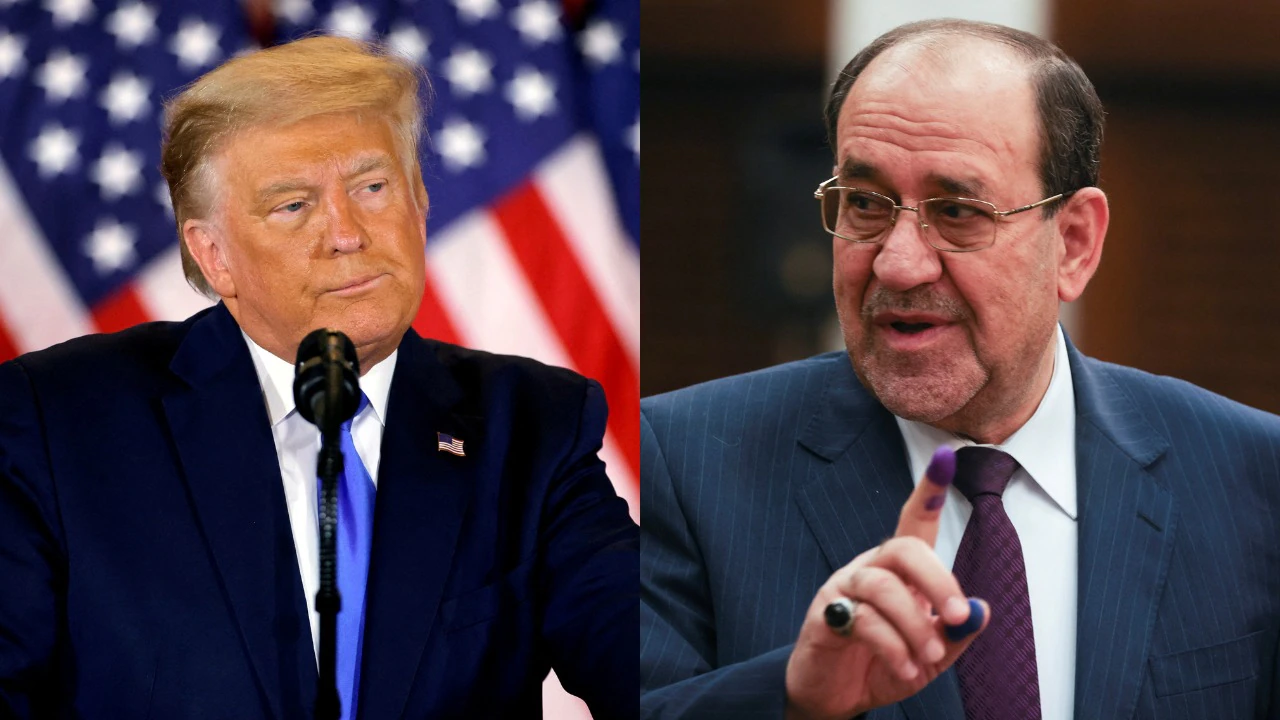
On January 27, Donald Trump, the President of the United States, published a tweet opposing Nouri al-Maliki’s candidacy for the office of prime minister. In a clear act of interference in Iraq’s internal affairs, he stated: “I have heard that great Iraq may be making a very serious mistake by bringing Nouri al-Maliki back to the position of prime minister. During Maliki’s previous term in office, the country fell into widespread poverty and chaos, and such a situation must not be allowed to recur.” He added that “because of his extreme policies and views, if he is elected, the United States of America will halt its assistance to Iraq, and without our help, Iraq will have no chance for success, prosperity, or even freedom.”
It should be noted that the United States is not the only actor with influence in Iraq; countries such as Iran and Türkiye also wield influence there. However, to date, no country—particularly not the United States and more specifically the Trump administration—has exercised influence in this manner or exerted such open and explicit pressure on Iraqi Shiite politicians. Accordingly, this note will examine the reasons behind Trump’s tweet and offer an analysis of it. It will then address the question of what factor or factors enable the United States to exert pressure on Iraq so openly and in such a threatening tone, and finally it will outline the scenarios facing the selection of a prime minister in Iraq.
Why Does Trump Tweet About Iraq’s Internal Affairs?
In fact, the U.S. president’s tweet can be examined and analyzed from two perspectives: Iraq’s domestic politics and regional dynamics.
1. From the domestic perspective, the tweet can be viewed from two angles:
First, Washington is unequivocally opposed to the option of Nouri al-Maliki. In this case, it is plausible that the publication of the tweet was the result of lobbying by Maliki’s domestic opponents and rivals in Iraq, including figures such as Mohammed al-Halbousi, Ammar al-Hakim, and Mohammed Shia’ al-Sudani. Each of these actors opposes Maliki for their own reasons. For instance, Mohammed al-Halbousi, the leader of a Sunni political bloc, believes that Maliki was the principal obstacle preventing him from attaining the speakership of parliament. Ammar al-Hakim, for his part, argues that Maliki’s authoritarian personality restricts the influence of the movement he leads, namely the Hikma Movement. Al-Sudani, meanwhile, has effectively been Maliki’s rival in the race for the prime ministership.
Second, the United States may be seeking to extract explicit and guaranteed commitments from Nouri al-Maliki—particularly regarding the framework of Iran–Iraq relations under a potential Maliki government, as well as the issue of disarming resistance groups. In this scenario, even if the tweet was prompted by lobbying from Iraqi factions opposed to Maliki, Trump and his administration have effectively used the situation as a tool to intensify pressure on Maliki.
2. From this second domestic-political angle, one can move to the regional dimension of U.S. opposition to the Maliki option.
In reality, the United States’ problem does not appear to be Maliki as an individual. Rather, Washington has placed before itself what it considers a successful strategy—namely, the Lebanese model following the rise to power of Nawaf Salam and Joseph Aoun as prime minister and president. This model consists of severing the links between Iran and its allied countries. The United States now seeks to apply the same model to Iraq. The key to implementing such a strategy is the neutralization of anti-colonial groups in these countries. In this context, it can be observed that in Lebanon the power of Hezbollah has been sharply curtailed, and concerted efforts are underway to cut off its financial and military resources. This approach corresponds closely to the Iraqi model as well: from the U.S. perspective, weakening the ties between Iran and Iraq requires neutralizing the financial and military resources of anti-colonial forces in Iraq—that is, the resistance groups.
Under these circumstances, from Washington’s point of view, a figure such as Maliki, who maintains relatively balanced relations with both Iran and the United States, does not appear to be an ideal choice. Instead, the United States seems to favor what it considers the most suitable Shiite options, such as Mohammed Shia’ al-Sudani, or even Mustafa al-Kadhimi, Haider al-Abadi, or Hamid al-Shatri (head of the Iraqi National Intelligence Service and the most pro-American security institution in Iraq).
Where Does the United States’ Ability to Openly Threaten Iraq Come From?
The reason behind this bold American action lies in the leverage associated with the Federal Reserve. In practice, the revenues generated from Iraq’s oil sales are first deposited into an account at the U.S. Federal Reserve and are then transferred to Iraq. According to official sources, approximately 88 percent of Iraq’s state budget revenues are derived from oil sales, and nearly 75 percent of this income is spent on paying the salaries of public-sector employees, retirees, and social security beneficiaries. Under these conditions, blocking the funds held at the Federal Reserve would mean the Iraqi government’s inability to pay public-sector wages. This is particularly critical given that, due to declining oil prices, the government is already facing serious difficulties in meeting salary obligations to these three groups. Consequently, the first and most immediate interpretation of Trump’s threat to cut off assistance to Iraq can be understood in this context of Federal Reserve leverage.
The roots of Iraq’s dependence in this regard, however, date back to 2003, when the Development Fund for Iraq was established under United Nations Security Council Resolution 1483. The purpose of this fund was to deposit Iraq’s oil revenues and protect them from seizure by foreign claimants. Although, in 2010, Resolution 1956 transferred the management of these resources to the Iraqi government and the Central Bank of Iraq, the U.S. Executive Order 13303 has continued to provide special protection for Iraqi assets within the American financial system. This executive order, which is renewed annually, allows Washington to revoke this protection should political will in Iraq shift in an unfavorable direction.
In practical terms, the Federal Reserve Bank of New York has become a “chokepoint” in Iraq’s economy. After 2022, U.S. oversight of dollar transfers was significantly tightened in order to prevent the flow of currency to Iran and to sanctioned groups. This policy led to the sanctioning or restriction of several Iraqi banks. Unlike other oil-producing countries that also hold reserves at the Federal Reserve but do not face comparable constraints, Iraq is subjected to exceptional scrutiny due to its heavy dependence on oil revenues and the dollar, as well as its history of legal claims.
A major part of this complexity stems from lawsuits related to Iraq’s invasion of Kuwait in 1990. Although the Kuwait compensation file was formally closed in 2022, numerous claims by companies and individuals are still being pursued in foreign courts. If U.S. protection were lifted before these cases are fully resolved, Iraqi assets would quickly become vulnerable to seizure. This reality has endowed Washington with a powerful instrument of political pressure over Baghdad.
Scenarios Facing the Selection of Iraq’s Prime Minister
Despite the renewed declaration of support by the Coordination Framework for Maliki’s candidacy, past experience in the interaction between Shiite political parties and the United States—such as the initial reading of the Popular Mobilization Forces (PMF) reform law in the previous parliament and its subsequent withdrawal under Washington’s pressure—indicates that multiple scenarios regarding the future of Maliki’s candidacy remain plausible. Notably, the Coordination Framework’s statement itself did not last even twenty-four hours and was reissued with modifications, including an explicit clarification that Maliki’s candidacy was supported by a majority rather than all members of the Framework, as well as an expressed willingness to cooperate with the United States. In this context, five likely scenarios can be identified for the process of selecting Iraq’s prime minister:
- Nouri al-Maliki’s withdrawal from the prime ministerial race.
- Maliki’s persistence and insistence on continuing his candidacy for the post.
With regard to these first two scenarios, Maliki’s meeting with Joshua Harris, Chargé d’Affaires of the U.S. Embassy in Baghdad, and the outcomes and implications of that meeting are likely to play a decisive role in determining the future trajectory.
- The selection of Mohammed Shia’ al-Sudani as the new prime ministerial nominee, given that the coalition under his leadership secured first place in the elections, held the reins of the most recent government, and that he himself had previously been a candidate for the position.
- The choice of a consensus candidate acceptable to the United States. Within this framework, figures such as Mustafa al-Kadhimi, Haider al-Abadi, and Hamid al-Shatri—the head of Iraq’s National Intelligence Service—could emerge as prominent options.
- Silence or tacit support by the Coordination Framework in the face of Maliki’s insistence on his candidacy, leading the government formation process to proceed to a parliamentary vote on the cabinet and the government’s program. In this scenario, the cabinet and its program may fail to secure a vote of confidence or face obstructionism and the inability to convene parliamentary sessions. In such a case—particularly if a vote of confidence is not obtained—identifying the parties that acted in alignment with U.S. preferences would be difficult due to the secrecy of parliamentary voting.