


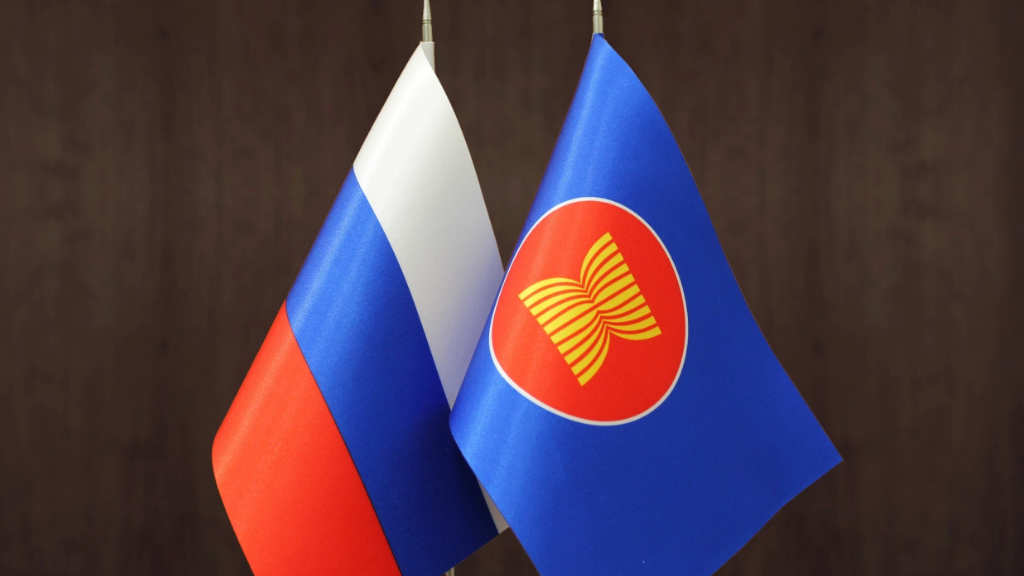
From defense rhetoric and petroleum exports to arm sales and diplomatic maneuvers, Southeast Asia is a region near and dear to Moscow’s heart upon which to make inroads internationally.
From defense rhetoric and petroleum exports to arm sales and diplomatic maneuvers, Southeast Asia is a region near and dear to Moscow’s heart upon which to make inroads internationally.
By Mehmet Enes Beşer
Russian strategic thinking has historically been motivated by the desire to project power beyond its near-abroad and secure a seat at the table of a multipolar world order. With relations with the West growing ever more strained, the Kremlin has increasingly had reason to look east—not just to China or India, but to Southeast Asia, one of the several individual subregions growing in geopolitical importance, economic dynamism, and political diversity. From defense rhetoric and petroleum exports to arm sales and diplomatic maneuvers, Southeast Asia is a region near and dear to Moscow’s heart upon which to make inroads internationally. Its presence there, however, is fragmented, dispersed, and harassed by a flood of local opinions, institutional bottlenecks, and substitute agents. Southeast Asia on initial view is fertile ground for Russian aspirations.
Southeast Asia resists zero-sum alignment, values strategic autonomy, and hosts a constellation of middle powers experienced in great power management. Russia’s emphasis on multipolarity, sovereignty, and non-interference in internal affairs resonates with ASEAN’s long-standing tradition, covering decades. And some Southeast Asian countries have for decades relied on Russian arms, offering historical ties that Moscow has tried to preserve and build upon. But these spheres of activity conceal much weaker reality.
Russia’s strategic depth in Southeast Asia is low in relation to China’s or America’s. However, while Moscow remains a fine weapon supplier—particularly to Vietnam, Myanmar, and Indonesia—its market share has been on the decline over the past two years due to increased competition from Western and Chinese defense industries, bad after-sales service, and increased integration of Southeast Asian militaries into Western systems. Secondary sanctions on Russian operation in Ukraine have also introduced new risks for buyers in getting involved in Russian partners for doing business. Energy has also been another pillar of Russian operation.
Rosneft and other major companies in energy have tried to invest in offshore ventures, LNG terminals, and pipeline clusters. Vietnam has been a long-standing friendly face in the oil exploration industry, and negotiations with Thailand, Malaysia, and Indonesia have been ongoing on potential cooperation. Logistic and budgetary limitations—compounded by foreign sanctions and war economy—have placed the overwhelming majority of such projects on ice, however. China is different, as Russia lacks financial flexibility, trade volume, and infrastructural presence to convert energy diplomacy into long-term regional imbedding. Diplomatically, Russia is in good relations with all the ASEAN countries and has become a member of regional bodies like the East Asia Summit and the ASEAN Regional Forum (ARF). Russia continues to reiterate its support for ASEAN centrality and presents itself as a non-colonial, non-interventionist friend—a distinction that it makes by implication with China and the West. Such rhetorical alignments aside, however, Russia cannot shape regional norms or lead on policy initiatives. Its contribution to ASEAN-led mechanisms is limited, and its bilateral relations are reactive, not strategic. Geography is one of Russia’s long-standing Southeast Asian challenges.
Russia is no Pacific power to Southeast Asian leaders, unlike America or China.
Its Far Eastern provinces are distant, undeveloped, and poorly linked with Southeast Asia’s economic universe. Attempts to turn Vladivostok into a Pacific gateway have failed. Even as a participant in regional dialogue forums, Russia’s geographical distance from the maritime hub of Southeast Asia diminishes its ability to influence the rules of the game. Combined with these limitations is coordination among China-Russia, thus making Moscow more difficult to market in an Asia apprehensive about Beijing’s more aggressive leadership. In contrast to Russia’s assurances that its alignment with China is not an alliance, an image of strategic coordination—bilateral military interoperability exercises, collective denunciation of the West, and cooperation on multiple multilateral platforms—is repellent to states which want to hedge against Chinese hegemony. For Vietnam in particular, this two-minds is a strategic headache: Hanoi enjoys its security connection to Moscow but increasingly frets at Russia’s proximity to Beijing, especially when tensions in the South China Sea persist.
The war with Ukraine complicated Russia’s Southeast Asia policy. In addition to the direct cost of sanctions and damage to reputation, the war diverted Moscow’s focus and energies away from Asia. All but one of the ASEAN countries have reacted to the crisis with diplomatic prudence—voting against UN resolutions, not actively opposing them—while in private, anxiety about Russia’s instability and eventual cost of global ostracism is increasing. For a region that prizes stability and amicable relations, Moscow’s course is more a cautionary tale than a model. But Russia will never be a specter in Southeast Asia.
Its residual defense ties, shared experience with old friends like Vietnam and Laos, and diplomatic subtlety maintain a toe-hold, if not a lead. Moscow can no longer compete in terms of scale perhaps, but still offer niche cooperation like in cyberspace, anti-terrorism, and educational exchanges. These low-key niches allow Russia to stay involved without ringing strategic alarm bells. The problem Russia has had in Southeast Asia, thus, is less one of access than one of relevancy. It can attend the meetings, it can sign the memoranda, and sell the equipment—though until and unless, there is some concrete, forward-looking regional idea, backed with economic presence and political continuity. Southeast Asia is at best leading the way for Russia’s desire for a multipolar world but, in fact, still a frontier yet to be developed by Moscow. It is ready to have a range of partners but protected against overcommitment. Russian policy here must transcend symbolism and retro-orientation. Moscow must show in order to be of use to Southeast Asia that it is not just a competing voice—but real, ongoing contributions.