


Leveraging the Divide
Leveraging the Divide
By Mehmet Enes Beşer
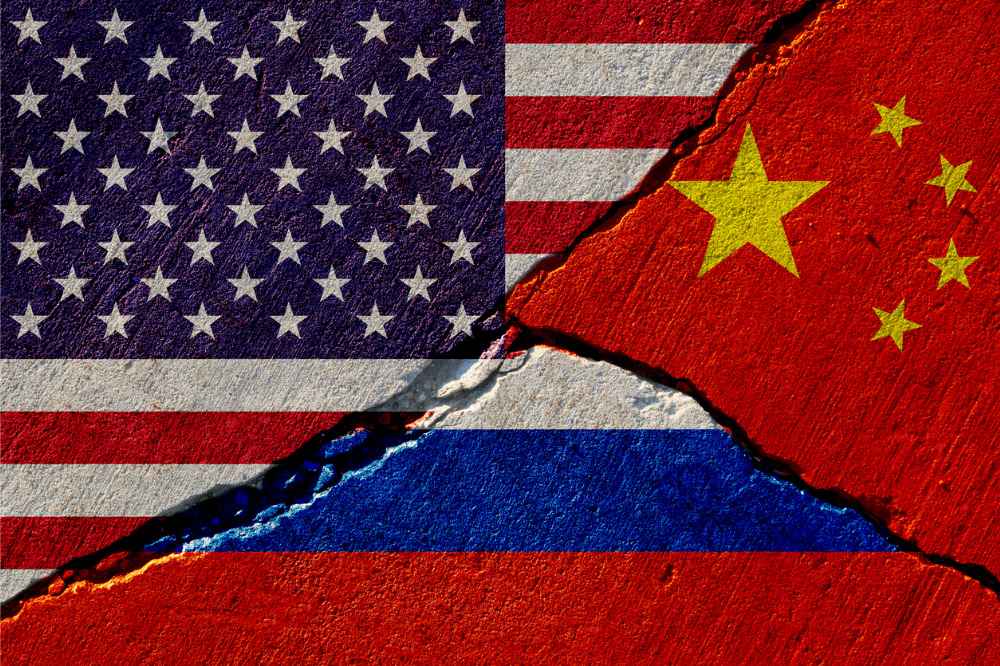
In the heightening United States–China trade war, global focus has shifted primarily to tariff schedules, supply chains shattered, and factories rebalanced. Beyond overt economic impact, though, lies a more sophisticated strategic actor edging its way into the openings. Sanctioned by the West, diplomatically isolated but globally ambitious, Russia is more than a disinterested bystander. It is proactively positioning itself to benefit from the growing tensions between Washington and Beijing. And to contra orthodoxy, Moscow’s payoff is not necessarily in exporting more oil or grains to China, but in leveraging geopolitical disintegration to boost its own presence in different realms.
The first level of opportunity is in Russia’s potential to serve as a political and logistical bridge in a fragmenting international order. As U.S.–China relations devolve into zero-sum competition, both sides are reorganizing their networks of influence. This opens up a free field for Russia to offer alternative avenues—either by land-based Eurasian corridors, multilateral organizations like BRICS and the Shanghai Cooperation Organization, or payment systems that bypass U.S.-dominated financial infrastructure. In these areas, Russia is no longer a transactional partner but increasingly a strategic facilitator.
This role is best appreciated in Moscow’s assistance to China’s hedging against Western vulnerability. As the U.S. persists in imposing more stringent export restrictions on leading-edge technologies and threatens further decoupling measures, Beijing is accelerating its push to seek alternative sources and parallel systems. Although Russia cannot be a complete substitute for American semiconductor or AI innovation, it can deliver politically acceptable collaboration, cybersecurity support, and collaborative research in those areas that are sensitive to dual-use scrutiny. By doing so, Russia allows China to minimize risk while integrating itself increasingly into China’s longer-term technological vision.
Meanwhile, Russia has no desire to depend too much on China. The actual gain for Moscow is to keep things unsettled. As Washington squeezes screws on Beijing, and vice versa, Russia increases its relative room to maneuver—licensing energy commerce with India, arms diplomacy throughout Africa, and grain co-ops in the Middle East, all in addition to reinforcing its strategic alignment with Beijing. This strategic maneuver enhances Russia’s global reputation and reinforces the myth that it is an indispensable actor in a multipolar world no longer polarized by Cold War binary alliances.
The more mercurial and lawless the U.S.–China economic relationship becomes, in fact, the more Russia can present itself as a stable—if oppressive—alternative. For countries weary of being pressured to “choose sides,” Russia presents itself as a pragmatic ally unencumbered by ideological necessity. The U.S., increasingly prepared to link commerce with values, and China, whose economic expansion typically leads to political demands, each risk alienating mid-range states resentful of conditionality. Russia, to the contrary, offers a low-maintenance choice—less well-capitalized but more strategically supple.
This is not to suggest that Russia is somehow immune to the risk of trade disruption. The post-Ukraine sanctions regime continues to limit Moscow’s access to capital markets and technology. Its long-term economic trajectory remains circumscribed by structural inefficiencies and demographic decline. But the Kremlin’s goal is not economic modernization—it is strategic autarky. By integrating itself into the new geoeconomic normal, Russia can normalize its pariah status and reduce the enforcement power of U.S.-led global norms.
Furthermore, Moscow has the ability to weaponize the ambiguity of the U.S.–China war as its own war of narratives. Throughout much of the Global South, the trade war is not merely seen as an economic dispute, but as evidence of liberal international order’s hypocrisy and disintegration. Russia grabs onto such a perception—exaggerating narratives of Western decline, elite strife, and double standards on the global stage through diplomatic communications and media platforms. This cheap abuse of soft power makes Russia a more valuable system-challenger whose worth is derived from disruption.
Conclusion
While the U.S. and China are waging a high-stakes battle over trade, technology, and global rules, Russia is playing a less flashy, more opportunistic game. It’s not trying to dominate the global economy—it’s trying to ride its cracks, translating volatility into leverage and competition into relevance.
Through the gray spaces of diplomacy, logistics, and storytelling, Russia is then able to transform systemic anarchy into strategic capital. It does not need to sit at the head of the table if it can control who sits next to whom—or who walks out first. In this new fractured world of alignment and transactional blocs, Moscow’s leverage lies not in its material capability, but its comfort with ambiguity.
The US–China trade war is more than a two-way clash. It is a stage on which actors like Russia can reset the rules of power. And Moscow, with years of experience of playing the fringes, is well positioned to do that.