


By Mehmet Enes Beşer
Rare earths are the kind of material you never think about—right up until you can’t stop thinking about them. They sit inside the stuff we now treat as normal: EV motors, wind turbines, missile guidance, medical scanners, smartphones, factory robots. Tiny inputs, huge consequences. And in the Indo-Pacific, they’ve become a simple, uncomfortable test: can we build the green and digital economy without building a new single point of failure?
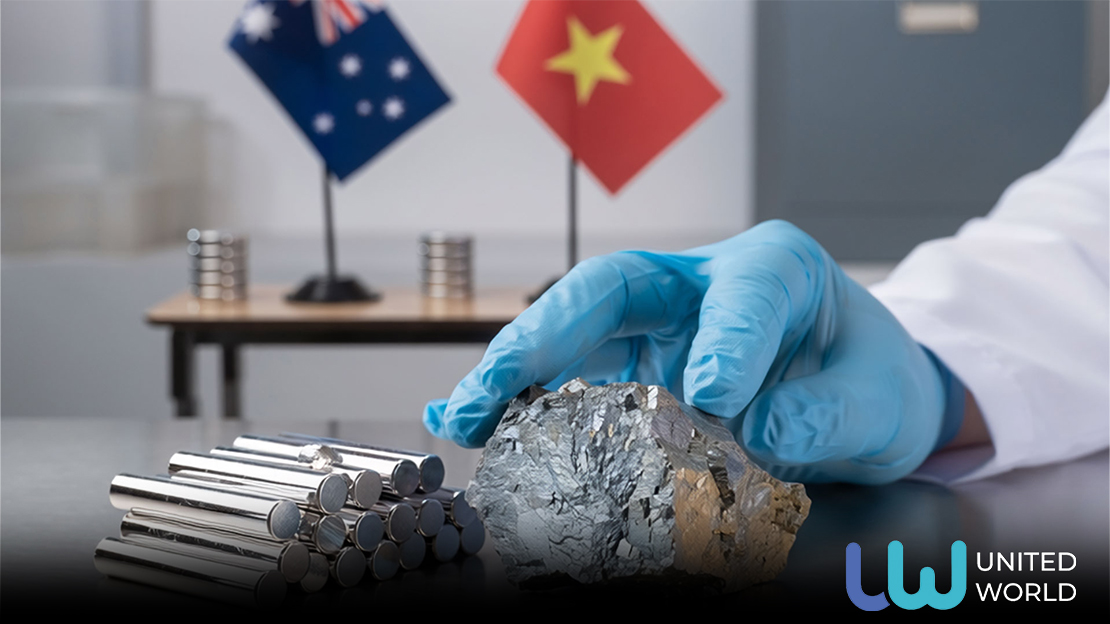
That’s why an Australia–Vietnam rare earth partnership matters. Not as a photo-op, not as a “critical minerals” buzzword, but as a piece of practical statecraft. Two countries with real interests, not identical interests, trying to turn a strategic vulnerability into something sturdier.
But let’s not romanticize it. Rare earths are not iron ore. They’re messy—chemistry-heavy, waste-heavy, politics-heavy. The hard part isn’t extraction. The hard part is everything after extraction: separation, refining, waste treatment, consistent purity, and the downstream conversion into metals and magnets. That’s where the choke points sit. That’s where the pain lives. And that’s where any serious partnership either proves itself or collapses under its own hype.
Australia and Vietnam do, on paper, fit together well. Australia has mining experience, engineers, project finance muscle, and (imperfect but real) habits of public scrutiny. Vietnam has industrial ambition and a clear incentive to stop being stuck at the low end of value chains. It doesn’t want to be a quarry that watches strategic minerals leave the country and return later as high-value components with a bigger price tag.
So this is what “de-risking” should actually mean: not speeches, not slogans—two partners building alternative pathways in a supply chain that is too concentrated and too fragile.
The mistake would be turning “partnership” into press-release language. The Indo-Pacific is full of those. Big words, small follow-through.
If Canberra and Hanoi want something rock-solid, they need to build it like an engineer would: stage it, stress-test it, fund the boring parts, and assume it will be attacked—not necessarily by enemies, but by reality. Price swings. Permitting delays. Community backlash. Election cycles. Technical surprises. The stuff that kills projects quietly while officials keep smiling.
Start with the obvious rule: don’t rush to the shiny end of the chain. Every critical minerals strategy seems to jump straight to the big trophy—“We’ll build a refinery,” “We’ll dominate midstream,” “We’ll break the monopoly.” That’s how you get stranded assets and angry taxpayers. A smarter approach is sequential. Pilot projects first. Transparent geological work. Processing tests with real ore, real impurities, real waste streams. Then scale—only when the data survives contact with reality.
Because if it can’t work at pilot scale, it won’t work at commercial scale. And if it can’t survive public scrutiny, it won’t survive in the long run even if it “works” technically.
This is where both sides need to be honest about what they’re actually protecting.
Vietnam will want local value, local control, and guarantees that this doesn’t become another story of “strategic resources exported, strategic benefits imported.” Australia will want standards, supply security, and reassurance that investments won’t get trapped in uncertainty or turned into political bargaining chips later.
None of that is unreasonable. The danger is pretending it isn’t there—then acting shocked when it returns as mistrust.
So build the rules into the deal instead of hoping goodwill will cover the gaps. Clear licensing timelines. Predictable royalties. Dispute resolution that doesn’t depend on political mood. Transparent environmental reporting with independent monitoring. Not as moral theater. As an insurance policy. Distrust kills more projects than geology ever will.
And then there’s the part most people avoid in polite conversation: waste.
Rare earth processing isn’t just complex; it can be ugly. Depending on the ore, you can end up dealing with challenging tailings and, in some cases, radioactive byproducts. Communities know this. Activists know this. Investors know this. If the first visible projects are perceived as “dirty mining dressed up as green transition,” the partnership doesn’t just lose public support—it loses legitimacy.
Australia has learned, often the hard way, that a project can be technically sound and politically doomed. Vietnam doesn’t need to learn that lesson by repeating it. One of the most valuable things Australia can “export” here isn’t just equipment—it’s discipline: baseline studies, real consultation that starts early (and doesn’t end once construction begins), serious tailings planning, and credible remediation commitments that are funded upfront rather than promised later.
If environmental credibility is treated as decoration, the whole thing becomes brittle.
Financing matters too, and not in the abstract “we will mobilize capital” way.
Rare earth projects are vulnerable. They swing with prices and geopolitics. They can look bankable one year and shaky the next. If the partnership relies on optimistic market assumptions, it will wobble the moment prices dip or governments change. The financing has to do strategic work: blended capital, credit support, and offtake structures that improve bankability without locking Vietnam into one buyer forever. Bring in diversified customers—manufacturers who want resilient supply—so the project isn’t hostage to a single relationship.
Then invest in what almost nobody puts on the cover of a strategy document: people.
A refinery is steel. A supply chain is skills. Lab capability. Quality-control culture. Technicians who can keep purity consistent at scale. Engineers who can troubleshoot without stopping production for six months. If Canberra and Hanoi aren’t building training programs, joint research links, exchange pipelines, and lab partnerships, they’re not building resilience. They’re building a facility and hoping competence appears by magic.
And yes, the downstream prize—the magnets—matters. That’s where value concentrates, and that’s where vulnerability becomes geopolitical leverage. But neither country should pretend it can become a magnet superpower overnight. The smarter play is to identify realistic segments of the chain where they can win together, step by step, and build credibility through execution rather than ambition.
Finally, a word about narrative, because narrative can poison a partnership faster than technical issues.
This shouldn’t be sold as an anti-China crusade. Not because China is irrelevant—obviously it isn’t—but because framing it that way will make the partnership politically toxic in Hanoi and strategically narrow in Canberra. Vietnam does not do loyalty tests. Australia shouldn’t demand them. The strongest economic partnerships in this region are the ones that are easy to say yes to because they produce tangible benefits and credible standards—not because they signal alignment in a great-power contest.
Diversification isn’t confrontation. It’s maturity.
So, define success the right way: not headlines, not summit language, not one big factory. Success is optionality. Optionality for Vietnam—more value retained at home, more technical competence, more leverage. Optionality for Australia—more resilient supply, deeper regional integration, a strategic relationship that isn’t only defense talk. Optionality for the region—more trusted nodes in an industry that’s been too concentrated for too long.
Then do the unglamorous work that makes optionality real: build governance, fund training, stage the technical pathway, put environmental credibility at the center, and design financing that survives stress.
Rare earths may be obscure. The lesson isn’t. In the Indo-Pacific, resilience won’t be declared. It will be engineered — deal by deal, plant by plant, standard by standard. Australia and Vietnam have a chance to show what that looks like.