


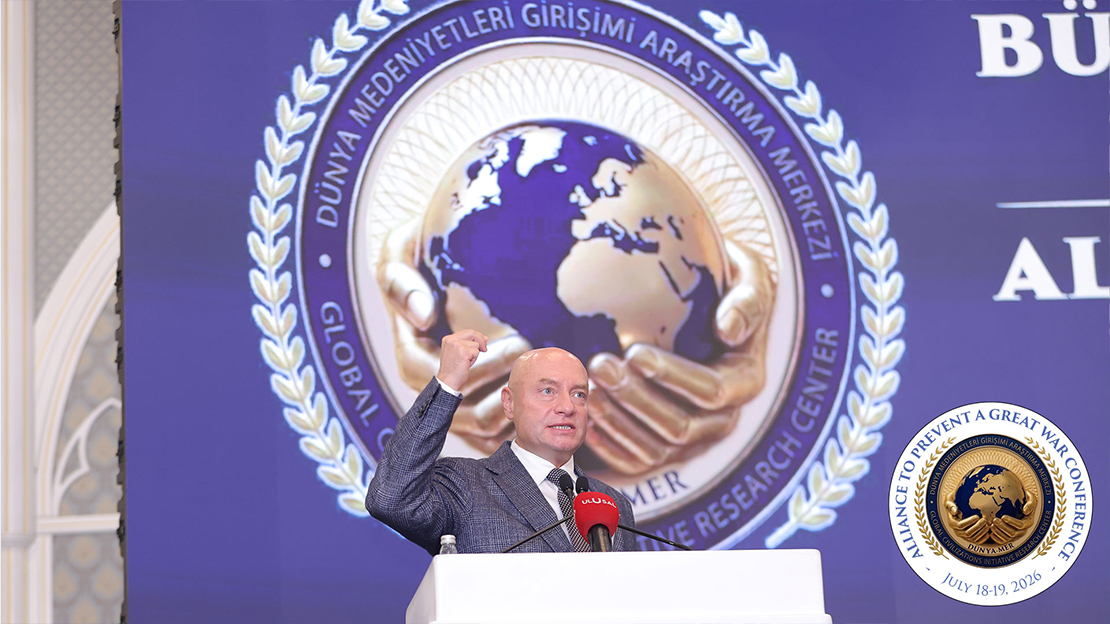
By Aleksandr Galushka, Former Minister for the Development of the Far East and the Arctic, President, “Kristall Rosta” Foundation, Russia
The international conference entitled “The Alliance to Prevent a Great War,” organized by the World Civilizations Initiative Research Center, was held at the Meyra Palace Hotel in Ankara on 18–19 July 2026.
UWI will present the speeches held on the conference during the coming days.
The conference, which featured presentations by speakers from Azerbaijan, Belarus, France, Germany, Greece, Iran, Italy, Japan, Russia, the Sahrawi Arab Democratic Republic, South Africa, Spain, Switzerland, the Turkish Republic of Northern Cyprus (TRNC), Türkiye, the United Kingdom, and the United States, was attended by approximately 200 distinguished invited guests.
Ministers, members of parliament, ambassadors, retired generals, scholars, politicians, diplomats, military officers, and experts examined the question of the “Alliance to Prevent a Great War” from a wide range of perspectives.
Below, we present the speech of Aleksandr Galushka. The title was set by UWI.
It concerns all people of good will around the world. The issue is preventing a great war. This is the main topic, and first of all, I am grateful for the opportunity to share my thoughts by participating in this conference. How can we truly ensure that a great war is prevented in our beautiful world? How can humanity live a peaceful, creative life, and how can the peoples of our world develop in a civilized manner? I would like to state my ideas on this subject.
We say there is a threat of a Great World War here because there are root causes, and there are triggering forces defining this challenge.
As is known, politics is the concentrated expression of economics. Geopolitics, in turn, is the concentrated expression of geoeconomics. When we look at these root causes through this lens, major threats emerge. Western colonialism has largely transformed into neocolonialism. In the past, the West traded worthless beads for valuable goods; today, in the interest of sustaining unearned income in the global economy, an unequal, unjust trade relationship continues.
There is a real economic cause here. Here we see the United States aggressively failing to restrain itself in the global market. It pressures other countries to maintain its hegemony. Because its true economic objectives are to sustain this unearned income and to draw values into its country from other nations without providing compensation. At the root of this exchange lie the rule of the dollar and a technological dictatorship. Similarly, massive military expenditures and large military bases are obviously built to exert pressure on sovereign states.
While discussing the power of the dollar, I would like to give two examples. As is known, how does this happen? Every country, under the current arrangements in the financial domain according to global rules, is obliged to form its own reserves. Reserves must primarily be created in US dollars or held as dollar assets, such as US government bonds. These will either yield no income to countries—with dollars simply sitting in a vault—or countries seeking external credit and dollar financing will have to pay high interest for these dollars.
This income disparity demonstrates, above all, how national capital is positioned under US direction. This foreign debt is proportioned within the gross national product. Here, without exception, developing countries feel the need to attract capital to grow their economies and are forced to pay interest rates of 10% or more. Meanwhile, developed countries—that is, the countries forming the core of the global economy—generate returns of well over 100%. So, we see how capital in the core countries of the global economy is invested, and this is realized directly through hegemon brands.
What do we see? The power of the dollar is taking on a more aggressive stance. An unprecedented event occurred: with the freezing of sovereign Russian assets, 300 billion dollars were outright stolen. Thus, what we face is not global dollar dominance, but the transformation of the dollar into an aggressive weapon.
Technological dictatorship is equally important. To this end, the US does everything to derive technological revenues and perpetuates technological inequality. It does not allow other countries to achieve technological development under any circumstances. When we speak of technology, in my view, one of the crucial tasks is to expose one of the myths of the liberal economy. We all have iPhones in our pockets. The core of this technology was developed with state money. It was achieved through state financing and, above all, through the power of intelligence agencies and the US Department of Defense; only then was it handed over to the private sector to be commercialized. Without these, there would be no iPhone. Advanced technologies in the US are financed and supported by the state.
Regarding technological advancement, the stance of the US is critically decisive. The US forbids other countries from developing technology elsewhere and blocks their technological progress. Legislation immediately follows, and technological sovereignty is obstructed.
If we look at global defense spending, one-third of all expenditures are made by the US. Looking at military bases around the world, 70% belong to the US. If we include NATO countries, this figure rises to 90%. Who wants war in this case? Who wants the great war? The answer is crystal clear. When we realize with you all that politics is driven by economics, and that true interests lie in preserving financial and technological dictation, we understand that the hegemon power will not grant military power to anyone who is not on its side.
Life goes on, and the world evolves. Peoples who wish to live, who wish to maintain humanity’s historical existence, and who wish to develop civilizational existence are opposing these processes. It is a gratifying event that we are clarifying and crystallizing thoughts in today’s conference. When we recognize the economic causes, we can also determine what to do to resist. Naturally, we must be economically and technologically strong, and we must possess comparable military power so that we can resist. We cannot establish world peace by remaining weak or disarmed.
Russia made this historical mistake once in the 1990s. Russia was left with nothing but nuclear weapons; it had nothing else. Sovereignty was abandoned, and its independent financial system was relinquished. What did the Russian Federation receive in return? It received a direct threat. The Russian people have a clear understanding; our people say, “If we didn’t have nuclear weapons, they would have bombed and fragmented Russia just like Yugoslavia.”
In the modern world, standing against this threat and opposing a great war is only possible through an alliance—by bringing sovereign states together. It will happen through the gathering of countries that demand multipolarity, wish to protect their national sovereignty, and refuse to pay rent to the hegemons. It can become a reality with those who do not want to pay the taxes extracted by the US from other economies.
I hope our conference today will make a contribution. We must specify certain points in our decisions and recommendations. Above all, we must together not merely abandon the dollar, but actively boycott it. How can we prevent a world war? Central banks buy US paper assets and finance them. As an innovation, we should declare a boycott against the dollar. We must switch to our own national currencies. We must abandon the SWIFT system. We need to build our own financial infrastructure. Russia is doing this; we are establishing an Eastern financial center. It will be formed with this exact logic. I invite all relevant parties and financial institutions to do this together.
We must invest in our own science. We must invest in our own education. We must develop our own technologies. Naturally, this must be done together with the private sector, but the primary power of the state is decisive here. There is not a single example to the contrary; in the high-tech sector, nothing has ever been accomplished without state support. We must abandon absolute liberal dogmas. We must renounce any dogma that impedes independent technological development. We must build technological alliances and form alliances in scientific research. We must achieve technological sovereignty.
Regarding military institutions and armed forces, countries are fighting for their own sovereignty. There is an organized bloc. Looking at the total volume of non-NATO defense expenditures, 45% of global spending is incurred there. This is being spent, but these forces lack interconnections among themselves. More military cooperation is needed. Joint exercises should be conducted. I am confident that these practical efforts and pursuing such a policy will save the world from a great war.
Thank you for your attention.