


By Dure Akram, from Lahore / Pakistan
When Turkish Vice President Cevdet Yılmaz addressed business leaders in Istanbul this month, he offered perhaps the most accurate diagnosis of Pakistan–Türkiye economic relations heard from either government in years. The friendship between Pakistan and Türkiye, he said, had always rested upon “strong emotional bonds.” The task now was to make it equally strong in “trade, investment, technology and production.”
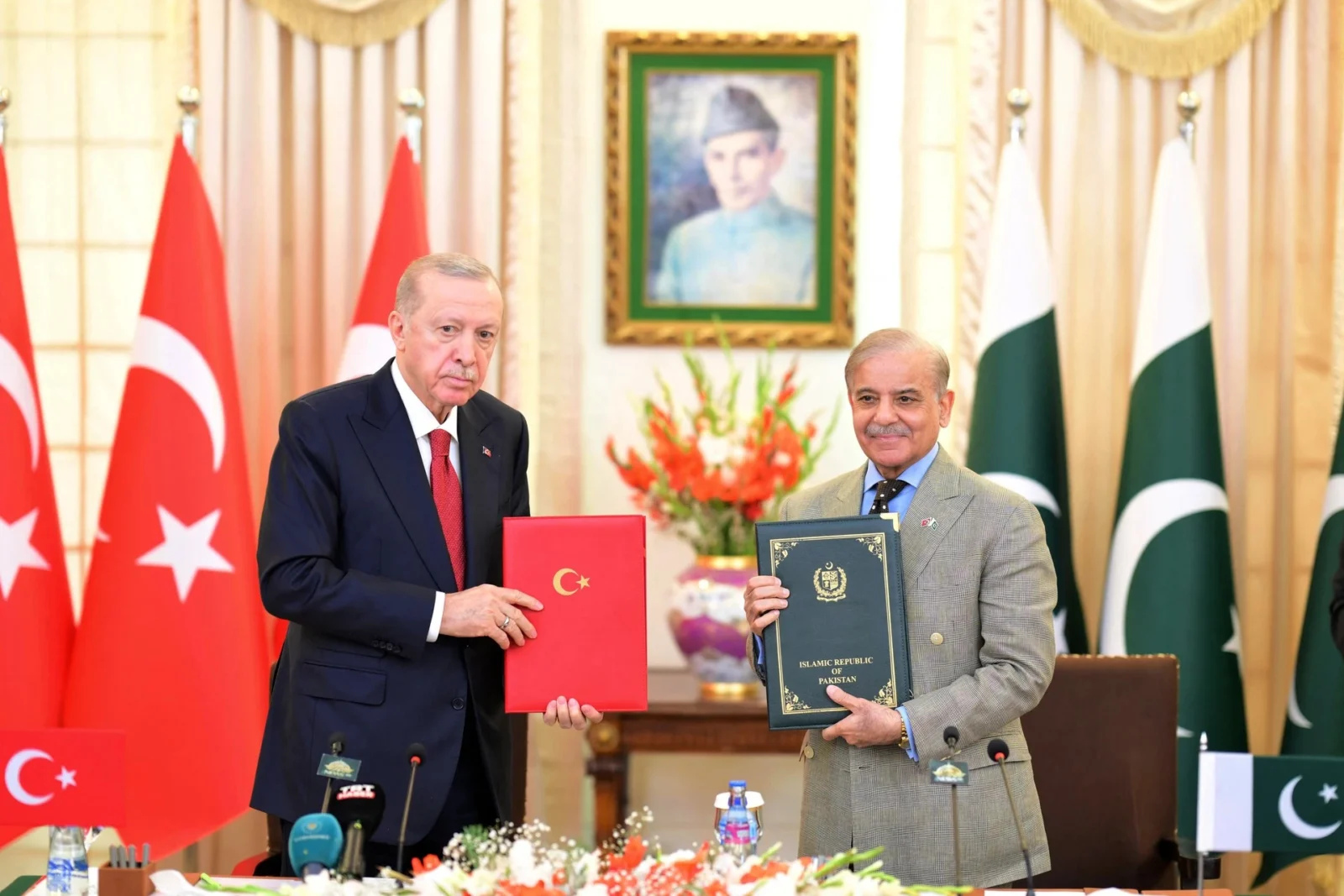
The figures can better explain the urgency behind his choice of words. At the same forum, Türkiye’s trade minister, Ömer Bolat, placed current bilateral commerce at only $1.2–1.3 billion. Standing in the same room, Pakistan’s Prime Minister Shehbaz Sharif announced that Pakistan had earmarked 1,000 acres in Karachi for a special economic zone bearing President Recep Tayyip Erdoğan’s name, invited Turkish companies into energy, mining, information technology and privatization, and promised to “roll out the red carpet” for investors. Hours later, Erdoğan and Sharif once again affirmed their ambition to raise annual trade to $5 billion.
That contrast carries the real story. No relationship in Pakistan’s diplomatic repertoire carries greater emotional warmth than the one with Türkiye. Few foreign leaders are received in Pakistan with the affection Erdoğan commands, and Pakistani leaders arriving in Ankara or Istanbul also experience a familiarity that has long exceeded ordinary protocol. That the family of sitting prime minister Sharif claims to have built a personal rapport with Erdogan’s family, being invited to and sending invitation cards to wedding ceremonies speaks with much clarity about the depth of their bonds. Yet the economic relationship remains stubbornly smaller than the political one, with commerce moving at a pace that bears little resemblance to the urgency of summit declarations.
The affection is neither invented nor merely ceremonial. During the Turkish War of Independence, Muslims of British India collected funds and organized political support for the Turkish national struggle. The memory survived Partition and helped shape the diplomatic relationship Pakistan and Türkiye established in September 1947. Their official declarations still describe these ties as a “sacred trust”, nourished by shared history and intended to pass from one generation to the next. Erdoğan himself has repeatedly invoked the support extended from South Asia during Çanakkale and the struggle for independence.
The difficulty begins when this powerful inheritance is treated as an economic instrument in its own right. Public affection can open presidential doors, sustain trust during crises and make difficult political coordination easier. It cannot clear a consignment through customs, provide export finance, reduce freight costs or persuade protected industries to surrender tariff advantages.
The diplomatic traffic of 2026 has made the imbalance between the two sides of the relationship especially visible. At the Antalya Diplomacy Forum in April, Erdoğan praised Pakistan’s efforts in securing a regional ceasefire and said Ankara would continue working with Islamabad towards peace. Pakistan’s Foreign Office recorded his assurance that Türkiye would continue supporting Pakistan’s diplomatic initiative. The meeting showed how naturally the two capitals can coordinate when the regional order comes under strain.
Sharif’s return to Istanbul on July 4 placed economics at the centre of the conversation. Received by Erdoğan at Vahdettin Mansion, he captured the emotional register of the relationship in a single line: “Türkiye’s success is Pakistan’s success. Pakistan’s progress is Türkiye’s progress.” The leaders discussed trade, investment, energy, petroleum exploration, mining and information technology, reaffirmed the $5 billion target and looked ahead to the eighth meeting of the High-Level Strategic Cooperation Council later this year.
Nine days later, Pakistan’s army chief Field Marshal Syed Asim Munir began a two-day visit of his own. Erdoğan received him at Ankara Airport in the presence of Vice President Yılmaz, Turkish intelligence chief İbrahim Kalın and Chief of the Turkish General Staff General Selçuk Bayraktaroğlu. Munir also met Defence Minister Yaşar Güler and was awarded the Turkish Armed Forces Distinguished Service Medal in recognition of his contribution to bilateral military cooperation.
Within little more than a week, Pakistan’s prime minister and its chief of defence forces had passed through Türkiye’s highest political and military doors. The sequence revealed the two speeds at which the relationship travels. Strategic and defence cooperation has identifiable institutions, professional constituencies, procurement programmes and command structures capable of carrying decisions beyond the summit room. Commercial cooperation remains driven largely from the top, repeatedly revived by presidents and prime ministers because it has yet to acquire enough private-sector momentum to sustain itself.
Türkiye’s official bilateral trade table records commerce of $1.3583 billion in 2024, up from $1.0059 billion in 2023 and $792 million in 2018. Turkish exports to Pakistan reached $918.2 million, while imports from Pakistan stood at $440.1 million, producing a Turkish surplus of approximately $478.1 million.
For Pakistan, therefore, the challenge extends beyond enlarging the total. A $5 billion relationship driven primarily by greater Pakistani purchases of Turkish machinery, chemicals, industrial equipment and defence-related goods would eventually encounter resistance in Islamabad. The target will become commercially and politically durable only when Pakistani textiles, apparel, agricultural products and value-added manufactures secure enough space in Türkiye to produce a more balanced exchange.
The scale of the undertaking is rarely acknowledged. Moving from $1.358 billion to $5 billion requires annual commerce to grow almost 3.7 times, adding more than $3.64 billion. Yet Turkish officials were still placing the figure at around $1.2–1.3 billion at the July 2026 forum. Variations in reporting periods and statistical treatment make a direct year-on-year comparison unsafe, though the broad conclusion still claims that the relationship has made no decisive advance towards its declared destination.
Erdoğan stated the problem with admirable directness during his 2025 visit to Islamabad. Trade had reached a historic high, he said, but remained “far behind our target of $5 billion”. The phrase was more revealing than the agreements signed around it. It acknowledged that the obstacle was no longer a shortage of political approval. Both governments have supplied that in abundance.
The bilateral trade file now contains its own archaeology of missed deadlines. In March 2016, the two countries (then too, governed by the same political parties) had signed a framework intended to lead to a free trade agreement, with officials expecting the final accord before the end of that year. A joint declaration in November 2016 again committed them to completing negotiations by year’s end. Several rounds of talks were held, covering goods, services, investment, customs facilitation and tariff concessions, yet the comprehensive agreement failed to emerge.
By February 2020, the sixth High-Level Strategic Cooperation Council was effectively restarting the process. The joint declaration required a scoping study to be completed by the end of March and envisaged resuming FTA negotiations in the second quarter of 2020. It also discussed a $350 million credit facility, reciprocal bank branches, renewal of a currency-swap arrangement, a pilot convoy on the Islamabad–Tehran–Istanbul road corridor and revival of the freight train. Many of the ideas now presented as the next breakthrough were already written into the official record six years ago.
The Trade in Goods Agreement that eventually entered into force in May 2023 was meaningful, though narrower than the comprehensive FTA envisaged in 2016. At the seventh HLSCC in February 2025, the two sides promised to begin technical talks within two months to add products to the concession lists and preferably conclude an agreement on services, digital trade and investment facilitation within a year. They also called for bank branches, cross-border payment cooperation, a possible renewed currency swap and the full commercialisation of the Islamabad–Tehran–Istanbul corridor.
This July, Bolat confirmed that technical negotiations to extend the goods agreement to additional products were still continuing. Imagine that. A comprehensive FTA expected in 2016 became a new scoping exercise in 2020, a limited goods agreement in 2023, another expansion promise in 2025 and ongoing technical negotiations in 2026. The failure lies less in diplomatic inactivity than in the absence of consequences when deadlines slide.
Some of the delay arises from the structure of the two economies. Türkiye sells Pakistan cotton, yarn, fabrics, textile machinery, industrial equipment, metal manufactures and chemicals. Its imports from Pakistan include cotton fabrics, apparel, dyes, PVC and tyres. The overlap is conspicuous. Both countries have politically influential textile and manufacturing sectors, and each government is cautious about exposing domestic producers to competition from an economy operating in similar segments.
This makes negotiations harder than the rhetoric of complementarity suggests. Pakistan wants deeper access for textiles, garments and other value-added exports; Türkiye has domestic producers with their own employment, export and political concerns. Turkish firms seek opportunities in machinery, energy and industrial inputs; Pakistan must consider its foreign-exchange constraints, and the pressure faced by local manufacturers. “Economic sensitivities”, the phrase repeatedly used in bilateral texts, are the guarded language of tariff politics.
Freight and finance deepen the problem. A preferential tariff means little when transport is costly, delivery schedules are uncertain, and businesses lack convenient payment channels. The Islamabad–Tehran–Istanbul railway has appeared repeatedly in declarations because geography places Iran between the two markets and makes a commercially reliable overland corridor strategically attractive. Its continued need for “reactivation” is evidence of the distance between drawing a line on a map and operating a dependable supply chain.
The banking agenda tells a similar story. Reciprocal branches, central-bank cooperation, currency swaps, export-credit facilities and cross-border payments have been discussed for years. Some institutional movement has occurred, including cooperation between the two countries’ export-import banks, though the financial plumbing remains too shallow for the commercial ambition attached to it. Small and medium-sized firms cannot build durable trade around presidential goodwill when letters of credit, settlement, insurance and freight remain cumbersome.
Malaysia offers a useful, though imperfect, comparison. Türkiye’s trade with Malaysia reached $5.118 billion in 2024 and $5.658 billion in 2025. Their FTA entered into force in 2015 and was later expanded to cover services, investment and e-commerce. The relationship is heavily imbalanced in Malaysia’s favour, so it cannot be copied wholesale, but it does demonstrate the effect of an operative agreement that is gradually widened rather than repeatedly relaunched.
The Pakistan–Türkiye economic relationship is not empty. Turkish investment in Pakistan exceeds $2 billion, while Turkish contractors have carried out more than 70 projects worth roughly $3.5 billion. There’s enough evidence on the ground to show that both states can support large, complicated and long-term commercial ventures when projects have identified sponsors, financing structures and institutional owners. The missing element is a broad trading ecosystem capable of bringing thousands of less politically connected firms into the relationship.
The proposed President Erdoğan Special Economic Zone could become an important test. Sharif has supplied the political commitment, a proposed location and 1,000 acres of land. The next steps must belong to administrators, developers, banks and businesses. The zone requires formal notification, a credible development model, power and transport connections, customs arrangements, investment protections, a schedule for delivery and anchor companies prepared to manufacture for export. A name, however prestigious, cannot substitute for these foundations.
The eighth HLSCC, expected later this year, should therefore abandon the comfort of another distant aggregate target. It should publish annual milestones for total trade, Pakistani exports, Turkish exports, investment and joint ventures; identify the tariff lines to be added to the goods agreement; set deadlines for the services and investment accord; establish a timetable for the Karachi zone; and issue a public implementation report every six months. Officials responsible for delayed actions should have to explain them to a joint commission rather than allowing unfinished commitments to disappear beneath the next communiqué.
Pakistan, for its part, must arrive with exportable propositions rather than a general appeal to brotherhood. It should identify competitive textile, surgical, sports, agricultural, pharmaceutical and information-technology products that can meet Turkish standards, establish distribution partnerships inside Türkiye and help exporters understand rules of origin and certification requirements. Ankara could offer commercially meaningful access in areas where Pakistani firms can genuinely compete, while encouraging Turkish companies to use Pakistan as a production and export base rather than solely as a market for finished goods.
The friendship has already achieved something rare in international affairs. It has preserved public affection across generations, produced trust between political and security institutions, and survived changes of government without losing its emotional force. In an increasingly transactional age, that is a strategic asset of considerable value.
However, now that the Bosphorus and the Indus have been exchanging poetry for generations, it is high time, they build a customs corridor wide enough for their ambitions. Until they do, the $5 billion promise will continue to hang above the relationship like an Ottoman chandelier in a room whose wiring was never finished.