


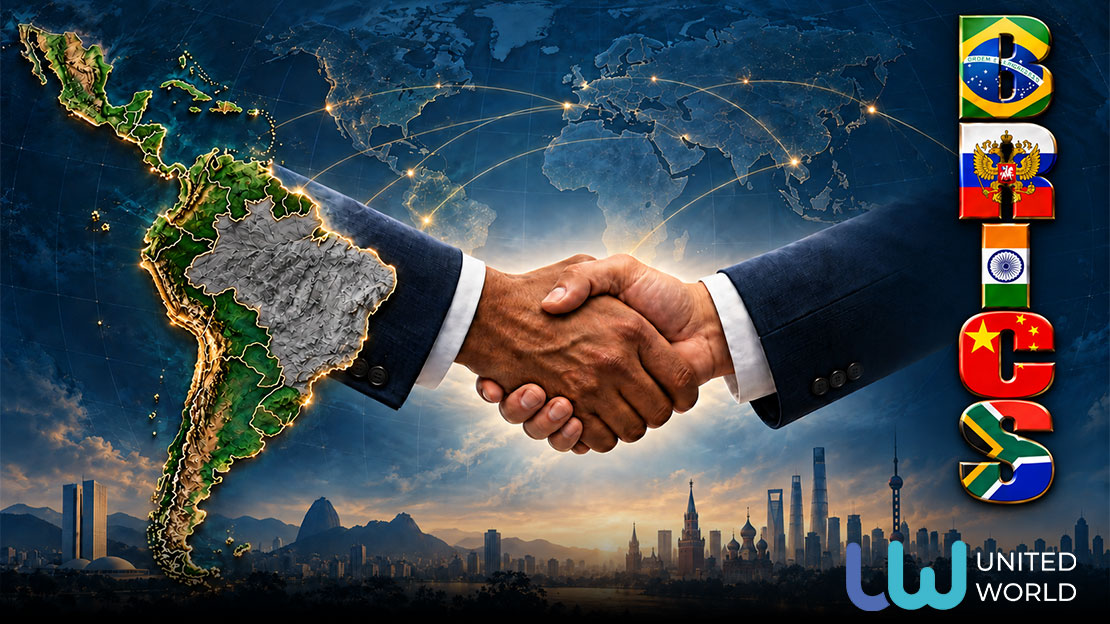
The BRICS summit of heads-of state gathered in New Delhi under the presidency of India. While the participating countries discussed how to deepen their cooperation among themselves, relations with other countries were also on the agenda. With Brazil being found member of BRICS and Cuba and Bolivia current partner countries, relations with Latin America can be considered still in their baby steps. UWI expert Yunus Soner provided an interview to the Indian media channel News X, which we document below.
I’m being joined by Ismail Yunus Soner. He is a journalist who is also working for TeleSUR TV. That’s a media organization from Venezuela Cuba and Nicaragua. So I haven’t spoken to a journalist over here from South America, so it’s going to be interesting to get your views on the BRICS summit, on the declaration that has been adopted. And my first question to you about the diversity that we have seen in the BRICS summit, we’ve seen Iran, particularly in the regional war that has repercussions for the rest of the world. We saw Iran, Saudi Arabia, and UAE participating. In fact, we also saw that UAE and Iran’s presidency held a bilateral on the sidelines, and there has been a consensus that has been successfully brought about under India’s chair in condemning attacks in West Asia on civilian infrastructure and peaceful nuclear facilities. Would you see India being successful in bringing all, you know in bringing all parties, all countries with conflicting views on the same table and being able to have them speak in the same voice in a united fashion by adopting this resolution?
I think in that sense, India has been successful. It is clearly an important step to have those politicians in the same room, the representatives in the same room. But I think this can just only be the first step because there is a reality in West Asia and it is the reality of the US being in retreat from the region or in defeat, if you will, goes hand in hand. And I think this is a reality that everybody in the region, in West Asia, has to acknowledge and calculate with, starting with the United Arab Emirates, also with Saudi Arabia and all other countries in the region have to see that the times that the US has dominated West Asia, has occupied Iraq, has organized coup d’etats in different countries, including the country that I am based in, Türkiye, those times are over. So I think this is the first step.
It’s important. But it is important also that regional actors acknowledge that solutions can only be found locally, regionally, in complete exclusion of external powers reaching out from Washington to our region. I think that’s the line to pursue, and that’s what’s needed. Actually, what we need is a further integration of West Asia into what I would call the Eurasian continent, and a little bit diminishing the role that Washington has played over the past decades, which has not been a peaceful one, which has not been a productive one, but it has been one of exploitation.
How is the South American media perceiving this BRICS summit?
The South American media, well, I will talk to for my TV channel Telesur and also for other media channels I follow. Those who insist on independence, on sovereignty, those who are more from the left, for them, BRICS and this summit is a source of hope.
Because that continent, since 1800s has been under US domination in a much, much worse way than Asia has ever witnessed. Several countries have been occupied by the United States. There has been endless coup d’etats, endless interferences into domestic affairs.
So for them, BRICS represents multipolarity, BRICS represents independence, a better bargaining position against the United States, relative autonomy, and that’s why they are very, very interested in the results that this summit produces and that this alliance produces in the future.
It’s a source of hope for them. Just to give you an example Mexico, for instance, quite a huge country, has lost half of its territory to the United States in a war and is still being under pressure day by day of facing threats of US invasion expressed by the US president himself. Several Mexican politicians are charged in US courts and for them, for instance, Chinese investments in Mexico are an alternative, are a way to liberate themselves from the economic dependence that they lived through from the United States.
Or take Brazil. For Brazil, the economic cooperation they had with China is a huge one. Actually, they are like part of the Belt and Road Initiative.
Take Venezuela. Venezuela had huge investments, also from India, for instance, in the oil sector. So this is for Venezuela a possibility to choose between partners. It’s not only the United States that you have to deal with. There is also the Indian nation, there is the Chinese companies, there is the Russian initiative, and so on. So for them, multipolarity is being able to choose, is being able to exercise sovereignty over their own resources, and very, very important. So BRICS is existential for them.
You know, BRICS has been expanding. It is now an 11-member-union. Can we anticipate, and are Latin American, South American countries also vying for a position to be partner countries in BRICS?
Yes, I would say, well, it depends. Those, as I mentioned, who insist on sovereignty, independence, who are more like production oriented, who would like to have open relations with the rest of the world, they are vying for membership in BRICS.
But then there is also another stream, another stream of politicians who have spent their lives in Washington, who have gone to US universities, who have their summer houses in Florida, who spent their lives in American tennis clubs and so on. For them, the world is the United States. For them, India and China, they don’t know anything about it, and if so, they have only negative prejudices. So for them, for those kinds of politicians, of course they are not for membership, and we live that.
Argentina is a good example. In Argentina, the previous government applied for membership in BRICS and was accepted. But then came elections, that government lost, the actual president won Javier Milei, and he’s a great fan of Donald Trump, a great, great friend of him. And he said, ‘no, BRICS, we don’t want to join it’. That’s a clear indication. And Milei is just a representative of a whole stream of politicians and of a whole stream of class, actually, which are kind of neocolonial actors. They get franchises. They live off US dollars. They live off business with the US only, and for them, the rest of the world simply does not exist. You wouldn’t believe that, but it’s incredible. They are like, it’s their country and the US, nothing else. Not even Europe, by the way.
But wouldn’t you also agree that Venezuela is in a similar situation? It has been coerced to be subservient to America. This was, of course, after the coup of the United States of America under the Trump administration and the former president, right now in jail. It is under custody of the United States administration. Is there a possibility that there could be a rebellion against the American administration within Venezuela where we see a leadership that has been installed itself by America?
Well, first of all, this is not exactly correct what you just referred to. Number one, the president of the Bolivarian Republic of Venezuela is Nicolas Maduro. He has been hijacked. Just let’s say it clear. He has been hijacked illegally, absolutely illegally. And the United States knows that, and the United States administration does not care about legality and international law. Second, the acting president, Delcy Rodriguez, is the acting president according to the Venezuelan constitution. So that she takes over the power when the president is not capable to do so is according to the Venezuelan constitution. That’s absolutely legal.
Now, regarding the relationship between Venezuela and the United States, the Venezuelan government thinks, considers that they are under threat. They stated that. If they do not try to manage the situation, the United States will return to military aggression. So they say they are trying to avoid a US invasion of their country or military attacks on their country, and that’s the reason why they are kind of trying to find a way to engage with the United States on the grounds of mutual recognition and respect.
Now, there is a huge there’s a huge discussion inside Venezuela going on about the agreements that have been made. That’s normal. There’s different opinions. There’s different considerations. And there’s also criticism. That’s normal. That actually shows that the governing party has a living internal life. And the president, the acting president, responds to that, to those criticisms. And one needs to see how that turns out and how the Venezuelans at the end decide.
But there is insistence, clear insistence, on the public opinion and the government side that Nicolás Maduro has been hijacked, that he’s the legitimate president of the Bolivarian Republic of Venezuela, and he has to be released immediately. That’s clear. And Venezuela is a country of rebellion. The country has been in rebellion since 20 years. And the country is, by the way, one that was aspiring very, very much to become a member of BRICS.
It was the summit in Kazan in Russia the year before the last one where Nicolas Maduro even attended, hoping that there would be an opening. It didn’t work out. But Venezuela is a clear, clear example for the desire for a multipolar world order.
It is a different country, actually. If you travel to Latin American countries, usually people on the street don’t know much about the rest of the world. Like the average person, he knows what’s going on in the US maybe he knows what’s going on in his own country, maybe some neighbor country, but the rest, they don’t care. Venezuela is quite different. Venezuela, when you walk on the streets in Venezuela, you ask anyone about the BRICS summit, or you ask anyone about the Belt and Road Initiative, or you ask anyone about the Iran conflict, they will give you a whole speech. A whole geopolitical analysis.
And that is what multipolarity produces, an open, wide horizon. And this is very, very profound in Venezuelan people after more than 20 years of Chavista government. This is a different population.
Interesting. Also, I was going to ask you about you know Latin American countries as a whole, as a group, as a community. How relevant and important do their opinions, their leaders’ opinions, become on the global stage when it comes to these global conflicts, whether it is the US Iran war, whether it is the Russia Ukraine conflict? Because you know, the world has not been insulated from the oil crisis and the crude crisis. Venezuela, of course, you know, there have been these supply chains, alternative supply chains that India has built with Venezuela as well, where we are looking to buy oil from Venezuela because we need to keep our lines of communication and oil supplies open because it’s a difficult situation to be in, like any other country would as well. But at the global stage, we see few leaders from Latin America coming out and speaking decisively about these global issues. What do you think? How does the media perceive this?
I think this is a little bit due to the fact that they have very strong battles at home. Take, for instance, Lula da Silva. Brazil is a founding member of BRICS and a leading one also, very active. But he’s not here because he’s facing elections in October in his country and he’s facing elections under huge US pressure.
I mean, he’s very successful in his country. That’s not the point. But he’s facing different threats because there are different forms of intervention possible, even into electoral matters. So this is the reason, I think, why Latin American leaders do not appear that much on the global scene.
Take another example. Claudia Scheinbaum, Mexican president, a very enlightened woman, a leading person. She’s extremely popular in her country, but she’s also facing huge US pressure, and day by day, she has to reject the idea of Donald Trump published on his social media account that Mexico is actually part of the United States. These are the battles they are fighting in their country. So that is a bit the reason why they might not show up that much on the world scene in terms of diplomacy.
Here, it’s a bit on the BRICS to reach out to them, I think. It’s on BRICS to maintain relations. It’s on BRICS to speak out with a clearer voice regarding defending their sovereignty. Because if BRICS claims to defend multilateralism, if it claims to defend multipolarity, well, this is part of the world, and this is an important part of the Global South. And it is a part of the Global South that has a huge history in rebellion, in self determination, in anti colonialism. I mean, everyone knows about Zapata and Pancho Villa, and everyone knows about Hugo Chavez, and everyone knows about Fidel Castro, the non aligned movement.
One of its legs was Latin America, so this is a very important tradition, a very important continent, and it is, I think, that BRICS needs to reach out more to that continent and in a more solidaric manner to support these people, not to interfere into their domestic affairs. I mean, people choose who they want, but when it comes to take, for instance, Cuba. Cuba is now under an embargo since 60 years, and right now it is not able to, as an Indian company today, you cannot sell oil to Cuba, though Cuba would pay for it.
You have the oil, you have the Indian oil company, wherever you get the oil, you cannot sell it to it. And this is due to embargo. And this leads to an island without electricity for hours. I mean, imagine it’s a similar climate like in India. Imagine this heat and that you have no electricity. All the food is going bad all the production is stopping, and this is a case where it is in the final declaration that the BRICS condemns it, but condemning it is not enough, because the Cuban people, for instance, they expect more. They look to China, they look to India, they look to Russia, they look to Brazil, they see big countries, they see old traditions, they see statehood. These are big countries, these are not small entities. I mean, India is a civilization. China is a civilization. These are big powers, nuclear powers. Some of them are members of the UN Security Council. Others want to be.
And then the Cuban people look to BRICS and say, ‘okay, you want a multipolar world. You want a multilateralism. You want to defend the UN system. You are rejecting this and that. What can you do? I can’t turn on my light. Can you sell me? I don’t want aid. Can you trade with me or not?’
That’s an important issue. I think we’ve touched upon a lot of these issues. It’s a very interesting conversation because while we were at BRICS over here, there has not been a specific focus. That has been put on Latin American countries, although there are problems in Cuba and Venezuela, Argentina, you’ve seen at this point of time, extremely close to America. Something similar at this point of time is being pressured in Brazil as well. So it’s interesting. And Brazil, being, of course, a very important founding member of BRICS. So, it’s going to be interesting to see how BRICS is going to expand itself and allow for a true, real global South representation. Uh, in across all spheres in the world today, but thank you for talking to us on News X World.