


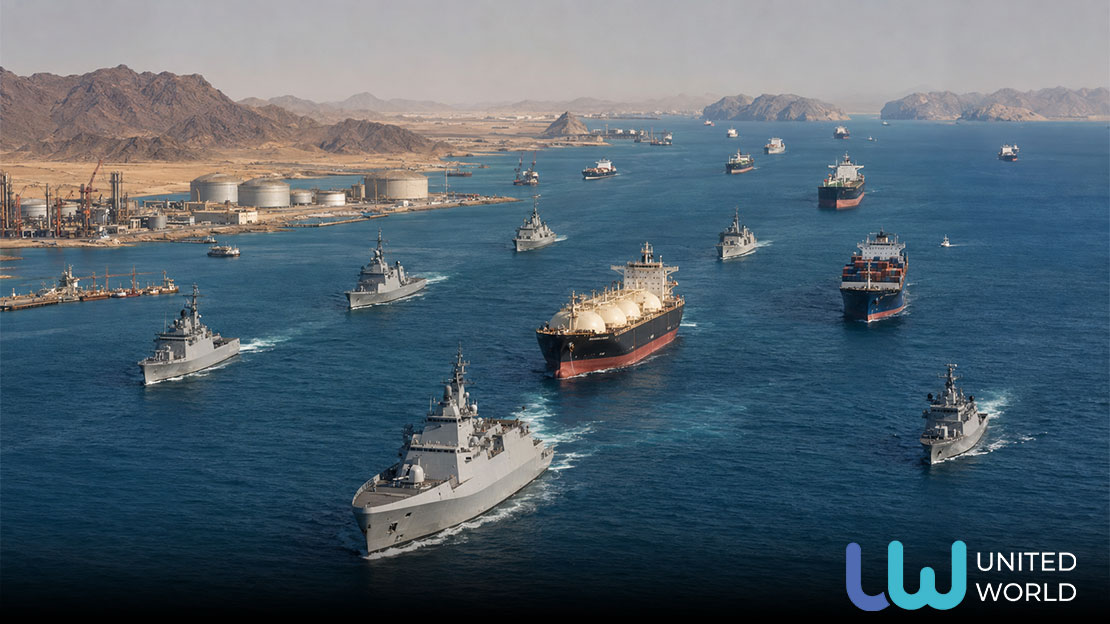
The biggest development during the past week was not merely the announcement of Saudi Arabia’s proposal, but the joint statement formally endorsing the creation of the coalition.
According to the joint declaration issued after the inaugural meeting in Riyadh, 14 countries agreed to establish what they described as a “framework for maritime defense cooperation.” The founding participants are Saudi Arabia, Türkiye, Pakistan, Egypt, Jordan, Yemen, Bangladesh, Nigeria, Sudan, Djibouti, Somalia, Bahrain, Kuwait and Qatar. Representatives from 43 countries and the European Union attended the Riyadh meeting, although not all became founding members.
The statement defines four principal objectives:
- enhancing maritime security;
- protecting freedom of navigation;
- securing international trade and energy supply routes;
- safeguarding maritime interests in the Bab al-Mandab Strait, the Red Sea and the Gulf of Aden, in accordance with international law and UN conventions.
Unlike the U.S.-led Operation Prosperity Guardian, whose immediate purpose has been to escort merchant shipping against Houthi attacks, the Saudi initiative seeks to create a permanent regional institutional framework. Reuters reported that Riyadh intends to host and lead the coalition while developing mechanisms for intelligence sharing, coordinated naval patrols, joint exercises, crisis response and maritime surveillance.
One of the most notable geopolitical aspects of the declaration is who signed—and who did not.
Türkiye’s participation gives the initiative considerable military weight. The Turkish Navy has become one of NATO’s largest maritime forces and has expanded operations from the Mediterranean to the Horn of Africa. Egypt’s support is equally significant because Cairo’s economy has suffered from declining Suez Canal revenues as shipping companies diverted vessels around the Cape of Good Hope. Pakistan contributes another capable navy with extensive Arabian Sea experience, while Djibouti and Somalia occupy strategic positions overlooking the approaches to Bab al-Mandab.
Equally revealing were the absences. Reuters noted that the United Arab Emirates and Oman did not join the founding group, despite their importance in Gulf maritime security. Their decision suggests that some Gulf states remain cautious about entering a new Saudi-led security architecture while balancing relations with Iran and pursuing their own regional strategies. Another country that did not sign the agreement was Iraq.
The timing of the initiative is also critical. It followed a sharp deterioration in maritime security after the Houthis declared a naval blockade against Saudi Arabia and intensified attacks on shipping linked to the Kingdom. At the same time, Houthi leaders have reportedly discussed imposing transit fees on commercial vessels passing through the southern Red Sea, an unprecedented attempt to exercise de facto control over one of the world’s most important maritime chokepoints.
For Saudi Arabia, protecting the Red Sea has become a strategic necessity extending far beyond traditional naval security. Nearly all of the Kingdom’s flagship economic projects—including NEOM, the Red Sea tourism development and expanding logistics hubs—depend upon secure maritime commerce. Any prolonged disruption would directly affect Vision 2030 by discouraging investment, increasing shipping costs and undermining Saudi Arabia’s ambition to become a global logistics center.
Perhaps the most important feature of the joint statement is its language. Rather than describing the coalition as an anti-Houthi or anti-Iran military alliance, the signatories deliberately framed it as a mechanism to defend international navigation, trade and energy security under international law. This wording leaves the door open for broader international cooperation while reducing the risk that the coalition is perceived solely as another front in the Saudi-Iran rivalry.
But more questions remain open, regarding scope and future of the statement. Though it does not mention it, quite possible that the coalition’s operations extend to the Strait of Hormuz in future, as the objectives, “safeguarding maritime traffic”, may well be applied here too.
Besides geographic extension, the initiative may be the starting point for a long-debated project of Middle Eastern NATO. It is accompanied by a number of bilateral defense and security agreements including Saudi Arabia, Türkiye and Pakistan.
But the biggest question that remains is whether the signing countries are capable and willing to send their navies into waters where these might encounter serios challenges.