




By Can Çakır, from Germany
Germany continues to debate over “mandatory military service”. But there is something new: requirement for men aged 17–45 to obtain permission for trips abroad lasting longer than three months.
According to the law that came into effect on January 1, men aged 17–45 may only leave the country with permission of the Defense Ministry during their conscription period. A similar rule existed before January 2026, but the German Military Service Act limited it to conditions such as a “state of tension” or “defense.” Under the amendment that entered into force on January 1, the rule can now be applied beyond such circumstances.
Contradictory statements from the Defense Minister
Although having come into effect on January 1, the debate about the law amendment has sparked in the beginning of April.
Responding to criticism, Federal Defense Minister Boris Pistorius initially claimed that the permission requirement was not effectively enforced and that approval would be considered automatic. However, he later acknowledged that the exception foreseen in the law had not yet officially entered into force and that a regulation would be introduced “by the end of the week”.
“Bureaucratic tricks”
Volker Boehme-Neßler, a professor at the University of Oldenburg, said in Cicero magazine that the permission requirement is clearly stated in the law. Despite that, in practice, he stated the relevant provision would only apply in the case of mandatory conscription, and is therefore not currently enforced, as military service in Germany remains voluntary. He also noted that Pistorius had effectively acknowledged this point.
Boehme-Neßler further argued that the public backlash is justified. “Politics has tried to quietly tighten the screws of military oversight,” he wrote, adding that “this strengthens the impression that responsible politicians are avoiding an open debate and instead resorting to bureaucratic tricks.”
Amid renewed debates in Germany over conscription, rearmament, and militarization, Erwin von Mildisch, Deputy Chairman of the youth wing of the Sahra Wagenknecht Alliance (JSW), spoke to “Aydınlık Europe”, the European supplement of Aydınlık newspaper of Türkiye.
“Deeply alarming militarization”
The new regulation in Germany requires men aged 17 to 45 to obtain permission for stays abroad longer than three months. What do you think is the aim of this regulation? Is it about spreading and entrenching a culture of militarization in society? Is the goal to increase pressure on young people?
That is exactly what it is about. This regulation is hypocritical and deceitful: outwardly, it is framed as a matter of security, but in reality, it aims to condition society toward military availability, obedience, and control.
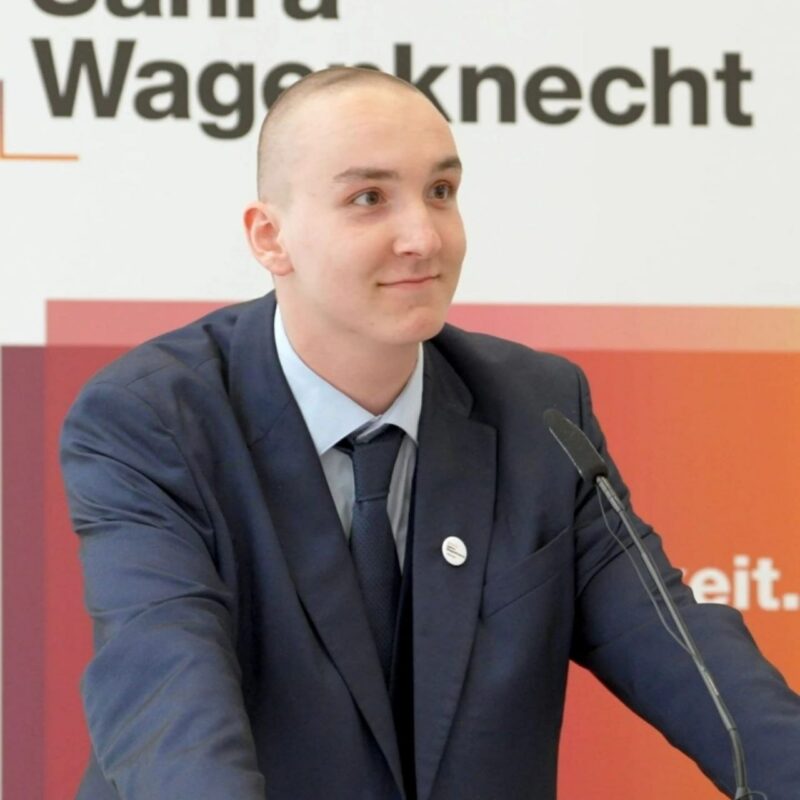
The fact that men over the age of 17 must obtain permission for stays abroad longer than three months is not a neutral administrative measure, it is an intervention in personal freedom and life planning. At the same time, with the new military service model, mandatory elements such as questionnaires and medical examinations for men are being reintroduced, and a form of compulsory service is openly being considered in case there are not enough volunteers. It represents a deeply alarming militarization.
Wars in Ukraine, Venezuela, Iran, Gaza
But the broader context is even more significant: we are witnessing a phase of escalating conflicts, whether in Ukraine, the Middle East, in Iran and Venezuela. These conflicts did not emerge out of nowhere; they are the result of Western power politics and intervention. Simultaneously, the West supports a genocide in Gaza and imposes sanctions on Russia that violate international law, in support of fascist Ukraine.
And precisely in this context, civil liberties are being restricted domestically, and young people are placed under increasing state control. The government is essentially saying: you should get used to war preparation at an early stage. They frame it as “responsibility” or even “defense”. That is where the hypocrisy lies.
Those who truly value freedom do not create new barriers to traveling abroad or further tighten mechanisms of military registration. Those who want peace demilitarize society, don’t try to discipline it.
As Karl Liebknecht said, “the main enemy is at home”
Debates over “military service” in Germany have remained prominent on the political agenda for years. As JSW, in your actions and statements, you emphasize the need for a peace-oriented policy and call for a return to voluntary military service. How successful do you consider yourselves in convincing, raising awareness, and mobilizing young people and society against the policies of the government and the military?
We are successful because we are voicing a truth that many people already feel but rarely hear expressed so clearly: the greatest threat to our security does not come from outside, but from our own rearmament policies. Or, to put it in the still-relevant words of Karl Liebknecht, the main enemy is at home, represented today by the Merz government.
Those in power, and the capital, are trying to convince young people that more military spending, more weapons, greater imperial ambition, and ultimately a return to compulsory service will bring “protection.” But the opposite is true. These policies create the very threats they claim to defend against. Rearmament is supposed to protect us from enemies that would not even exist without it.
Rents and tanks
More and more young people are beginning to understand this. They see billions being poured into tanks and missiles while rents rise, education is underfunded, and social security is eroding. They realize they are not being mobilized for peace, but for geopolitical interests. Our task as JSW is to make these links between war and social decline clear and to organize resistance. We say it plainly: it is not us who must become ready for war; it is the political system that must finally become ready for peace.
Why militarization now?
What dynamics do you see as the foundation of the militarization process that Germany has entered through the allocation of enormous budget resources? Is it about imperialist ambitions and expansionist aims? An attempt to stimulate the slumping economy? Or the reproduction of the political hegemony of the governing powers?
It is not a coexistence of different causes, but a coherent system: capitalism and imperialism are inseparably linked.
A capitalist system that depends on constant growth, competition, and profit cannot remain peaceful in the long term. At some point, markets, resources, and spheres of influence become insufficient, and it is precisely then that economic competition turns into political and military violence. That is the point at which capitalism becomes imperialism.
That is exactly what we are experiencing today. Germany is not rearming because there is suddenly more danger, but because it wants to secure its economic interests globally. Access to markets, raw materials, and trade routes are, if necessary, secured militarily.
The arms industry is a key beneficiary in this process. While cuts are made to the welfare state, billions are flowing into weapons. This is no coincidence: war and rearmament are a field of business in capitalism. Profits arise where destruction is prepared or organized. The political function here is clear: a society that is united against external enemies questions internal conditions less. Militarization distracts from social inequality, exploitation and the concentration of wealth.
The discourse of “Dependence on the US” among decision-makers: What to make of it?
Many political decision-makers in Germany and the EU have repeatedly emphasized in recent years that there is an “excessive dependence on the US” and the risks and problems this entails. The recent militarization initiatives have also been partly justified on this basis. You also take an anti-imperialist position and view the US as the leading imperialist power. How do you assess the policies of German and European decision-makers in this context? Is it deception? Or does this policy also contain legitimate aspects?
Criticism of dependence on the US is absolutely important and still far too weak.
The US is the leading imperialist power of our time and the biggest counterforce when it comes to a peaceful and global order consisting of sovereign states. Its foreign policy is characterized by wars of aggression, regime changes, interventions, and economic abuse of power, even to the point of endangering entire civilizations, as we can currently see in the inhumane blockade of Cuba. Anyone who ignores this is deliberately closing their eyes to reality.
But what do the German and European elites make of this reality once they finally acknowledge that the US is not our “best buddy”?
Not a departure from imperialism, but a “European imperialism”
They do not draw the conclusion of disarmament. Instead, they opt for more military strength of their own, more rearmament, and more geopolitical power politics, framed as “moral”, “democratic” and “European”. This is not a departure from imperialism but an attempt to build a European imperialism of its own.
That is why this line of argument is largely deceptive. It is not about peace or genuine independence, but about becoming stronger within the Western power bloc and pursuing one’s own interests more aggressively.
Indeed, Germany remains closely tied to NATO and behaves politically, militarily, and strategically like a vassal of the West, the US, and the EU. At the same time, Germany has a dream of becoming a stronger power itself, for example by building the strongest conventional army in Europe. In other words, this policy is not only about supporting the unjust Western policy of dominance but positioning itself at the forefront of it.
For JSW, it is clear: we do not need a stronger West, we need a break with this logic. We demand withdrawal from NATO, an end to rearmament, the closure of US military bases in Germany, and a consistent peace policy based on diplomacy, cooperation, and international solidarity. Anything else, in our view, only leads to a further division of the world into blocs of power and to young people being exploited for militarization.