


Main political events in Türkiye in the last week.
Main political events in Türkiye in the last week.
Last week, Türkiye’s political agenda remained intense.
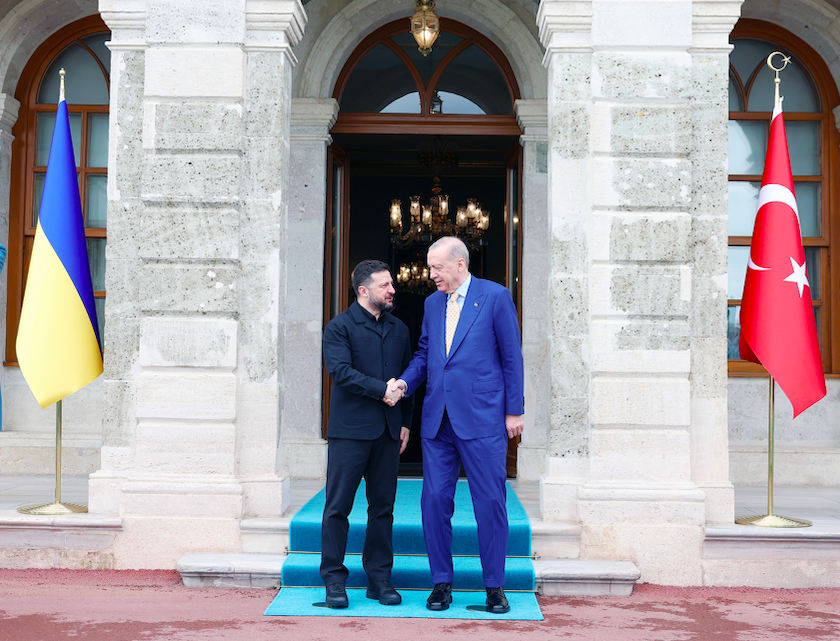
A meeting between President Recep Tayyip Erdoğan and his Ukrainian counterpart Volodymyr Zelenskyy stood at the top of the agenda.
Secondly, Foreign Minister Hakan Fidan participated in a meeting in Damascus attended by Syrian President al-Sharaa and Zelenskyy.
Meanwhile, statements by the Ministry of National Defense regarding NATO were also among the prominent topics.
Erdoğan–Zelenskyy meeting
Last week, President Recep Tayyip Erdoğan met with Ukrainian President Volodymyr Zelenskyy in Istanbul.
In a written statement issued by the Presidency’s Directorate of Communications, it was announced that the two leaders discussed Türkiye–Ukraine bilateral relations, efforts to achieve peace in the Ukraine–Russia war, as well as regional and global developments.
During the meeting, Erdoğan reaffirmed that Türkiye would continue to support negotiations between Ukraine and Russia.
It was also shared with the press that Erdoğan addressed the issue of navigation safety in the Black Sea.
Erdoğan’s emphasis on the Black Sea drew particular attention since in recent weeks a Turkish oil tanker was attacked by Ukraine near the entrance of the Bosporus. The tanker carrying 140,000 tons of oil just 24 kilometers from the Strait, narrowly avoided severe damage. Another development for the Black Sea was reports that NATO-linked forces could be deployed around the Bosporus.
President Erdoğan also expressed his satisfaction with Ukraine’s efforts to strengthen its relations with Gulf countries.
Following the meeting, Zelenskyy said he and Erdoğan had agreed to take new steps in bilateral security cooperation. He said there was clear political will on both sides and that working groups from Ukraine and Türkiye would soon finalize the details of the next phase.
Zelenskyy added that Ukraine is prepared to support Türkiye in areas where it can offer strong expertise, particularly in know-how, technology and practical experience. His remarks pointed to a broader and more structured partnership, with both sides looking to move from political coordination to concrete initiatives.
Beyond security issues, media reports indicated that the two leaders also discussed energy infrastructure and gas resources.
Foreign Minister Fidan’s Syria Contacts
Following his visit to Türkiye, Zelenskyy departed for Damascus, while Turkish Foreign Minister Hakan Fidan simultaneously traveled to the Syrian capital.
Fidan attended a meeting where Zelenskyy and his Syrian counterpart, President Ahmed al-Sharaa, came together.
Fidan also held separate meetings with Syrian Foreign Minister Shaybani and Ukrainian Foreign Minister Dmytro Kuleba Sybiha. According to press statements, these talks covered bilateral relations and regional issues.
As a result of these visits, reports indicated that a trilateral mechanism was established between Türkiye, Syria and Ukraine. Ukrainian Foreign Minister Sybiha announced that, within the framework of this new mechanism, the three countries would address security and logistics issues. He emphasized the importance of trade routes and maritime transportation security, noting that these would be treated as priorities.
Meanwhile, it was reported that al-Sharaa and Fidan discussed political and economic relations. The meeting also addressed the spillover effects of the ongoing war in Iran on Syria, and the latest developments in Lebanon.
Sources from Turkish Ministry of Foreign Affairs stated that ongoing bilateral projects aimed at Syria’s reconstruction were also discussed during the talks.
Statement from the Ministry of National Defense on NATO
The Ministry of National Defense issued a statement regarding new NATO headquarters to be established in Türkiye.
While confirming that a Maritime Component Command will be set up in the Bosporus and a Multinational Corps Headquarters in Adana, the Ministry stated that “there will be no compromise on the principle of regional ownership or the Montreux Convention.”
The Ministry’s statement on the matter reads as follows:
“In recent days, it has been observed that certain media outlets and social media platforms have made assessments based on incomplete information and have confused certain concepts regarding Türkiye’s contributions to NATO, the Coalition of the Willing, and activities carried out in the Black Sea.
First and foremost, our Ministry prioritizes informing the public accurately and in a timely manner. In this context, weekly press briefings are held regularly, and questions from members of the press are addressed. Work in the fields of defense and security is carried out in coordination with relevant authorities, and once the process is completed, the necessary information is shared transparently with the public in a manner that does not compromise national security.
Information regarding Türkiye’s fundamental Black Sea strategy, as well as the NATO and non-NATO multinational Maritime Headquarters established under this strategy, and the Multinational Corps Headquarters whose establishment in Adana is ongoing, is as follows:
There will be no compromise on the principle of regional ownership or the Montreux Convention. All activities are conducted in accordance with this principle.
Türkiye’s approach to Black Sea security is based on preserving the balance and stability ensured by the Montreux Straits Convention and on the principle of regional ownership, whereby littoral states take the primary role. Thanks to this approach, the Black Sea has not turned into a large-scale conflict zone, as was the case in the past. During the Russia–Ukraine war, Türkiye firmly implemented the provisions of the Montreux Convention, preventing the conflict from expanding into the maritime domain.
Despite increasing geopolitical competition and security risks in the Black Sea, Türkiye continues to maintain its stance of preserving regional stability, avoiding escalation, and ensuring that security is primarily provided by littoral states. Thanks to this approach, the Black Sea has not, as in the past, become a theater of large-scale conflict today. During the Russia-Ukraine war, Türkiye has resolutely applied the Montreux Convention, thereby preventing the conflict from spilling over into the maritime sphere. Despite the growing geopolitical competition and security risks in the Black Sea, our country continues to uphold its stance on maintaining stability in the region, preventing the escalation of tensions, and ensuring that security is primarily provided by the littoral states. In line with this approach, Türkiye continues to take initiatives to prevent the Black Sea from becoming an arena of competition and plays an active role in preserving the regional security architecture.”
The Coalition of the Willing, under which planning is being conducted for security arrangements in the event of a negotiated end to the Russia–Ukraine war, is a multinational initiative not affiliated with NATO, with 33 countries having already expressed their willingness to participate.
Within the framework of this initiative, the Multinational Force Ukraine (MNF-U) is planned to be managed through an operational headquarters established with a core staff in France (Paris).
The Maritime Component Command (MCC) of this force will be carried out by us in order to maintain security and stability, uphold the principle of regional ownership, and preserve the balance established by the Montreux Straits Convention.
During the meeting held in Ankara on April 15–16, 2025, it was agreed that Türkiye would continue to lead maritime planning activities, and that the legal framework set by the Montreux Convention would serve as the basis for these plans.
The Maritime Component Command Headquarters was established as of August 25, 2025, with a core staff composed entirely of Turkish personnel. While 14 countries have pledged contributions to the Maritime Component Command, contributions involving naval platforms will be provided only by littoral states, Türkiye, Romania and Bulgaria.”