


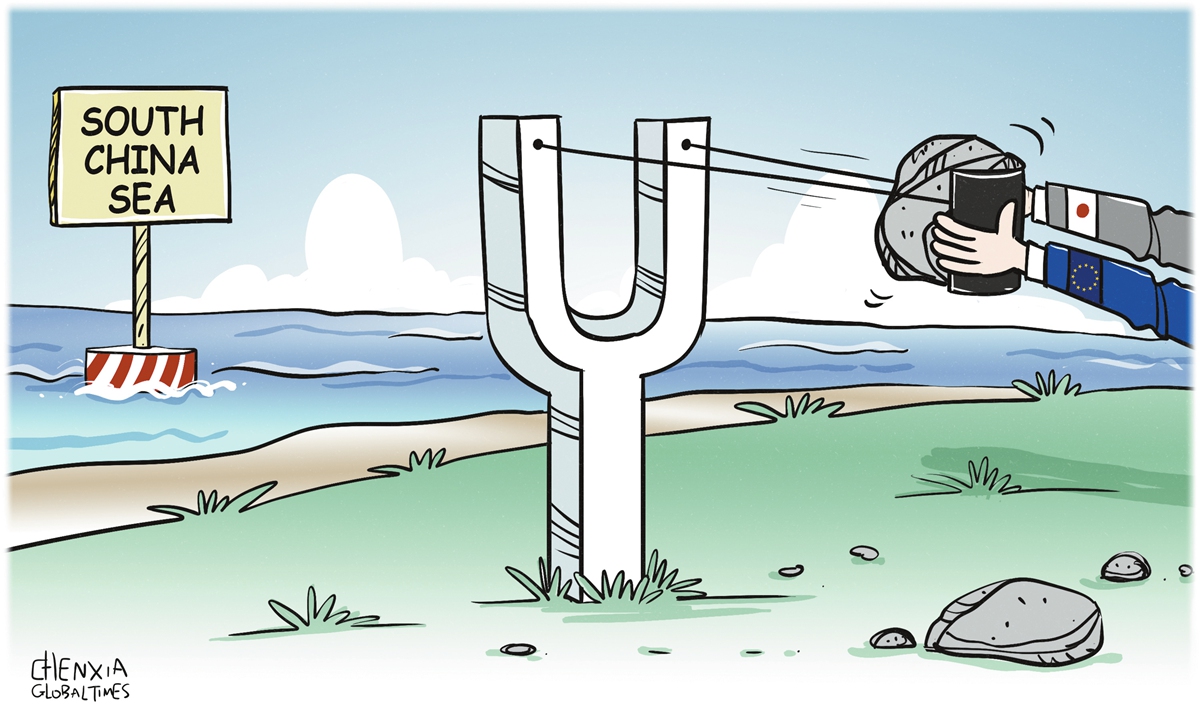
External Maneuvering, Internal Disruption
External Maneuvering, Internal Disruption
By Mehmet Enes Beşer
The South China Sea has been the Indo-Pacific’s most combustible hotspot for many years. With rival claims within the sea, strategic sea lanes, and delicate military capabilities, the area needs to be managed with careful diplomacy, each party exercising restraint, and regional stewardship to prevent tensions from increasing. But recent moves by players outside the proximate geography—i.e., Japan and the European Union—have introduced new complications to already fraught situations. Framed in terms of defending “international norms” and advancing “freedom of navigation,” these moves are actually highly likely to be heightened tensions and threatening the peace and stability they claim to protect.
During the last several years, the countries bordering the South China Sea most immediately—China, the Philippines, Vietnam, Malaysia, Brunei, and Indonesia—have worked through differences in a mixture of bilateral diplomatic negotiation, ASEAN dialogue meetings, and strategic hedging calculations. The structure is less than ideal, and the process moved very slowly at times. But they are a regional agreement that the South China Sea issue has to be solved by those most immediately concerned, through Asian-led diplomacy and not geostrategic horse-trading.
Japan and the EU, through projecting their naval presence and collaborative maritime vigilance in the interests of “rules-based order,” risk disrupting this delicate balance. Their intervention, shrouded in a disguise of multilateralism, essentially internationalizes an intraregional conflict—exporting it to a platform of strategic messaging against China. In addition to making ASEAN centrality obsolescent as the balancer of maritime tensions, it also raises the possibility of miscalculation and unintended conflict.
Japan’s position in this equation is particularly sensitive. Tokyo has rightful security concerns and historical connections with Southeast Asian states, but its deeper involvement within U.S. Indo-Pacific policy increasingly makes it a counterbalance to China. Naval maneuvers off disputed seas—especially joint maneuvers with external powers—have implications far beyond deterrence. They are considered in Beijing as intrusions into its critical interests, and in ASEAN capitals generally as the military presence in regional waters of another foreign power.
The European Union intervention in affairs in South China Sea, although more symbolic, is also disturbing. Swayed by its shaky strategic footprint in Asia and eager to present its “geopolitical union” face, the EU has made statements, deployed vessels, and pushed for more maritime-based coalitions in the region. Yet the EU’s centuries-old history of insulation from Asian naval war, its colonial past, and limited adherence to international law make its interventions risky and self-serving. Rather than being an aid to ASEAN’s peace-making efforts, these actions complicate them by introducing new agendas and shattering regional consensus.
The bigger concern is that such third-party actions reduce the space for peaceful negotiation. When the South China Sea is used as a proving ground for rival power blocs, the bargaining power for compromise is lost. Regional actors can be coerced into taking sides, watering down the delicate diplomacy ASEAN has nurtured over decades. More significantly, the rise of new military players in the region sets more opportunities for tactical errors—clumsy confrontations, misinterpreted motivations, or cyber misunderstandings—to be on the path to become larger war as they escalate beyond control.
That is not to say that the EU and Japan can turn their backs on the South China Sea or set aside openness values and international law. But effective support must be in the form of facilitating dialogue, maintaining ASEAN centrality, and encouraging legal and diplomatic channels—rather than sending warships or issuing bluffing statements. Peace in the South China Sea will never be secured by power projection, but through constructing trust, accommodations, and constructive diplomacy anchored on regional realities.
Conclusion
Japan and the EU’s entry into the South China Sea, while often couched in ideals and law, is more likely to aggravate than resolve the South China Sea’s underlying issues. Their actions, whether intentionally or not, shift the issue from regional discussion to international rivalry, reducing the chances of peaceful resolution and further diving into distrust.
If, in reality, peace and stability in the South China Sea are what are desired, then external powers must evolve. An appreciation of local leadership, diplomatic restraint, and constructive engagement with multilateral mechanisms is a more sustainable path than the display of strength on the cheap. The region does not need additional pressure—it needs space to figure out its own solution. The further outside powers meddle into these disputed waters, the more difficult that is.