


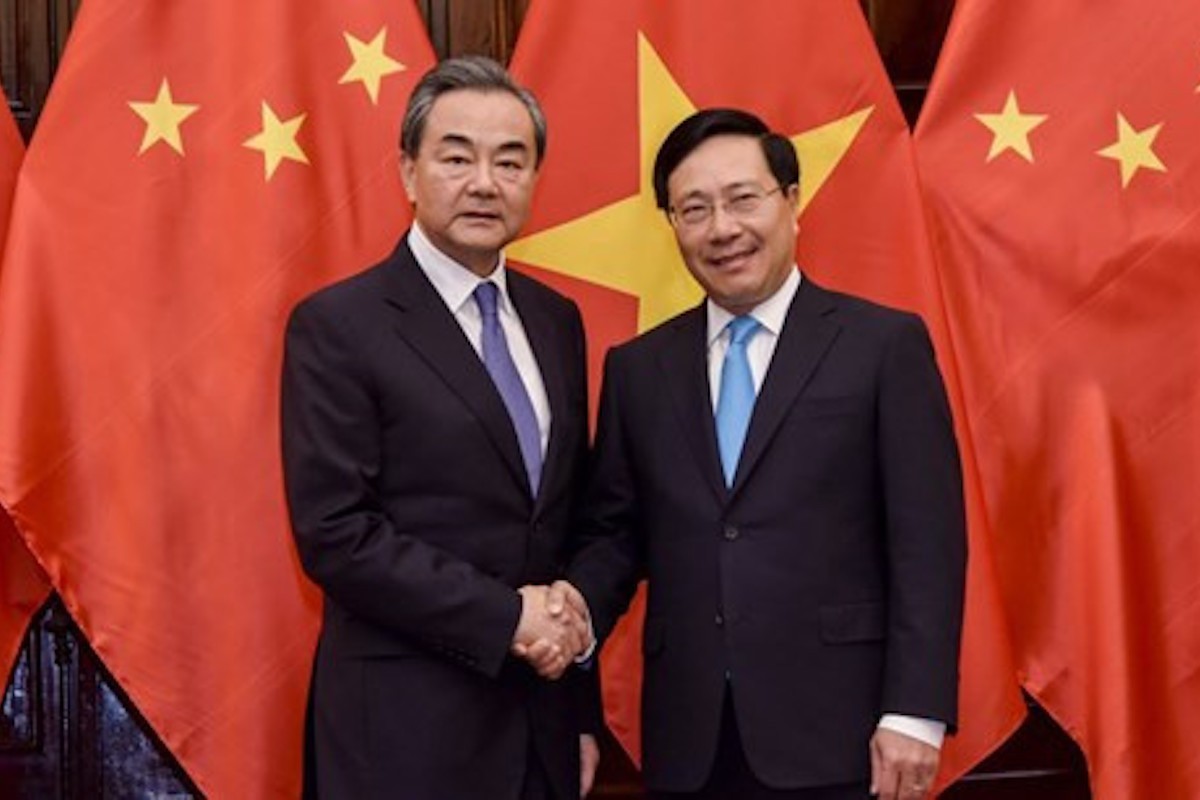
Vietnam’s rethinking of the Belt and Road Initiative is not an act of weakness, but an action in response to changed realities.
Vietnam’s rethinking of the Belt and Road Initiative is not an act of weakness, but an action in response to changed realities.
By Mehmet Enes Beşer
Vietnam has walked a cautious path on China’s Belt and Road Initiative (BRI) for years, not wishing to become too entangled in Beijing’s geoeconomic orbit. While Hanoi has publicly endorsed the BRI, its participation has been low-key by intention compared to Indochinese neighbors Laos and Cambodia. But as new realities in gestation—like the appearance of BRI flagship infrastructure projects in Laos, the deluge of Chinese investment into Cambodia, and the heightened regional integration brought about by these corridors—start taking root, Vietnam is compelled to rethink its strategy. As the regional status quo is transformed at dizzying speed under the thrust of Chinese capital and connectivity, Hanoi has a bleak choice: can it stay aloof?
The BRI’s influence is most visibly felt in Laos, where the $6 billion China-Laos railway has physically and symbolically linked Vientiane to China’s southern Yunnan province. Operational since 2021, the railway is a flagship BRI project—accelerating trade, tourism, and logistics between the two countries. Short-term benefits have been felt despite apprehensions over the increasing indebtedness of Laos to China and whether it will be able to pay in the long term or not. Short-term benefits are in terms of increased freight traffic, improved land connectivity to the world economy, and reorientation of Laos as a regional land-link hub.
Chinese-funded highways, special economic zones, and real estate developments in Cambodia have redeveloped Sihanoukville and reconfigured Phnom Penh’s cityscape. China is Cambodia’s largest foreign investor and main donor, and infrastructure construction on a scale few nations are able to execute is facilitated. From its presence on every hydropower dam to the new Phnom Penh airport initiative, the BRI is cementing Cambodia’s economic dependence while, at the same time, its infrastructure upgrade commences.
For Vietnam, these developments exhilarate strategic and pragmatic fears. For the practical, the creation of a new continental economic corridor from southern China into Laos will go around Cambodia into Vietnam promises to go over the classic function for Vietnam as land-based transportation and manufacturing hub. Unless Vietnam acts in a timely fashion, Vietnam can be by-passed from a new continental trade conduit with the potential of re-routing investment, devorating competitiveness, and unraveling regional supply chains.
At the strategic level, the deepening economic alignment between Beijing and Hanoi’s neighbors creates a new periphery dilemma. Vietnam’s long-standing concerns about Chinese influence—rooted in historical conflict, maritime disputes, and an enduring asymmetry in power—are compounded by the sense that China is economically encircling it. While Hanoi maintains strong ties with Japan, South Korea, the United States, and the EU, it cannot ignore the gravitational pull of Chinese capital in continental Southeast Asia.
But Vietnam’s calculation is not entirely reactive. Its reevaluation of the BRI is cautious and calculated, motivated by a desire to hedge risks without sacrificing independence. Rather than welcoming the BRI en bloc, Hanoi appears to be balancing selective engagement, seeking connectivity projects that are in the interests of national development planning and safeguarding sovereignty. These are the pursuit of connectivity with China’s drive to Vietnam, i.e., Vietnam’s “Two Corridors, One Belt” policy with China some years ago and new multimodal commerce veins of north Vietnam to Laos and Thailand.
Vietnam is also attempting to set regional interconnectivity terms, rather than merely react to them. Through ASEAN, the Mekong-Lancang Cooperation framework, and accession to multilateral agreements such as the CPTPP and RCEP, Hanoi is striving to ensure a promise that trade and infrastructure are never instruments of dependence. Its vision is a multipolar world of infrastructure in which Japanese, South Korean, American, and Indian capabilities balance Chinese dominance with other investments and multi-sourced finance.
Moreover, Hanoi has a sharp appreciation for the dangers of debt trap and shadow lending—dangers Laos and Cambodia more and more directly face. Vietnam’s Party leadership and economic planners prioritize transparency, environmental responsibility, and sovereignty—priorities that will limit the extent of BRI engagement but maintain the integrity of Vietnam’s development model.
But the cost of remaining on the outside is rising. Chinese-funded infrastructure across Cambodia and Laos is not only reshaping the channels of logistics—it is solidifying regional integration and standard-setting, from customs regimes to digital infrastructure. If Vietnam remains too distant, it will be edged into a marginal position in a region whose boundaries are being shaped ever more by others.
Conclusion
Vietnam’s rethinking of the Belt and Road Initiative is not an act of weakness, but an action in response to changed realities. As Chinese capital remakes the Mekong subregion, Hanoi is adjusting its strategy—not to get into line hastily for the BRI, but to manage it on its own terms. The test is to do so strategically consistently: to extract the maximum from the BRI, reveal least, and remain committed to a higher vision of regional sovereignty and equilibrium.
Vietnam provides in this a paradigm of the ways middle powers can coexist with great-power behavior—neither slavishly following nor doggedly opposing but instead crafting their engagement on grounds of pragmatism, sovereignty, and strategic imagination.