


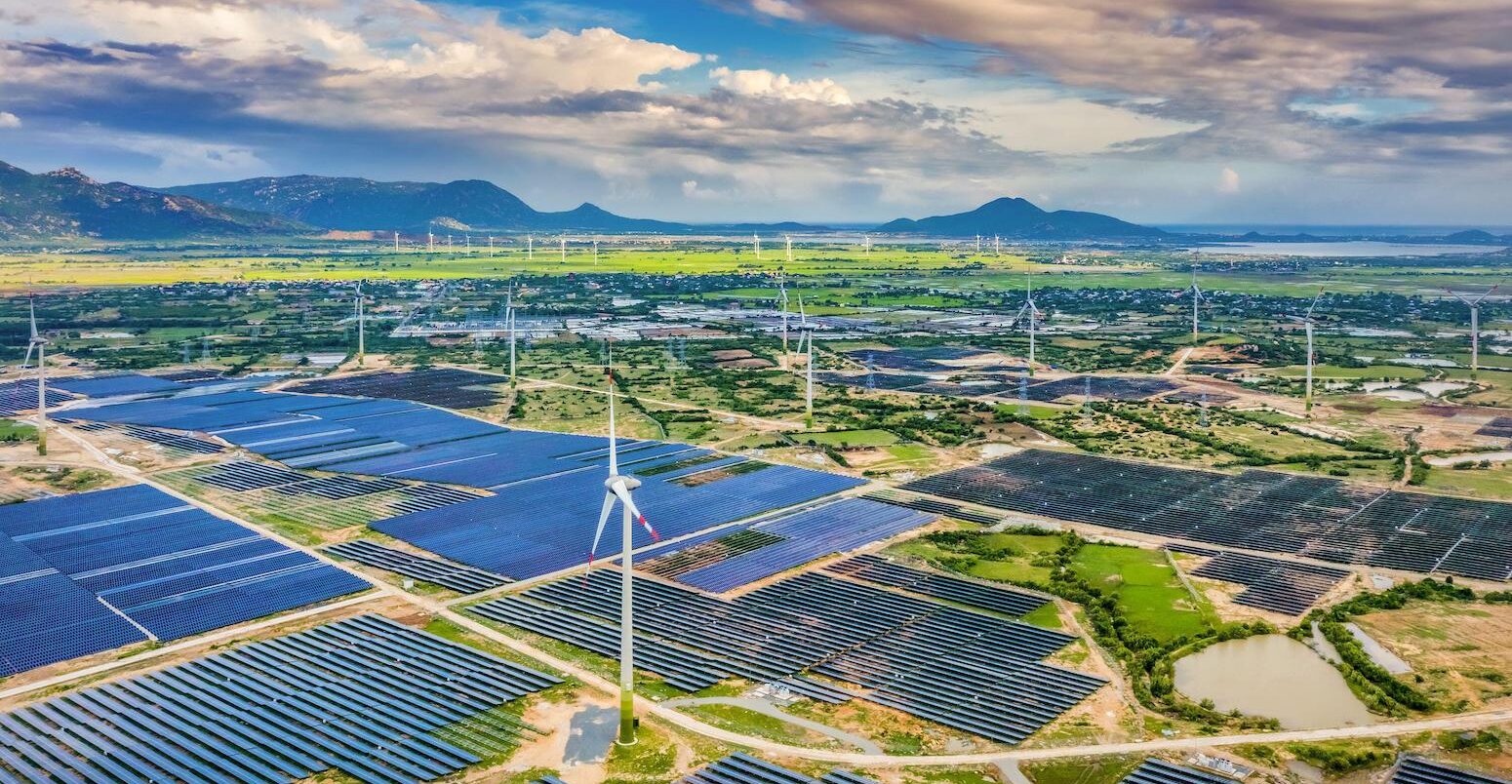
Solar plants on a large scale are prone to land disputes, especially where there are uncertain tenure status or indigenous communities.
Solar plants on a large scale are prone to land disputes, especially where there are uncertain tenure status or indigenous communities.
By Mehmet Enes Beşer
The ASEAN region boasts some of the finest solar irradiation in the world, offering a geographical advantage in tapping solar power to meet its rapidly growing energy needs. With Southeast Asian economies industrializing, urbanizing, and modernizing, solar power has emerged as the cornerstone of the region’s renewable energy policy. The majority of such countries, led by Vietnam, Thailand, and the Philippines, have shown that policy support matched with falling prices of technology has the potential to trigger rapid deployment of solar energy. All that aside, however, the broader ASEAN region is still substantially behind its true potential, marred by ambiguity in policy, technical hurdles, finance issues, and structural disparity in energy access. In order to be capable of utilizing the entire potential of solar energy in Southeast Asia is not only a question of increasing the production but also to overcome a group of system obstacles.
The solar power resource potential in ASEAN is encouraging. Most ASEAN countries have a mean solar irradiation between 4 and 5.5 kWh/m²/day, and therefore the production of solar PV power is technologically viable in most places. Unlike hydro and wind, solar is more evenly distributed, which makes decentralized installations an option that can be applied to grid-connected or off-grid towns. This is the reason why solar is most attractive in countries like Indonesia and the Philippines, whose geographical extent and electrification opportunity still persist.
Vietnam has been a regional solar leader in the last years. Supported by trailblazing feed-in tariff regimes and favorable regulatory frameworks, it achieved a record expansion of solar PV capacity to over 16 gigawatts in 2021 from a near zero in 2018. The boom was driven by a combination of political determination, international finance, and strong private sector uptake. However, the boom laid bare underlying infrastructure weaknesses, including grid congestion, solar curtailment, and lack of energy storage capacity.
Thailand, which started ahead of much of its Southeast Asian neighbors, has set up a solidly rooted solar sector based on robust policy guidance, public-private partnership, and rural electrification-led investment. Rooftop solar and floating solar grew steadily, with the government encouraging twin-use solar-agriculture projects as a way of maximizing land use. Growth, however, has slowed in recent times due to policy zig-zags and prime grid-connected location fill-up.
The Philippines is replete with possibility and behemoth problems. As an archipelago of over 7,000 islands, its dispersed geography is ideal for solar-powered mini-grids and off-grid uses. But policy inconsistency, red tape, and a lack of investment in transmission networks still hold back solar mass usage. Solar rural electrification programs with storage facilities have worked in some areas, but the lack of national strategy leaves projects isolated and donor-dependent.
Other countries such as Malaysia, Indonesia, and Myanmar have also taken their time. Malaysia has had several rounds of large-scale solar auctions and started a net energy metering scheme earlier this year, but its solar vision is still lagging behind fossil fuel dominance in the energy mix. Indonesia has ambitious solar targets in its National Energy Grand Strategy but remains predominantly reliant on coal, with planning by utilities and bureaucratic land acquisition hindering solar development. Political uncertainty in Myanmar has shelved several clean energy projects in the midst of the country’s enormous off-grid opportunity.
Across ASEAN, the brightest prospects for solar expansion exist in three fields: technological advancement, regional integration, and access to energy. First, cost reduction in solar PV systems has been breathtakingly rapid, and solar has become the most financially competitive source of new power generation in the overwhelming majority of the region. In addition to new breakthrough technologies—bifacial panels, integration of battery storage, floating solar, and use of smart grids—solar energy is now more geographically and load pattern-compatible than ever before.
Second, regional integration through the ASEAN Power Grid (APG) and the accompanying energy integration regimes can make cross-border balancing of solar output and demand feasible. High-land, high-potential countries like Cambodia and Laos can export clean energy to more technologically advanced, land-constrained neighbors. Consistent technological standards, interconnection practices, and harmonized rules will be keys to unlocking the regional solar market.
Third, solar offers an answer to mitigating energy poverty and inequalities. Over 45 million people in ASEAN lack access to guaranteed electricity, distributed in rural villages and townships on islands. Solar stand-alone systems and mini-grids provide cost-effective alternatives to costly diesel generation or extension of off-grid systems. Social enterprises and NGOs have already found ways to bring solar kits for lighting, education, and mobile charging into remote villages. These kinds of solutions, with the proper policy backing, can be established to achieve greater resilience and development objectives.
But such opportunities come with inherent problems that limit solar’s final potential. The top of these is policymaking uncertainty. Solar development has been hindered in many ASEAN economies by stop-go policymaking, uncertain procurement, and defective long-term planning. Tariff shocks, contract renegotiations, and bureaucracy escalate investor uncertainty and create project delivery clogs.
Grid infrastructure is a chronic bottleneck. Most national grids were constructed to feed centralized, fossil-fueled power systems and are not equipped to deal with the variability and distributed nature of solar energy. Available transmission capacity, grid stiffness, and inefficient energy storage facilities all contribute to technical losses and curtailment. Until grid operations are upgraded—through digital control systems, demand forecasting, and storage integration—the reliability of solar power will be limited.
Financing access is also a key barrier, namely to off-grid communities and small and medium-sized enterprises (SMEs). While foreign investors are attracted to large solar farms, domestic solar entrepreneurs face high interest rates, constrained collateral, and constrained knowledge of clean energy lending by financial institutions. Vehicles such as green credit lines, guarantees, and blended finance platforms are needed urgently to lower the cost of capital and de-risk solar investment.
Finally, social equity and acceptance issues must not be overlooked. Solar plants on a large scale are prone to land disputes, especially where there are uncertain tenure status or indigenous communities. Communities at the local level will fight expansion if they do not perceive solar growth as a good thing, a sharing rather than extractive development, and equitable growth. Ensuring that benefits from solar trickle down—whether through revenue sharing, co-ownership, or local employment—will be instrumental in long-run sustainability.