


Between Alliances and Tensions: Greece, the West, and the Eastern Mediterranean Chessboard
Between Alliances and Tensions: Greece, the West, and the Eastern Mediterranean Chessboard
In recent years, Greece has found itself navigating an increasingly complex geopolitical landscape, balancing its historical alignment with the NATO and Western powers against mounting regional tensions in the Eastern Mediterranean. At the heart of this dynamic lie not only the country’s relations with Türkiye, but also the growing role of Israel and shifting strategies in the broader Middle East.
Western Alignment Under Pressure
Athens has long positioned itself as a pillar of Western influence in southeastern Europe. Successive governments, including that of Prime Minister Kyriakos Mitsotakis, have deepened ties with the United States and European partners, particularly in defense and energy cooperation. According to recent reporting by international news agencies, Greece has expanded access to military bases for U.S. forces, while NATO infrastructure across the region has been reinforced amid ongoing tensions with Russia and instability in the Middle East.
This alignment, however, has not come without domestic criticism. As UWI author Dimitris Konstatakopoulos told us in Athens, there is “a lot of pressure… from the United States on Greece,” particularly in efforts to curb Chinese economic presence and reorient energy dependencies. He argues that “all the United States policy is a policy of preparing a war against Russia and China,” suggesting that Greece is being drawn into broader geopolitical rivalries.
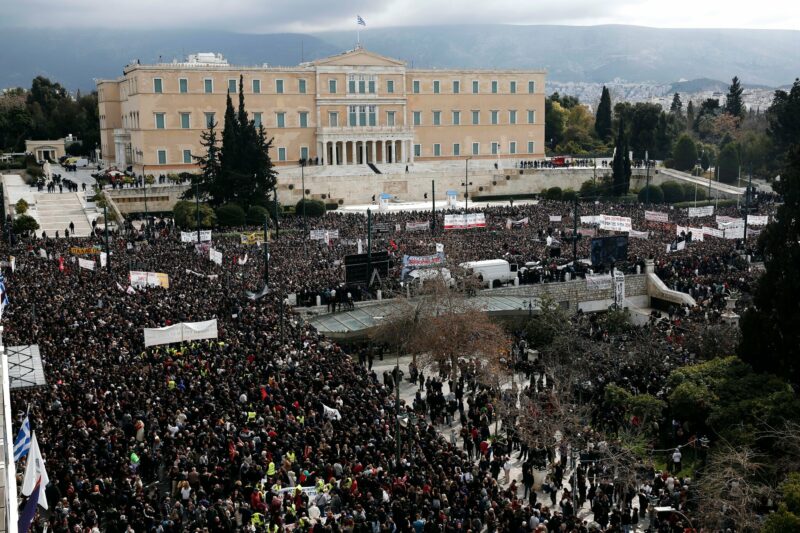
Such concerns are reflected in public sentiment. In recent months, protests have taken place in Athens and Thessaloniki against NATO expansion and the policies associated with U.S. President Donald Trump, with demonstrators criticizing military cooperation agreements and Greece’s perceived role in Western interventionism. News agencies report that these protests often intersect with wider dissatisfaction over inflation, governance, and foreign policy direction.
Cyprus and Military Build-Up
A key flashpoint in the region remains Cyprus, whose strategic location has made it central to Western military planning. Reports from defense correspondents indicate increased Western military deployments and logistical activity on the island, including expanded use of British sovereign bases and closer U.S. cooperation with Cypriot authorities.
For many analysts, Cyprus embodies the overlapping interests of global and regional powers. Konstantakopoulos warns of a broader pattern of external influence, claiming that Israel wants to “colonize both parts of the island”:
“I think they would like Cyprus to become a part of Greater Israel. It is included in the dreams, which dreams have the tendency to become reality nowadays, of Greater Israel. And also, we know that the Zionist movement, from the very beginning, the first goal of the Zionist movement was that they create Israel in Cyprus. And even Theodor Herzl, the founder of the Zionist movement, went to Chamberlain, the British Prime Minister, and asked them to give them Cyprus. Chamberlain told him, ‘I cannot throw away the Greeks’, and so the plan was not highly successful. But the idea existed.”
Today, he adds, is Israel buying up real estate in great dimension both in the north and the south of the island, “building entire neighborhoods”.
Israel’s Role in Greek-Turkish Tensions
One of the more controversial perspectives emerging from the interview concerns the role of Israel in shaping Greek-Turkish relations. The analyst argues that Israeli-backed energy initiatives—such as proposed Eastern Mediterranean pipelines—were never intended to be realized, but instead served to “provoke a kind of tension between Greece and Türkiye.”
“I believe the main reason Israelis have proposed those plans was to provoke… tension,” he states, adding that Ankara’s strong reactions, including maritime agreements with Libya, contributed to an escalating arms race between the two NATO members.
“You know, Israel has always used the antagonism between Greece and Türkiye to create problems. And it has even created this antagonism. especially with the Cyprus question.”
While such claims are debated, it is undisputed that Israel has strengthened its strategic partnerships with Greece and Cyprus over the past decade, particularly in energy and defense. Joint military exercises, intelligence cooperation, and trilateral summits have become regular features of regional diplomacy.
Yet, the integration of Greece into an American-Israeli energy network makes no sense for Konstantakopoulos:
“Those are completely stupid things, I mean from the point of view of Greeks, because there is no such demand for American LNG from Greece anywhere, and they are constructing huge things which I think they will never be used, at least in full capacity. And this is because the Americans wanted to make disappear all Russian influence, that’s the first thing. The second thing is that they want to sell their gas, because now this incredible prime Minister we have, Mr Mitsotakis, has signed a deal according to which Greece will import I don’t know how much US LNG from 2030 to 2050. If you can tell me what will happen with the prices of LNG in 2040, or if we are going to use LNG in 2040, then I will give you a fortune.”
Yet this alignment has also complicated Greece’s position in the Middle East. As the war in Gaza continues to draw international condemnation, public opinion in Greece has shifted sharply. The interview highlights “a huge pro-Palestine, anti-Israeli movement,” which has emerged despite the government’s relatively cautious stance.
Domestic Discontent and Political Fragmentation
The intersection of foreign policy and domestic politics is increasingly evident in Greece. According to the Greek analyst, public dissatisfaction is fueled not only by economic hardship but also by a perception that the country’s sovereignty has been compromised since the financial crisis of 2009–2010.
The bailout programs imposed by international creditors are described as “catastrophic,” having “destroyed the country instead of saving it.” This legacy continues to shape political discourse, contributing to skepticism toward Western institutions and policies.
At the same time, Greece’s political landscape remains fragmented. While opposition to NATO interventions and Israeli actions is growing, there is, as the interviewee notes, “not a strong political or social force to resist United States imperialism.” The left remains divided, and new movements have yet to consolidate into viable alternatives.
A Fragile Balance
Despite these tensions, both Greece and Türkiye have shown an interest in avoiding direct confrontation. The interview emphasizes the importance of maintaining the status quo, warning that any attempt to alter it could “provoke new crises.”
This cautious approach is reflected in recent diplomatic engagements, though many remain skeptical about their long-term impact. With both countries facing domestic pressures and electoral cycles, significant concessions appear unlikely in the near future.
Meanwhile, external actors—from the United States to Israel—continue to play influential roles in shaping the country’s dynamics. Whether through military deployments, energy projects, or strategic partnerships, their involvement adds layers of complexity to an already volatile environment.
Conclusion
Greece today stands at a crossroads, caught between its Western alliances and the realities of a shifting geopolitical order. Its relations with Türkiye, its cooperation with Israel, and its role in the Middle East are all intertwined in a delicate balance.
As regional tensions persist and global rivalries intensify, the challenge for Athens will be to navigate these competing pressures without exacerbating conflicts or undermining its own stability. The question remains whether Greece can maintain this balance—or whether it will be drawn deeper into the fault lines of a changing world.
Recently, on the Munich Security Conference, US Secretary of State Marco Rubio had called to reinstate an alliance for Western civilization, of which is Greece is often considered the cradle Konstantakopoulos has clear words:
“What he means by Western civilization is not Western civilization. It is the worst traditions in the West. Because civilization means the international law, which was also a result of the fact that the Soviet Union has won over Nazis. And now we have Mr. Trump saying, as Adolf Hitler before him, that he is completely uninterested in international law and the law he obeys is his own will, his own mind and his own consciousness.”
The Greek analyst makes a call to Latin American leaders and the governments of BRICS: “When you have a Hitler in front of you, you must treat him like Hitler. You cannot play games.”