


How is Israel’s move to recognize Somaliland backfiring?
How is Israel’s move to recognize Somaliland backfiring?
By Adem Kılıç, Political Scientist
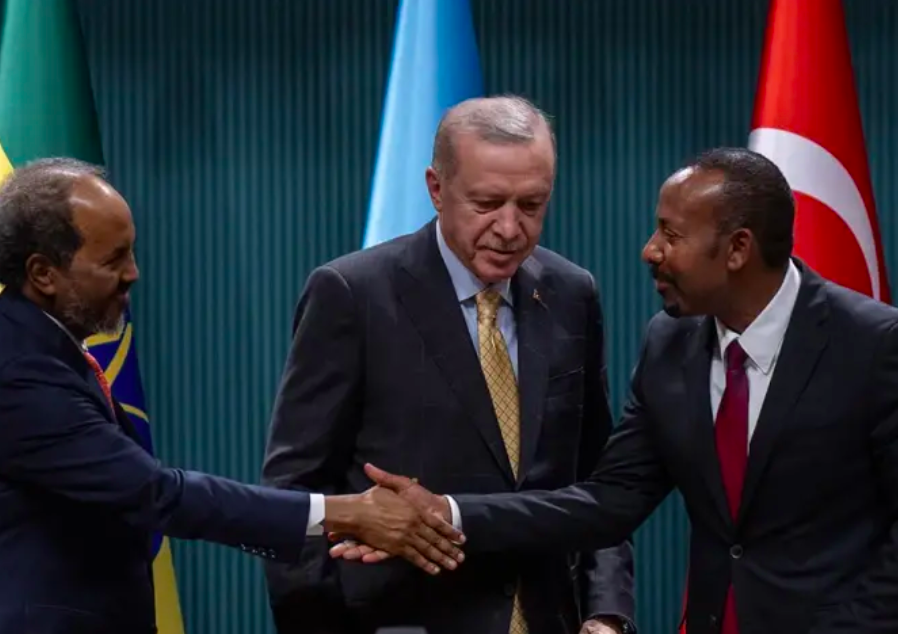
President Recep Tayyip Erdoğan’s visit to Ethiopia last week, following visits to Saudi Arabia and Egypt, signaled not only a diplomatic engagement but also a new phase in Türkiye’s Horn of Africa strategy.
The timing of the visit was particularly noteworthy, coming after Israel’s decision to recognize Somaliland and the resulting expectations of geopolitical shifts in the region.
Indeed, the geopolitical shift anticipated by some in the region following Israel’s decision to recognize Somaliland clearly demonstrated that the Horn of Africa has once again become a center of global power competition.
The message conveyed by President Erdoğan’s visit was quite clear.
Türkiye has now reaffirmed that it is no longer just a Somalia-focused actor in the Horn of Africa region, but is the most influential actor capable of changing the entire regional equation, including Ethiopia.
Türkiye’s Horn of Africa strategy and growing influence
Türkiye’s Horn of Africa policy entered a new and significant phase with the humanitarian diplomacy initiative launched during the 2011 Somali famine.
Through this process, Türkiye has become an indispensable actor for the country, both by establishing security partnerships that contribute to rebuilding state capacity in Somalia and by investing in economic infrastructure and social assistance.
The transformation of the TURKSOM military training base in Mogadishu into Türkiye’s largest military facility abroad and the critical role played by the Turkish Armed Forces in restructuring the Somali army were among the most concrete indicators of this transformation.
On the other hand, port operations, airport projects, construction investments, and increasing commercial relations have positioned Türkiye as one of the main actors in the Somali economy.
Recently, Türkiye’s presence in the region has also taken on a geo-economic dimension, particularly with the dispatch of Turkish drilling ships to the Somali coast.
Indeed, the combination of energy exploration activities, defense cooperation, and diplomatic contacts has confirmed that Türkiye is now acting not only as an investor but also as a game-changing actor in the region.
Türkiye’s role as a mediator during the tensions between Somalia and Ethiopia has further solidified this perception.
The combination of hard power and soft power
The most distinctive feature of Türkiye’s activity in the Horn of Africa has been its ability to use hard power and soft power simultaneously and in a balanced manner.
On the one hand, Türkiye has supported the country’s integrity and national security through the export of defense industry products, primarily UAVs, military training programs, security agreements, and maritime security cooperation. On the other hand, it has created a lasting impact on society through humanitarian aid activities, health investments, education projects, infrastructure works, and diplomatic mediation efforts.
This approach has opened a new “win-win” window for countries in the region that are tired of Western colonial policies and China’s debt-based strategy.
Ethiopia, being one of the largest countries in the Horn of Africa in terms of demographics and military strength, has historically been at the center of regional balances.
For this very reason, Türkiye’s strengthening of its relations with Ethiopia has become critically important not only in terms of bilateral relations but also in terms of regional stability.
Thanks to Türkiye’s diplomacy, Ethiopia’s plan for maritime access via Somaliland was withdrawn, and an alternative solution within the framework of Somali sovereignty was pursued, clearly demonstrating Türkiye’s crisis management capacity and global mediation power, as seen in the Ukraine war.
This process also provided an important gain in terms of reducing the risk of regional war.
Why Israel’s move on Somaliland will remain limited
Israel’s decision to recognize Somaliland may seem like a step that could alter geopolitical balances at first glance, but the reality of power on the ground indicates that its impact will remain limited.
Somaliland’s lack of international recognition, the cautious approach of global powers to this move and their failure to follow suit, and the continuing international consensus on Somalia’s territorial integrity are among the factors limiting the impact of Israel’s move.
In addition, the support given by Türkiye, Gulf countries, and African Union members to the incumbent administration ensures that the balance of power on the ground remains in Somalia’s favor.
On the other hand, as Türkiye’s military, economic, and diplomatic presence deepens, the likelihood of Israel establishing lasting influence in the region significantly diminishes. Therefore, Türkiye’s active diplomacy, all the steps it has taken, and its effective policy are causing and will continue to cause Israel’s recognition decision to remain a symbolic step that produces no strategic results.
On the other hand, the Horn of Africa is located at the intersection of the Red Sea and the Indian Ocean, one of the most critical sea lanes for global trade. Therefore, the balance of power formed here directly affects not only Africa but also the Middle East and the global trading system.
Türkiye’s growing presence in the region allows for the emergence of a new actor in Red Sea security, strengthens strategic alignment with Gulf countries, and creates new markets for the Turkish defense industry.
Conclusion
In conclusion, President Erdoğan’s visit to Ethiopia marks a critical turning point, signifying a new phase in Türkiye’s policy in terms of the returns on its years of investment in the Horn of Africa.
The visit conveys the message that Türkiye is no longer just an effective partner in Somalia, but a geopolitical actor capable of shaping the entire regional equation, including Ethiopia. When defense industry collaborations, energy initiatives, investments, and diplomatic mediation are considered together, it is clear that Türkiye’s influence in the region has deepened significantly.
Within this picture, Israel’s move in Somaliland appears doomed to remain a short-term political maneuver, and as the balance of power on the ground, economic realities, and diplomatic support networks expand in Türkiye’s favor, this step appears to be one whose strategic weight will diminish further.