


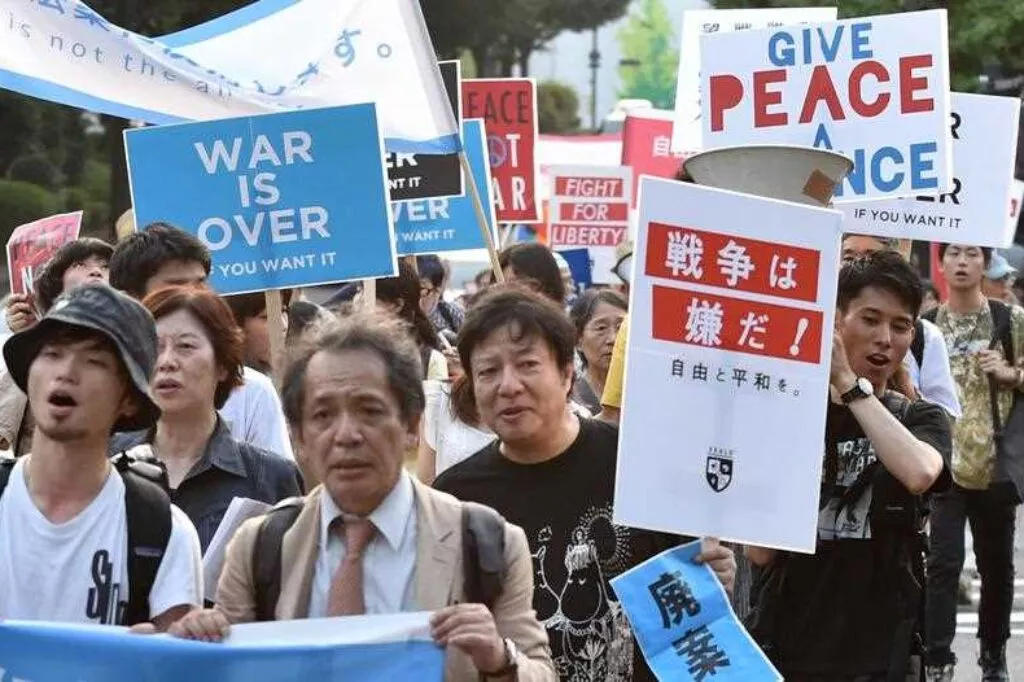
A Japanese roundtable discussion about the government’s militarization policies and their wider context.
A Japanese roundtable discussion about the government’s militarization policies and their wider context.
Published in SHISO-UNDO NEWS No. 182
Participants:
Akira Fujiware (School Worker / Moderator) Shozo Hirono (Activist Group Shiso-Undo) Hiroshi Inagaki (Shiso-Undo Editorial Department) Hideto Osaka (Local Government Non-Regular Worker) Kazuhiro Okie (International Politics Researcher) Kasane Yonemaru (Part-Time Office Cleaning Worker) Aiko Fujimoto (Public Sector Worker)
The Takaichi Sanae administration maintains high approval ratings
Fujiwara: Right now, across every sphere—politics, economics, military, culture, and ideology—the violent intentions of the capitalist class in Japan and globally are accelerating into action. With no end in sight to the Ukraine-Russia war or Israel’s genocide in Gaza, the U.S. is now plotting war against Venezuela. Already, around 100 people have been killed based on the unfounded accusation that their ship was a “drug transport vessel.” The Trump administration is conducting airstrikes.
Meanwhile, within Japan, the co-opting of desperate people into right-wing and xenophobic movements is steadily expanding. However, resistance to this is currently far too weak, both theoretically and practically. While support for far-right forces is notably rising among the younger generation, resistance movements themselves are facing an unavoidable aging crisis. Despite this, there is not even a serious attempt to examine the causes ideologically or historically.
Yet we absolutely must explore a path to turn this crisis around and find a way forward. Today, we wish to hold this roundtable discussion from this perspective, so we ask for your cooperation. So, where shall we begin? Perhaps, with the Takaichi administration? From there, we might look back a bit or conversely consider future prospects. Let’s hope the discussion expands beyond mere analysis to focus on concrete challenges and how we should proceed.
Inagaki: I’ve printed out some recent poll numbers showing how the Takaichi administration is viewed domestically in Japan. As expected, the administration’s approval rating remains high. While it has dropped slightly, the Mainichi Shimbun survey of November 22-23 shows 65% approval and 23% disapproval. Approval rates by age group also show higher support among younger generations. Support stands at 74% among those aged 18-29 and 76% among 2 those in their 30s. Regarding the controversial “existential crisis situation” remarks concerning a potential Taiwan contingency, 50% of respondents “did not think there was a problem,” while 25% “thought there was a problem.” On the issue of reducing the number of Diet seats, 63% are in favor and 14% are opposed.
Furthermore, the Mainichi reported that when Trump and Takaichi met in October and reaffirmed the policy of strengthening the Japan-U.S. alliance, 64% “approved” of this, while 15% “did not approve.” Also, in the JNN (TBS-affiliated) poll released yesterday, 75.8% “support” the Takaichi administration, while 20.7% do not. However, support has fallen 6.2 percentage points since last month’s survey, while disapproval has risen 6.4 points. Last month’s survey showed 82% support.
Regarding the earlier-mentioned remarks on a Taiwan contingency, 55% of respondents said there was “no problem” with Takaichi’s statement that “a Taiwan contingency could become a crisis threatening Japan’s existence,” while 23% said they “think it is a problem.” Judging from media coverage, public opinion appears to strongly support Ms. Takaichi’s statement. How should we interpret the high approval rate for the “existential crisis situation” remark? Shiso-Undo’s December 1 issue includes articles by Ōsaka-san and Mo Mian. We should discuss this while considering those perspectives as well.
Hirono: I fully agree with the arguments made by Ōsaka-san and Mo Mian. That said, upon hearing Takaichi’s remarks, I was reminded—perhaps absurdly—of the 1938 “KONOE Fumimaro’s Statement.” The Konoe Cabinet issued three separate China policies within the same year, each reflecting differing intentions as the situation evolved. The first statement said: “The Imperial Government will henceforth not regard the Nationalist (Chiang Kai-shek) Government as an adversary.” Subsequently, they attempted to sow division within Chinese society and establish a pro-Japanese puppet regime, aiming to overthrow the Kuomintang faction led by Chiang Kai-shek (who continued the anti-Japanese struggle; of course, the Chinese Communist Party also participated in the Anti-Japanese National United Front and fought). However, this failed, leading to the expansion of the Sino-Japanese War and ultimately the Pacific War. I felt that Takaichi’s recent remarks crossed a clear line, much like this incident—seeking confrontation and war rather than fostering peaceful relations.
Of course, the historical context, the backgrounds and personal qualities of Konoe and Takaichi differ significantly. Yet, they share distinct similarities: both are imperialists and anti-communists, harboring a sense of superiority toward Asia and openly displaying the arrogance of an oppressive nation. I believe these common traits are clearly discernible.
The various aspects of militarization and its driving factors
The differences between the domestic and international situations in 1938 and today are: China has surpassed the United States in GDP at purchasing power parity to become the world’s largest economy, possessing roughly six times Japan’s economic power and a population of 1.4 billion. It also overwhelmingly surpasses the United States in technological capability, and its military strength ranks third globally after the U.S. and Russia (Japan ranks eighth). Some might argue, “Therefore, it is simplistic and misguided to think the Takaichi administration will go to war immediately.”
There is no doubt the world is currently in a period of dramatic transition and transformation. … The rise of the ‘Global South’ in the international community and the accompanying shift in the balance of power… Many global economic forecasts indicate that by 2050, seven countries—China, India, Brazil, Russia, Indonesia, Mexico, and Turkey—will account for approximately 50% of the world economy, while the share held by the Group of Seven (G7) nations will decline to about 20%. The power balance underpinned by the dollar-based international financial order and economic strength will change.“ (Mainichi Shimbun, November 13, ”Reading the Turbulent World” by NAKAMITSU Izumi, UN Under-Secretary-General) This much is clear.
However, Japan’s monopolistic ruling class (along with the capitalist classes of the US and the West, of course), their political proxies like Trump and Takaichi, and the bureaucrats and business leaders who serve them are undoubtedly well aware of these reports from bourgeois research institutions.
That is precisely why I believe their sense of crisis is intense. They are actively seeking an escape route from the crisis of the capitalist system, building legal and operational frameworks to wage war relentlessly, nurturing the military-industrial complex, strengthening military power, and militarizing the entire economy and society.
The Stockholm International Peace Research Institute (SIPRI) in Sweden released a report on December 1 regarding the 2024 sales figures of global defense contractors. The defense-related sales of the top 100 companies have increased by 5.9% year-on-year, reaching a record high of $679 billion (approximately ¥106 trillion). The combined sales of Japanese companies in the top 100 rose 40% year-on-year to $13.3 billion (approximately ¥2 trillion). This growth was driven by increased domestic demand in Japan as it seeks to strengthen its defense capabilities. … Ranked first was the U.S.’s Lockheed Martin. Five Japanese companies made the top 100, with Mitsubishi Heavy Industries at 32nd place being the highest-ranked. The others were Kawasaki Heavy Industries (55th), Fujitsu (64th), Mitsubishi Electric (76th), and NEC (83rd). Sales for those companies have increased by 25% to 87% year-on-year. … U.S. companies accounted for 49% of total sales.” [London, Kyodo] The global war economy is rapidly advancing.
The record growth for Japan’s five companies is likely primarily due to the Japanese government’s allocation of 43 trillion yen for defense capability development over the five years from FY2023 to FY2027, following the revision of the three security and defense documents at the end of 2022.
The Kishida administration had decided on a policy to increase defense spending to 2% of GDP by FY2027. The Takaichi administration decided to “move it up by two years” and raise it to 2% within FY2025. In November, the cabinet approved a supplementary budget proposal including approximately 1.1 trillion yen for defense and related expenses. Including the initial budget, total defense and related spending for FY2025 will reach about 11 trillion yen. Assuming Japan’s GDP is 600 trillion yen, reaching the 3.5% level reportedly sought by the US would require about 21 trillion yen.
The Japanese government is strengthening military bases nationwide, including missile 4 bases in the Southwest Islands (including Okinawa Island) and Kyushu, with a Taiwan contingency in mind. Joint exercises between the Self-Defense Forces and the U.S. military are conducted year-round.
The “LDP-Japan Innovation Party Coalition Agreement” signed on October 20, 2025, includes 12 pillars and 47 policy items such as Maintaining male-line succession for the Emperor / Revising Article 9 of the Constitution and creating emergency provisions / Legalizing the use of common names instead of separate surnames /Establishing the “Crime of Damaging the National Emblem of Japan” /Developing long-range missiles and acquiring nuclear submarines, /Abolishing the “Five Categories” of the Three Principles on Defense Equipment Transfer and fostering the defense industry / Enacting an anti-espionage law /Restarting nuclear power plants /Strengthening measures against foreigners /Reducing the number of seats in the House of Representatives by 10%, and other ultra-reactionary policies.
During her meeting with Trump, Takaichi conveyed that “Japan and the U.S. have now become the world’s greatest alliance. Japan will also contribute to global peace and prosperity,” calling for “building a new golden age of the Japan-U.S. alliance together with President Trump.” Underlying this, however, likely lies a resentment bordering on hostility toward the cooperative relationship forming among China, DPRK, and Russia as a counterweight to this alliance.
Amidst these domestic and international circumstances, Takaichi, as Japan’s Prime Minister, was questioned during the House of Representatives Budget Committee on November 7 about specific examples of a “crisis situation threatening Japan’s existence” that would allow Japan to exercise its right to collective self-defense in the event of a Taiwan contingency, which could involve a U.S.-China clash. She responded: “Earlier, the term ‘contingency’ was mentioned. That could take various forms. For example, what means would be used to place Taiwan completely under the control of the Chinese government in Beijing? … If that involved the use of warships and the exercise of force, I believe this would undoubtedly constitute a crisis threatening Japan’s existence.” Takaichi deliberately made this public statement in the Japanese Diet during the year marking the 80th anniversary of the victory in the Chinese People’s War of Resistance Against Japanese Aggression and the World Anti-Fascist War. My earlier association with the Konoe Statement stemmed from a sense that Takagi’s remarks might mark a turning point in Japan’s course.
The preamble of the 1972 “Japan-China Joint Statement” states: “The Japanese side deeply regrets and reflects on the responsibility for the grave damage inflicted upon the Chinese people by Japan through war in the past.” Article 2 states: “The Government of Japan recognizes the Government of the People’s Republic of China as the sole legitimate government of China.” Article 3 states: “The Government of the People’s Republic of China reiterates that Taiwan is an inalienable part of the territory of the People’s Republic of China. The Government of Japan fully understands and respects this position of the People’s Republic of China and upholds its position based on Article 8 of the Potsdam Declaration.“ From China’s perspective, Takaichi’s remarks inevitably raise the question, “Why bring this up now?” Considering the historical context, it is only natural for China to interpret this as, “Is Japan attempting to repeat past actions?” or “This constitutes Japan, a defeated nation of World War II, openly breaking promises made to China and the international community.”
Takaichi is likely speaking with full knowledge of these historical facts and agreements. She deliberately uses phrases like “the Chinese government in Beijing,” openly revealing her own anti-communist stance that seeks to sow division in cross-strait relations. I suspect many of the citizens supporting Takaichi barely grasp the history and significance behind this…
Since childhood, I’ve wondered why our grandparents’ and parents’ generations couldn’t stop that reckless, foolish war. Now, a similar situation is unfolding in my own lifetime, and I can’t stop it. Public opinion overwhelmingly supports Takaichi. So the question arises: what should we do about this? But first, I believe we must clearly define how we perceive this situation itself and how we position Takaichi’s remarks.
Fujiwara: This connects to what was written on the front page of the December 1 issue of Shiso-Undo1. Regarding the situation we just discussed, Mr. Osaka, what are your thoughts?
Osaka: As Mr. Hirono mentioned, I have serious doubts about whether the people supporting Ms. Takaichi’s remarks truly understand their content. We are a generation that received peace education in school and acquired at least a basic knowledge of modern and contemporary history. Therefore, we should inherently understand to some extent “what the problem is.”
However, isn’t there also the problem that, due to the infiltration of right-wing trends over the past few decades, society has become increasingly reactionary? As a result of the enemy’s ideological offensive, the historical reality has become obscured.
Hirono: That inevitably brings to mind the era of the Sino-Japanese War and the Asia-Pacific War. Back then, the Emperor, the military, education, and newspaper/media reports all instilled the idea that “this war is a holy war” and “Japan is right.” The entire nation ended up waving the Hinomaru (the Rising Sun) flag to send off soldiers. The cry of “Punish the wicked China” echoed nationwide, even drawing children into it.
Historical perception as seen in Takaichi’s 1995 statements
Takagi: Looking at society as a whole today, we see a deliberate push to strengthen the war-making apparatus: Self-Defense Forces officers collectively visiting the Yasukuni Shrine; LDP’s Councillor NISHIDA Shoji and Shinseito’s Representative KAMIYA Sohei loudly spouting nonsense about the Battle of Okinawa and gaining some support for it; and distributing the ‘Children’s Edition Defense White Paper’ to elementary schools nationwide. Takaichi’s fondness for the Imperial Rescript on Education is well-known. The media, too, turns a blind eye to their own role in glorifying the Asia-Pacific War and covering up war crimes, consistently resorting to presenting both sides of an argument or simply parroting the government’s line. Labor unions, including the Japan Teachers’ Union, have seen their ability to mobilize dwindle dramatically. It seems this very situation, where people feel cornered, is the backdrop for the high approval ratings of the Takaichi administration.
Another point—I was discussing this earlier with Inagaki-san, on March 16, 1995, during a House of Representatives Foreign Affairs Committee session, Takaichi, then a member representing the New Frontier Party (Shinshin), confronted Foreign Minister KONO Yohei. She cited the DPRK’s representative at the UN Special Committee who had stated, stated, “If the ‘enemy state clause’ is deleted to absolve Japan of its crimes, it would justify aggression and crimes and trample upon the UN Charter.” Takagi responded, “Personally, I did not believe that the enemy state clause had become largely irrelevant to our country upon joining the UN. I considered it a deeply humiliating clause.” She also cited then-Ambassador to the U.S. KURIYAMA Takakazu’s press conference in Washington, where he stated, “Japan must not forget that postwar Japan exists only because it properly faced the history that led to World War II and reflected upon it. The younger generation must also know this.” Takaichi said “At the very least, I belong to a generation that cannot be called a party to those events. I have no such reflection, nor do I believe I should be asked to reflect.”
Seeing reports of such Takaichi’s remarks reminded me of how my senior from the Shiso-Undo group, Ms. NITANI Toshiko, who was a junior high school teacher at the time, had expressed outrage: “I was truly shocked. I never imagined such a person would enter the Diet.”
In other words, Takaichi has consistently maintained her own view of history. One even senses an underlying thought behind such statements: “Shall we do it again?”
Fujiwara: As the moderator, I’d like to add that while Takaichi stated in her 1995 remarks, “I’m from the postwar generation, so I don’t need to reflect,” Abe Shinzo said something similar in his 70th-anniversary statement: “We must not burden our children, grandchildren, and future generations—who had no involvement in that war—with the fate of continuing apologies.” “We don’t want to leave the younger generation with the burden of perpetual apologies.” That point aligns perfectly, and it resonated favorably with the younger generation. No, the “statement” was crafted precisely because it understood the prevailing social climate where such an approach would gain support. I believe the high support for Takaichi among the younger generations stems from the fact that such awareness about the war is spreading among them. That is, there are things that should be learned as part of postwar history: the course of the Sino-Japanese War, why the “enemy state clause” mentioned by Ōsaka-san was included, and the fact that a Japanese Prime Minister once explicitly promised that Taiwan is an inseparable territory of China.
However, even if they knew these things, it would be “knowledge only for school tests” – not knowledge grasped proactively out of necessity. In other words, it is perceived as having no connection to themselves or to modern society.
This is backed up by, for example, the TBS-affiliated public opinion survey mentioned earlier. TBS is often seen as relatively critical of the government and more fair than Fuji TV or TV Asahi, yet even there, Takaichi’s approval rating is high.
I often watch the TV program too, and there are commentators like Aoki Osamu who makes relatively reasonable statements. However, even when criticizing the “flag desecration law” or the “anti-espionage law,” they invariably conclude by asking, “But is it really okay to become a dark country like China or North Korea?” This way, no matter what they say, the message that Japan is fundamentally a democratic and peaceful country comes across as the overwhelmingly effective “concluding point” from the mouths of these ‘reasonable’ and “left-leaning” commentators.
In other words, the argument that “Regardless of past history, Japan is under attack now, right?” carries strong persuasive power.
For our generation, we heard war experiences directly from our parents or grandparents. But for those born in the 1990s or 2000s and later, it’s already ancient history. It’s been processed as an irrelevant “past.”
And overlaid on that is the image spreading even among left-leaning circles that “China is a dangerous country that ignores human rights, and we don’t know when it might attack us.”
This is why a hardline stance like Takaichi’s can even appear “innovative” in a sense.
The fact that 60.4% support the military spending increase policy while only 30.4% oppose it would have been unthinkable 20 or 30 years ago. The reasons for this shift likely lie in the context described above.
Osaka: Within the LDP, there used to be politicians with wartime experience, like former faction Kochi-kai chairman Koga Makoto and former Secretary-General Nonaka Hiromu. They held their own sense of reflection regarding China. But today’s LDP has almost no such figures. I believe China’s criticism of Takaichi’s recent remarks targets not just her personally, but the ultra-right stance symbolized by those words, and the broader Japanese public opinion and political landscape supporting it.
While browsing online, I found that People’s Daily Online published a fairly accurate international commentary under the authoritative byline “Zhong Sheng” on People’s Daily. Immediately after Takaichi’s remarks on November 7, there was a party leader debate on TV. Facing that debate, Takaichi stated the following regarding Taiwan: “Under the San Francisco Peace Treaty, Japan renounced all rights, and we are not in a position to determine Taiwan’s legal status.” However, this phrasing completely ignores the series of agreements Japan must adhere to, including the “upholding of Article 8 of the Potsdam Declaration” within the Japan-China Joint Statement of 1972, which dates back even to the Cairo Declaration.
Hirono: Regarding Takaichi’s remarks on the Taiwan issue, many countries, including France as a founding member of the UN, should support China’s position. The media should actively report this and, ideally, Japan should more clearly point out the error. Yet, neither the media nor political parties can speak so plainly. Consequently, they settle into a posture of feigned neutrality, treating it as if China is merely making unreasonable demands. Takaichi herself has stated things like, “I see it as a point for reflection that my response was perceived as going beyond the government’s conventional stance,” but she makes it sound as if those who perceived it that way are somehow at fault. She uses the word “reflection” while showing no actual reflection and refusing to retract her statement. In a book published in May, Sataka Makoto apparently wrote about Tamaki Yuichiro, Tachibana Takashi, Saito Motohiko, and Ishimaru Shinji, “What they have in common is a lack of reflection. Or rather, they refuse to accept it when asked to reflect.” Now, we should probably add Kamiya Sōhei of the Sanseito Party and the members of Japan Innovation Party (Nippon Ishin) to that list. But standing tall among them is Takaichi, the senior figure who declared “no reflection” boldly 30 years ago and continues to practice it today.
Fujiwara: What do you think, Fujimoto-san? Does this kind of thing come up as a topic at work?
Fujimoto: Not at all. Absolutely not. I think that’s a real problem. They are incredibly inward-looking. Only workplace topics come up there.
Osaka: Don’t young people even know Japan fought a war with China? They know we fought America, though.
Hirono: A teacher at school once said to me, “Kids today can’t connect the fact that Japan fought a war with America in the past with how friendly we are with them now.”
Fujiwara: Yeah, I think that’s true. The image of America as “good” is ingrained from childhood, not through historical understanding or political context, but through the context of commercial products. Disneyland and its Mickey Mouse are symbols of that, and I absolutely hate them.
Yonemaru-san, what do you think after hearing all this? Is China’s countermeasure “going too far”?
Yonemaru: The labor movement I’m involved in opposes the Takaichi administration and continues anti-militarization and anti-war actions. However, while we agree that “Takaichi’s remarks should be retracted,” at the same time, many voices are saying, “Isn’t China’s recent response—like halting economic relations and even suppressing people-to-people and cultural exchanges—going too far?” “Couldn’t such a response actually fuel the crisis?” For instance, when an anime singer’s concert gets canceled in middle of her performance, footage of it gets repeatedly aired on TV, right?
Even among those who don’t support Takaichi, I suspect quite a few people feel aversion toward China’s approach based solely on the “appearance” created by the media, rather than judging the “substance” of their claims. I feel this is a very problematic, dangerous situation.
Inagaki: While we criticize Takaichi’s remarks, the real issue is how seriously we perceive their “gravity” and criminal nature. From China’s perspective, this is such a grave matter that a resolute stance like severing diplomatic ties is only natural.
Yonemaru: Exactly. We haven’t adequately explained that gravity. That’s the core problem, I believe.
Hirono: It’s said that between 10 million or 20 million, perhaps even more, Chinese people were killed under the Japanese military’s “Three Alls Operation” of “kill all, burn all, loot all.” How they were killed—even specific examples—are scarcely known in Japan.
That’s probably why people today might say things like, “Surely we don’t need to go so far as canceling cultural performances.” But from the perspective of those who were killed, it’s not just about “not forgetting.” It also comes across as, “If you haven’t reflected, will you do it again?” That point isn’t understood in Japan. I suspect people like Takaichi know China will be angry and are trying to use that to mobilize domestic public opinion.
Fujiwara: Yes. Thinking along those lines, it’s increasingly likely that this wasn’t a “slip of her tongue” but rather a deliberately planned statement.
Considering opinion polls, they likely assessed how each age group perceives relations with China and views the Chinese government before bringing it up at that precise moment—that interpretation isn’t unreasonable.
Even regarding the Senkaku Islands issue, media rarely challenges the premise that “those islands are Japanese territory.” For instance, while the radar lock-on by Chinese fighter jets received significant coverage, the fundamental nature of that sea area itself—though considered international waters—has questionable aspects given historical context. Yet the narrative remains firmly fixed on the framework of “China unilaterally provoking Japan.”
Okie-san, what are your thoughts on what we’ve discussed so far?
The surprising reactions from the U.S. and Taiwan
Okie: What I found particularly interesting in Mo Mian’s paper was his point that while Takaichi intended to draw the U.S. into the issue, the U.S. – specifically Trump – didn’t necessarily act accordingly. Another point was that the people of Taiwan are cooler and calmer. You rarely see mass media reporting from these perspectives, right?
Honestly, I had no idea Trump’s words and actions were like this until I read Mo Mian’s report.
Fujiwara: Afterwards, the media did briefly run small articles saying “Trump didn’t criticize China’s stance.” But it wasn’t covered extensively.
Osaka: The content of the phone talks between Takaichi and Trump wasn’t properly reported either, right? It feels deliberately hidden. Takaichi herself isn’t saying anything. But in reality, Trump is offering advice. He said so in some interview, didn’t he?
Fujiwara: Yes, in the FOX News interview. I looked it up. When the host said, “China isn’t a friend, right? Those guys are hopeless,” Trump replied, “No, no, other guys are taking far more advantage of America.” According to Trump, another country is taking the most from America in trade relations.
Okie: Mo Mian commented in his paper that this “another country” clearly refers to Japan, right?
Fujiwara: So, the U.S. is still operating pragmatically. They genuinely don’t want a major confrontation with China. You can see where the U.S. judges the “high-risk adversaries” by comparing their approach to Venezuela, Palestine, and Iran. A clash with China is simply too dangerous for the U.S.
Okie: Plus, divisions within the U.S. are deepening, and opposition to Trump is growing rapidly. Zohran Mamdani (34), a radical leftist Democrat advocating democratic socialism, was elected as NYC Mayor, and with conflicts with Trump, things are unstable, right?
Hirono: Japan is often called “dependent on the US,” but separate from that, Japan’s ruling class also has its own vested interests. I think they’re desperate to collaborate and maintain the established privilege system of advanced capitalist nations.
Since they can’t function without aligning with the US, they’re pressured to “buy weapons” and “raise military spending to 3.5% of GDP.” At the Korea-US summit, the Republic of Korea announced plans to quickly raise defense spending to 3.5% of GDP and explicitly stated approval for building nuclear submarines. In ROK, the top four defense companies—Hanwha Group, Hyundai Rotem, LIG Nex1, and Korea Aerospace Industries (KAI)—were included in the world’s top 100 defense companies for the second consecutive year following 2023. It’s staggering, isn’t it? ROK’s military spending, the scale and frequency of ROK-US joint military exercises. This situation persists even after Yoon Suk-yeol’s departure.
Fujiwara: Observing the flow of public opinion, strongly emphasizing the Taiwan issue could significantly boost domestic support for military expansion. That might be the point of focus. Doing so would also make it easier to achieve the military budget increase—originally planned to reach 2% of GDP over five years—by accelerating it and completing it two years ahead of schedule. Regarding the nuclear issue, it even seems like they’re working backwards to “force recognition.” As for funding sources, getting bogged down in detailed debates would make implementation impossible. So the tactic is to build momentum all at once. They might be trying to create the narrative: “Takaichi spoke up for us,” “Even when the old-guard media criticized her, Takaichi stood up alone,” and then push it through on that wave of momentum.
Inagaki: Recent reports suggest discussions have begun to implement a “defense tax hike” starting January 2027, raising income taxes to fund increased defense spending. A Kyodo News poll also shows overwhelming support for this defense tax increase.
But of course, military expansion will make people’s lives even harder. You’d think people could imagine that, but the image of “threats from China and North Korea” is having a stronger effect.
Hirono: I feel like the public’s imagination is being manipulated to prevent them from thinking critically. There are so many people struggling—non-regular workers earning under 2 million yen a year, single mothers, people barely making ends meet with daily living costs skyrocketing. I go to the supermarket often, and it’s not just rice—vegetables and all fresh produce are ridiculously expensive.
If tax hikes pile on top of that, what happens? If you think about it a little, you’d realize “this is crazy,” but I wonder if they’ve even been robbed of the mental space to think. While smartphones are glued to their hands… Under the AI bubble, global giants like Nvidia, Apple, Google, Microsoft, and Meta—these massive American tech companies—dominate the top ranks.
Fujiwara: A while back, our union shared data clearly showing that while corporate internal reserves keep growing, workers’ wages—the labor share of income—keep falling.
Hirono: Fact-checking is essential, of course. But remember when Trump visited Japan and said, “I feel good because there are no ‘Trump go home’ protests in Japan.”
A huge difference in the scale of mass movements
Inagaki: The ‘Akahata’ newspaper features maps showing anti-war actions across the country, listing participant numbers. Figures like 200 or 300 people. They publish these numbers, which are so small you might think it’s better not to report them at all, alongside statements like “actions like this are unfolding nationwide.” Of course, given the current situation, I understand the immense effort organizers put into gathering even 100 people. But even so, compared to movements abroad, it’s a different order of magnitude. What’s truly needed are actions on the scale of 30,000 or 300,000 people, but the reality is nowhere near that. It’s off by two or three digit orders of magnitude.
Fujiwara: Now, in this global situation where wars won’t stop, what are mass movements like in other countries? How is the situation in Japan perceived by overseas activist groups? What do you think?
Inagaki: While mass movements in Europe and America have generally declined significantly over the past 20-30 years, opposition to the genocide in Gaza is being fought globally with actions ranging from tens of thousands to hundreds of thousands of participants.
Okie: Exactly. Across Europe too, solidarity struggles with the Palestinian people are taking place through rallies, demonstrations, and general strikes involving hundreds of thousands. For example, after the Gaza ceasefire was announced, the “National March for Palestine” took place in London, UK, with over 500,000 participants declaring “The struggle for Palestine’s liberation continues” and demanding the UK government stop supplying weapons to Israel and halt the starvation in Gaza. In Amsterdam, the Netherlands, the “Red Line” demonstration, where participants wore red clothing to protest that the mass killings in Gaza had crossed the threshold, drew 250,000 people—the largest turnout in the past 20 years. In Spain, a 24-hour general strike in solidarity with Palestine was held, with over 1,000 trade union branches participating and more than 70,000 people marching in Madrid.
The struggle to end the massacre is being waged not only in Europe but worldwide. In Havana, Cuba, a rally of 100,000 people protesting the Gaza massacre was held in the square in front of the U.S. Embassy, following a call by President Díaz-Canel. Italy also saw a general strike involving 500,000 people. Greece is fighting a general strike, and various movements are emerging in the U.S. too. It’s completely different from Japan.
Inagaki: And how we interpret that “difference” is another theme we should discuss going forward, isn’t it?
Fujimoto: In the message sent to our “October Socialist Revolution Centennial Commemoration Rally” by the World Federation of Trade Unions, it stated: “We are watching the situation in Japan with grave concern. In Japan, there is large-scale military expansion, deepening subordination to American imperialism, and the dangerous rise of reactionary forces seeking to revive militarism and fascist ideology. These trends threaten not only the peace and rights of the Japanese people, but also the stability of the entire Asia-Pacific region.” In other words, the dangerous situation in Japan is being closely watched globally.
Fujiwara: China has been conveying its views on Japan’s Takaichi remarks to various countries like Germany and the US (Trump), seeking their opinions. While no one openly criticizes Japan, they are extremely cautious about responding with one-sided condemnation of China.
Yet Japanese media only pushes the narrative that “China is scheming by touring countries to build allies.” The very framing is completely different from other nations’.
Japan’s mass movements, including the labor movement, are overwhelmingly weak compared to the numbers of participants in movements around the world that have emerged recently. Behind this lies the historical reappraisal we’ve discussed, the failure to clearly define our position as the working class, and the weakness of our international perspective.
Having confirmed these points, let’s move on to the next discussion: “So what should we do to change this situation?”