


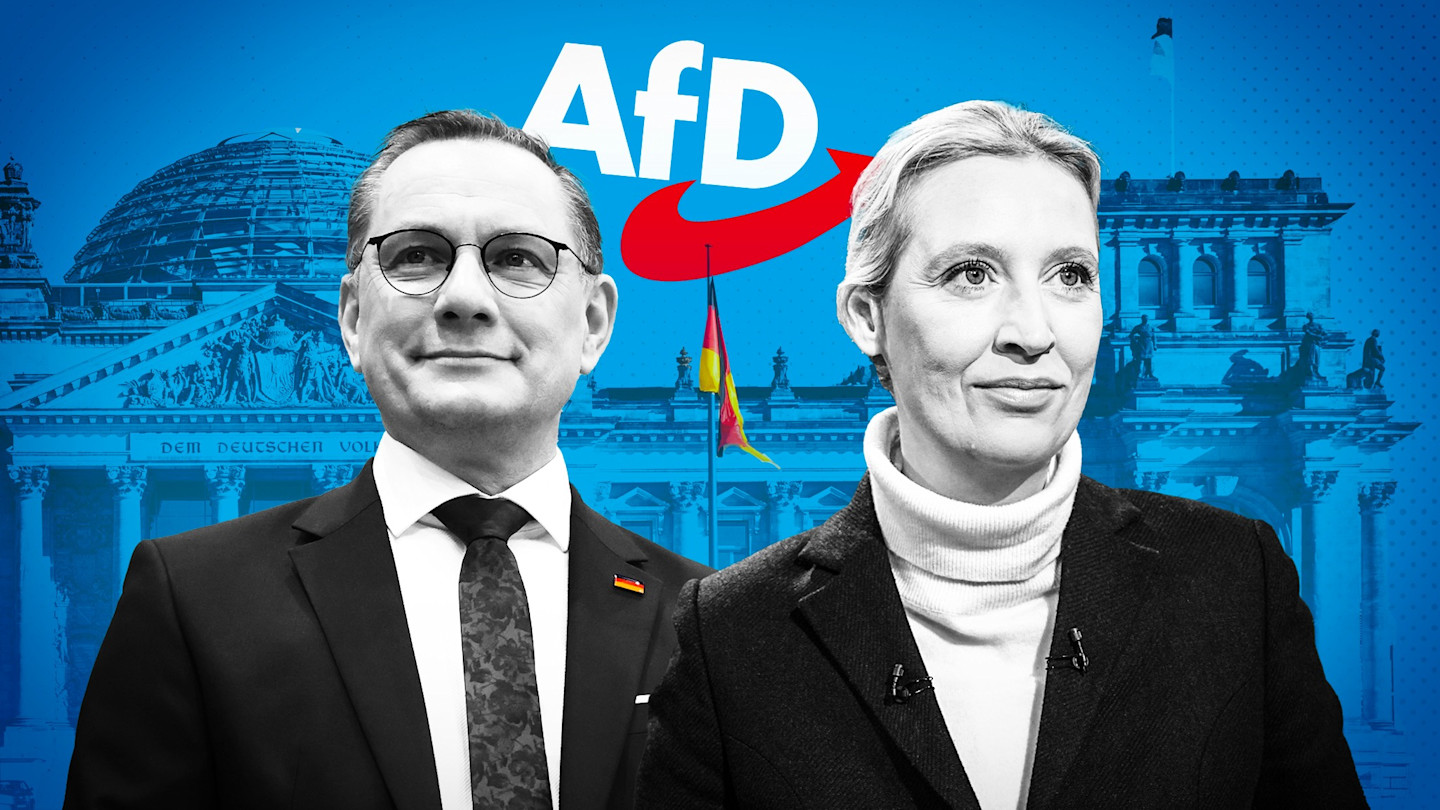
The discussion has split the party mainly into two camps.
The discussion has split the party mainly into two camps.
It is no secret that the Trump administration supports nationalist right-wing parties across Europe. Trump, Musk, and numerous figures from the US administration have openly expressed their support in various meetings and statements, and continue to do so.
Now, one of those parties, the AfD, is going through an internal debate over the relationship with Washington. Closely watched in German political circles, the discussion has split the party mainly into two camps. One side prioritizes avoiding a rupture with Trump and favors glossing over potential points of friction, while the other doesn’t want to give up “Germany first” and “sovereign and strong Europe” policies even if that means confronting Trump.
“Patriotic European parties”
The Trump administration has been offering explicit support to nationalist right-wing parties in Europe. Elon Musk’s words that “Only AfD can save Germany,” remains fresh in public memory. The support has become so overt that there raised voices across Europe saying “stay out of our internal affairs,” even many people took to streets protesting Musk.
In the National Security Strategy 2025 of the US, these parties were described as “patriotic European parties” and framed as follows:
“American diplomacy should continue to stand up for genuine democracy, freedom of expression, and unapologetic celebrations of European nations’ individual character and history. America encourages its political allies in Europe to promote this revival of spirit, and the growing influence of patriotic European parties indeed gives cause for great optimism.”
Common points
In fact, there is considerable alignment between Trump’s “MAGA” and “patriotic European parties”. Shared positions include ending the war in Ukraine and restarting relations with Russia, opposing “woke” culture and “globalist elites”; and opposing “irregular/illegal migration”, etc.
For the AfD, the divergence doesn’t lie in these common points. Indeed, the party has largely kept in step with Trump on these matters. The real fault line emerges where US aggression ranging from annexation demands and rhetoric dismissive of Europe become visible.
The AfD, one of the leading “patriotic European parties” seems to be navigating between its alignment with MAGA and the US’s aggression and “annexationist” policies. This hasn’t remained confined within the party, but has become a prominent topic in German politics.
Currently, the AfD’s position is shaped mostly around three key issues: the US’ attack on Venezuela, its claim on Greenland, and tariffs imposed on Europe. As said before, one side in the party prioritizes avoiding a rupture with Trump and favors glossing over potential points of friction, while the other doesn’t want to give up “Germany first” and “sovereign and strong Europe” policies even if that means confronting Trump.
Two AfDs?
A January 14 article in Stern magazine by Martin Debes examines the situation under the frame of “two AfDs”. The article notes that Trump’s interventions have “complicated the internal situation” and confirmed “an older view that there are at least two parties bearing the AfD name.”
According to the article: One of the AfDs is mostly “neoliberal-leaning AfD”. This AfD “follows the MAGA movement almost uncritically”, is “in solidarity with Israel in the Gaza conflict”. Figures like von Storch are here.
The other AfD is “openly nationalist” (völkisch) AfD which relies on Moscow as a geopolitical partner.
The AfD refrained from taking a definitive stance on the US’ tariffs on Europe and US’ attack on Venezuela.
As for the tariffs, Weidel struck a cautious tone, warning about the economic consequences if US tariff policies became even harsher and describing them as a “serious threat to the German economy.” She called for reducing tensions and holding negotiations. So Weidel’s critique didn’t target Trump, instead focused on the economic risks for Germany. Similarly, AfD foreign policy spokesperson Markus Frohnmaier stressed that foreign policy should be “based on German interests” and advocated a more mediating approach with Washington.
Weidel and Frohnmaier: “Friendly to transatlantic and Israel”
The difference in tone between Weidel and Chrupalla reflects broader divisions at the top of the party. According to the article in Stern, Weidel and Frohnmaier represent rather a “transatlantic and Israel‑friendly line” and “offensive defense policies including mandatory military service”. In contrast, Chrupalla “advocates the opposite, at least indirectly criticizing the US for months” and visited China “demonstratively”.
The article writes that this divide resurfaces with every major political development and with each new US intervention deepens the rift.
One example came in June 2025, when the US bombed Iran’s nuclear facilities. While Chrupalla wrote on social media that “The fuse has been lit in the powder keg that is the Middle East. Negotiations on Iran’s civilian use of nuclear energy have failed. War in the region is not in the interests of Germany or Europe. I condemn the attacks and call on all parties involved for restraint!” In contrast, Frohnmaier said “Of course, Israel has every right to ensure that the existence of the state is not threatened”.
Another instance of this internal divide became evident in December 2025, when Frohnmaier visited the US with a delegation of around 20 parliamentarians. In New York, he criticized Germany while praising Trump at a Republican Party event. Upon returning to Germany, Frohnmaier submitted a proposal to parliament calling for a “new transatlantic partnership.”
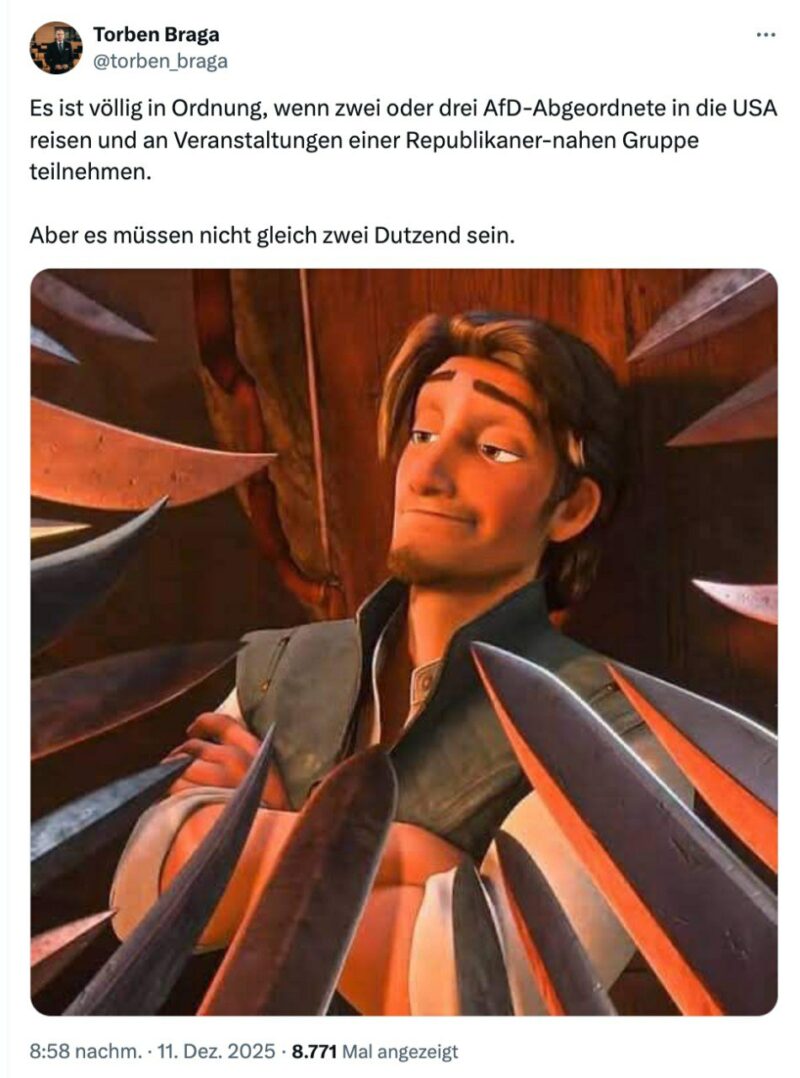
Meanwhile, AfD Thuringia MP Torben Braga wrote on X that “It is entirely acceptable for two or three AfD MPs to travel to the United States and attend events organized by a group close to the Republican Party. But it does not have to be two dozen of them.”
Björn Höcke and Benedikt Kaiser
Compared to the Weidel side, Chrupalla speaks out much more loudly against the US. Some party members adopt an even more openly critical stance toward Washington. The article in Stern cites Björn Höcke who led the AfD to its first state-level election victory in Thuringia.
Höcke is known with sharp accusations of the US like “It was and is US strategy, as a foreign power (raumfremde Macht) on our continent, to drive wedges between peoples and between nations that could actually work very well together”. He also advocated the US, as a non-European power, “should withdraw from Europe”, since “the natural partner for our way of working and living would be Russia, a country with seemingly inexhaustible raw materials”. Also, he described the CDU as a “transatlantic vassal party”.
The article says that “Höcke’s protégé”, Benedikt Kaiser, enjoying the advantage of not being an official party member, “can speak more freely and has been campaigning publicly against uncritical rapprochement with the US and AfD foreign policy experts supporting Netanyahu’s plans to displace Palestinians”.
“Blind allegiance or national sovereignty”
Compact magazine devoted its February issue to the US–AfD relationship with the title “Dangerous Love Affair”.
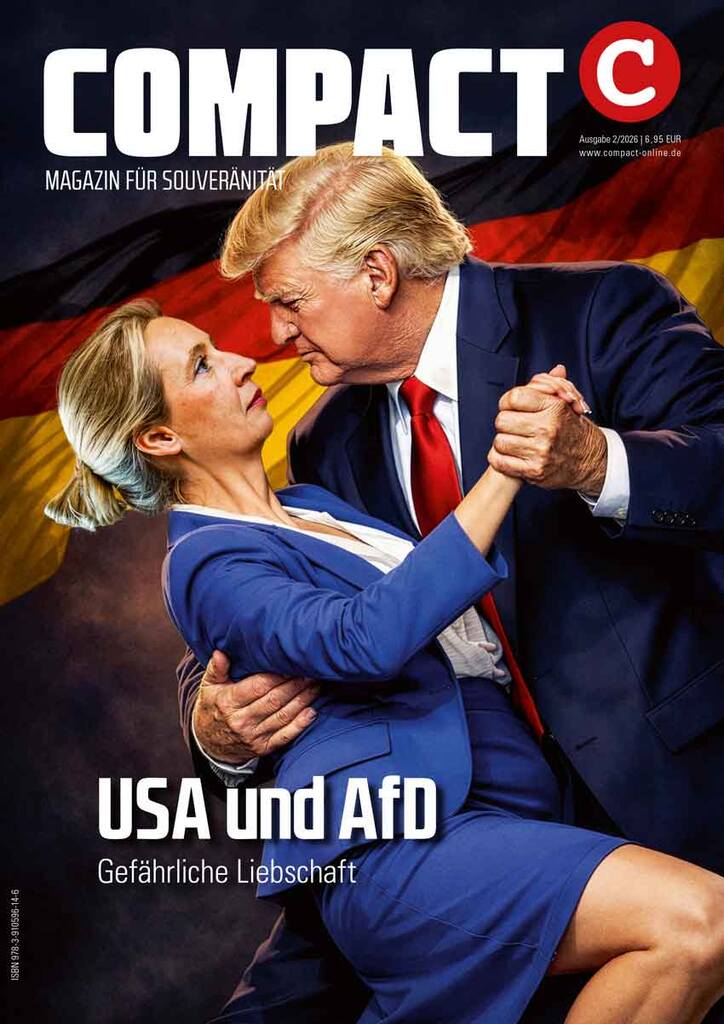
The magazine introduces the issue as follows:
“In 2025, the U.S. and AfD were considered an ideal political pair. However, by early 2026, relations abruptly deteriorated. Military escalations and power politics threats from Washington forced the AfD to confront a critical decision: blind allegiance or national sovereignty? The issue became particularly contentious when Alice Weidel faced open attacks from US Republicans for criticizing Trump. While a part of the party continues to maintain close ties with Donald Trump, others make warnings regarding interventionist policies and violations of international law.”
Caught in dilemma
On 19 January, in an article by Dietmar Neuerer in the Handelsblatt, political scientist Marcel Lewandowsky describes the AfD’s “internal conflict” as the party’s “obligation to simultaneously consider its proximity to Trump and the scepticism towards the US (USA-Skepsis) within the party, particularly in the eastern German states, and the low approval rating of the US president among German voters.”
Political scientist Oliver Lembcke also believes the AfD finds itself caught in a dilemma. According to Lembcke, the party has so far been able to present itself as “representing patriotic interests” and “a part of an internationally aligned anti‑liberal movement with Trump”. But in the new situation shaped by the US’ attack on Venezuela, Washington’s claim on Greenland, and tariffs imposed on Europe, the “AfD is being forced to take a clearer position which has exposed and deepened internal fault lines”.
Major rift over Greenland
Probably, where the party’s differing positions come into sharpest conflict is Greenland.
A segment of the party argues that it should stay out of the Greenland dispute entirely.
Markus Frohnmaier said Greenland is not an issue concerning Germany, but an issue between Denmark and the US. MP Maximilian Krah also declared flatly that “Greenland does not concern us.”
In contrast, Tino Chrupalla said that “this imperial policy must be viewed critically” and “such Wild West methods should, of course, be rejected.”
The head of the youth wing joins the debate
Another notable voice in the debate has come from Jean‑Pascal Hohm, head of the party’s youth wing, Generation Deutschland. On January 18, Hohm took to X with a post titled “We must not bow to blackmail!” and wrote:
“Greenland is part of a sovereign state within the European Union. As Germans and Europeans, it is our duty to support the Danes and Greenlanders. We must not bow to blackmail through tariffs or military threats.
If we allow the United States to annex Greenland, it would mark the end of the idea of a free, strong, and sovereign Europe in a reshaping world.
Those who think we should hand Greenland over to the Americans out of fear of a trade war, or because they sympathize with the Trump administration’s other decisions, are not German or European patriots. They see our homeland only as an appendage or playball of great powers.”
Jean-Pascal Hohm argued that Europe should not diminish itself: “The peoples of Europe have left their mark on world history. Despite all the political and economic missteps, societal disruptions, and other challenges of recent years, Europe remains a major economic power and an important global actor. What we need now are government leaders and politicians with courage, confidence and a strong stance.”
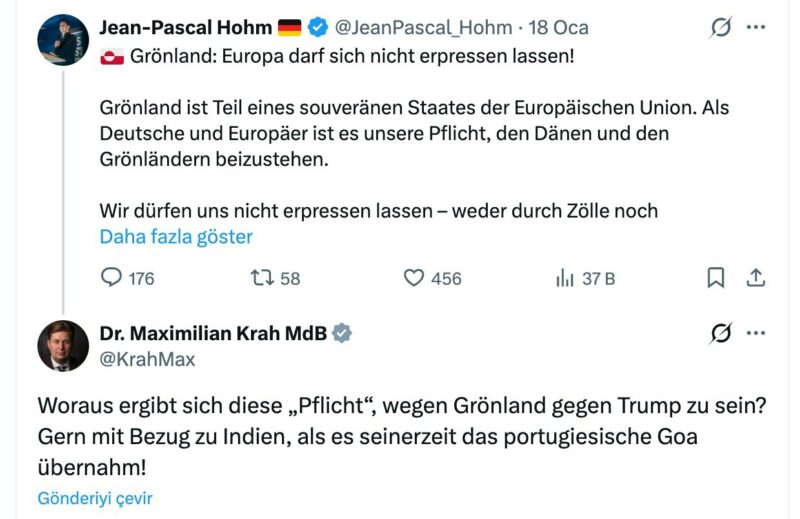
MP Maximilian Krah responded to Hohm’s post. The split within the party can be seen in Krah’s critics and Hohm’s response.
Krah wrote: “Where does our ‘obligation’ to oppose Trump over Greenland come from? Please answer in connection with the example of India taking Goa from Portugal!”
And Hohm replied again:
“The situation itself does not create an obligation to oppose Trump. However, it is in our interest to protect and defend Greenland as part of Europe.
Trump understood Greenland’s strategic importance. We must understand it too, and instead of abandoning Greenland, keep it within the sphere of influence of a European country.
I want Europeans to be taken seriously again by their partners and allies. Sometimes, this means standing firm.”
“Trump shield” against ban proceedings
Krah then added another comment:
“Geographically, Greenland belongs to America. Large-space ordering (Großraumordnung)? Our interest is to avoid conflict with the US. What has Greenland given us so far? As the AfD, we should avoid a fight with Trump as much as possible. After all, he protects us from ban proceedings.”
Former AfD foreign policy spokesperson and current MP Matthias Moosdorf also joined the debate, criticizing Hohm:
“Here we go again. Someone is declaring sovereignty with their mouth. A continent that has lost 10% of its share of global GDP in recent years can only impress its own lunatics by puffing itself up. All others simply aren’t listening.
Moosdorf further targeted Denmark, writing:
“It is truly paradoxical: a country that brought about Greenland’s current status through war, expansion and colonial rule is outraged because another politician dares to question that status. Donald Trump did not say, ‘We are invading.’ He said that Greenland’s status could be discussed.”