


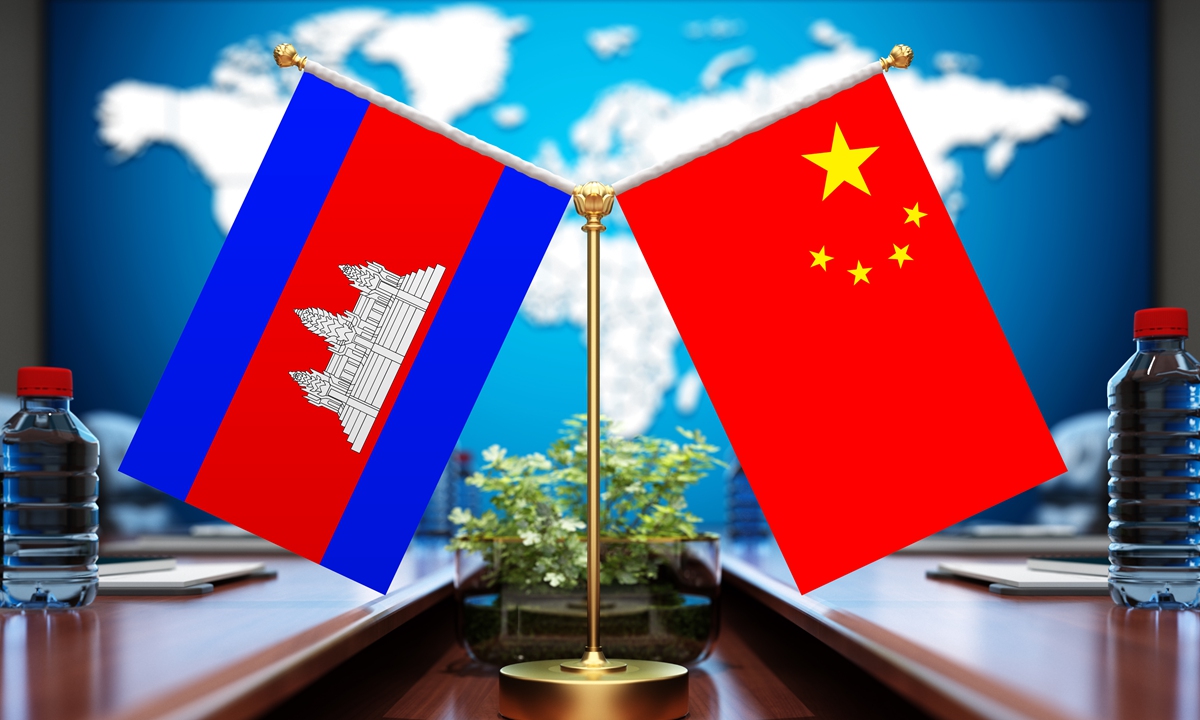
The relation is one of strategy-driven trust, politics-driven comfort, and development-driven pragmatism.
The relation is one of strategy-driven trust, politics-driven comfort, and development-driven pragmatism.
By Mehmet Enes Beşer
As President Xi Jinping’s Southeast Asian tour in last year makes headlines, it is the symbolism rather than the content of his meeting that contradicts the Chinese leadership’s priorities in the region. Among the highlights is China’s enhanced partnership with Cambodia. China’s ideology diplomacy, or alternatively described as idealism or pragmatism, is rich soil in Cambodia where century-old loyalty, political friendship, and complementarity in development are converging to achieve a fertile chapter for China in regional history.
China’s “shared future” rhetoric is no rhetorical nicety of sugar icing. It is a regional strategy in which economic interdependence, political trust, and ideological convergence are the pillars of long-lasting alliances—i.e., with the small states excluded from the traditional Western development or diplomatic paradigms. For Cambodia, it offers strategic refuge and material gain. In return, it offers Beijing a credible ally in ASEAN and a testing ground for demonstrating the strengths of its governance model.
Cambodia’s Prime Minister Hun Manet took on his father’s intimate link with China and appears eager to intensify it. Infrastructure development, the linchpin of China’s Belt and Road Initiative, has been at the forefront of the relationship. The construction of roads, bridges, dams, and the deepening of the Sihanoukville port have reshaped Cambodia’s geography—and with it, Chinese-Cambodian attitudes towards Chinese development involvement. In contrast to Western aid, which is freighted with conditionality on governance or human rights, China’s strategy prioritizes speed, scale, and sovereignty.
But the bonds reach well beyond the building sites. One country that has become Cambodia’s largest foreign investor and trading partner is China, and the two are building digital infrastructure, tourist links, and cultural connections. Security links are also being built, including joint military exercises and intelligence-sharing, which worry regional onlookers but are as yet not part of Beijing’s script on strategic beachheads.
The critics of the China-Cambodia relationship argue that it is pro-authoritarian and bound to result in debt dependence. There is some substance to these grievances. But for Phnom Penh, however, Beijing’s affection is stability in a volatile world. While Western engagement has turned more critical and conditional, Beijing has been a consistent friend—indeed, a consistent champion of Cambodia through critical diplomatic moments, like defying global condemnation of its political crackdown in its own territory.
To Beijing, Cambodia is dual-purpose of two. For sure, it is proof of what tightly correlated bilateral support can do for the “shared future” mirage. Or perhaps, it is a geopolitical boon—a voice within ASEAN that by its nature inclines to sides-taking and taking sides on matters close to China like the South China Sea or security norms of regional security. This form of alignment provokes ASEAN consensus but increasingly enables Beijing’s desire for a disunited, non-aligned Southeast Asia that resists U.S.-led containment.
On the other hand, the future of the alliance will be determined by how it develops. The challenge for Cambodia is how to add up the Chinese investment in a way that builds capacity in the long run and isn’t simply relying on foreign investment in the short run. For China, the challenge is whether it can translate its rapidly expanding power into a genuinely inclusive regional order in which soft power and regionalism are complements to its hard infrastructure and security ties.
As President Xi’s tour continues to unfold, the optics are carefully curated: images of warm bilateral meetings, signed memoranda, and shared cultural symbols. But the deeper message is clear. China is not only building roads—it is building narratives, alliances, and a regional future in which it occupies the central role.
Conclusion
The China–Cambodia relationship, nurtured over several decades and supercharged by Xi Jinping, is representative of Beijing’s vision to recreate regional order in its image. It is one of strategy-driven trust, politics-driven comfort, and development-driven pragmatism. Whether it can be replicated in other Southeast Asian countries—or is a one-off—will hinge on the reaction of both sides to the evolving aspirations of their people as well as the shocks of an increasingly multipolar world.
At a time of shifting blocs and unsteady global leadership, Cambodia offers China a stage upon which to cast vision, influence, and stability. And for the Phnom Penh government, the Beijing romance is not cynical—it is, at least provisionally, a wagers-on-future game. Whether such alleged shared future is truly multilateral or single-handedly prescribed by Beijing remains to be decided by future events. But meanwhile, Chinese-Cambodian friendship is writing one of the most dramatic—and geopolitically loaded—episodes in Southeast Asian history-making.