

Interview to Turkish TC channel Ulusal Kanal.
Interview to Turkish TC channel Ulusal Kanal.
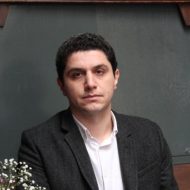
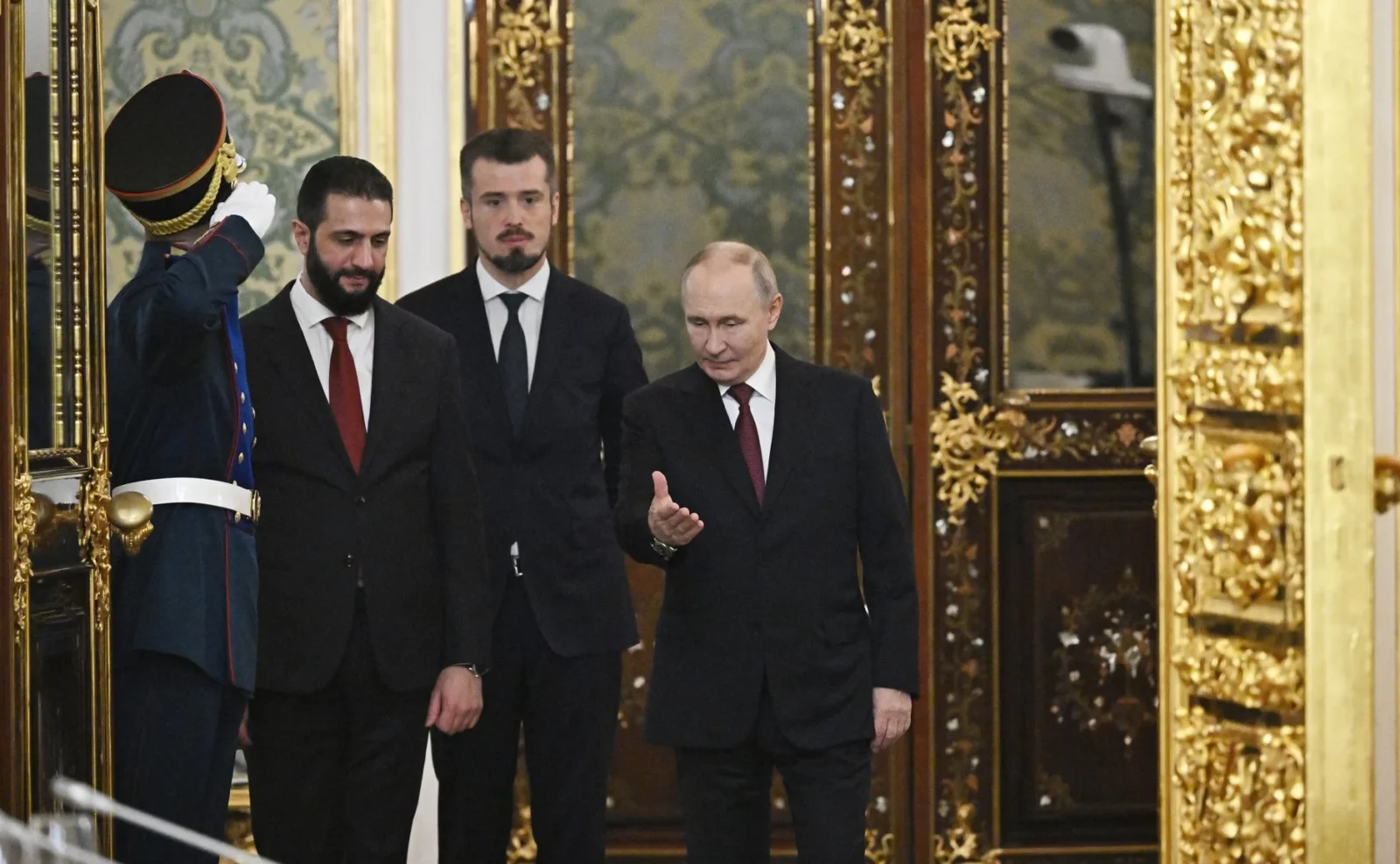
UWI writer and political scientist Onur Sinan Güzaltan discussed the meeting between Russian President Vladimir Putin and his Syrian counterpart Ahmed al-Sharaa in Moscow on January 28, as well as the US-Russia-Ukraine talks, on Ulusal Kanal Television. The interview, conducted in Turkish, has been translated into English by UWI.
What does al-Sharaa’s visit to Russia mean at a time when the ceasefire between the Syrian Democratic Forces and the Damascus government is holding? Is Russia signaling, “I’m still in the region”?
Russia has been present in Syria for a long time, since the Soviet Union era, with only a brief interruption after the collapse of the Soviets. With the internal turmoil that began in 2011, Russia increased its influence in Syria once again and secured significant gains both militarily and commercially. As a generally pragmatic, realist country that acts according to geopolitical realities, Russia’s main objective after Assad’s fall is to preserve its presence in Syria, not as strongly as before though. Syria is particularly important for Russia as a gateway to the Mediterranean.
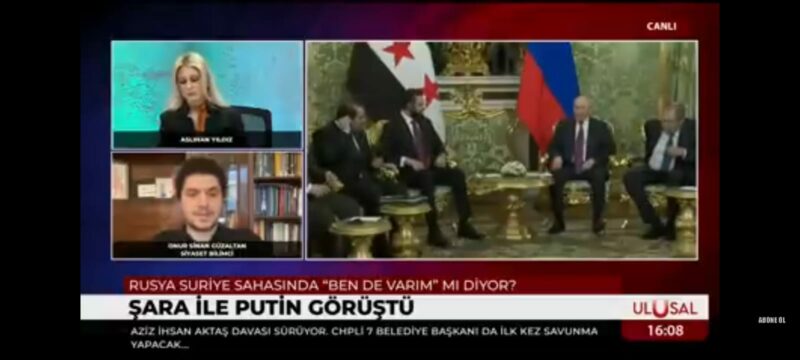
Al-Sharaa and Putin have now held their second meeting in the past four months, which signals that Russia wants to remain in Syria and maintain its military presence. I don’t think Russia is acting or will act ideologically; rather, it appears ready to adapt to the new circumstances after Assad’s fall.
In a statement on the matter, Putin said: “Since our previous meeting, much has been done to rebuild relations between our states. The level of economic cooperation has increased. There has been a 4 percent rise in bilateral trade. This may fall short of our expectations, but it is still a noteworthy development. This trend must be sustained. A great deal is being done to improve our relations across all areas.” He also noted that Russia could take part in Syria’s reconstruction. Are these signs that relations between the two countries will deepen?
In a recent statement, Foreign Minister Hakan Fidan commented on Assad’s overthrow and al-Sharaa’s rise to power, saying that the change was the result of an international consortium. It means there was an international consensus on a soft transition. When you look at Russia’s current ties with Damascus, it is fair to say that Moscow, whether openly or quietly, also endorsed this soft transition. I think the statements you mentioned demonstrate this.
Al-Sharaa has said that the two countries have conducted 13 delegation visits since his government took office, adding, “There are many issues we can consult on and work together.” He also stated that Russia plays an important role in the process of improving conditions in Syria and the region. We see the Syrian army gaining the upper hand in the face of the Syrian Democratic Forces (SDF) and taking steps toward territorial integration. Has Russia had an impact on this?
Frankly, I have doubts about how much this process a process of territorial integration is. Yes, the Syrian army has made advances against the SDF. But at the same time, Israel’s presence in the south of the country continues.
Moreover, on January 6, 2026, representatives of the al-Sharaa and Netanyahu governments met in Paris “under US auspices”. Syrian Foreign Minister Asaad al-Shaibani, Israel’s Ambassador to Washington Yechiel Leiter, US Special Envoy for Syria Tom Barrack, and Trump advisers Steve Witkoff and Jared Kushner were in the meeting. The US State Department released a joint statement. According to this statement, the parties agreed to “establish a joint fusion mechanism—a dedicated communication cell—to facilitate immediate and ongoing coordination on their intelligence sharing, military de-escalation, diplomatic engagement, and commercial opportunities under the supervision of the United States.”
More broadly, there is a possibility that the US-Israel could strike Iran. The US has also threatened Iraq. There are reports that ISIS detainees in Syria are being transferred to Iraq. There are also reports and official statements pointing to rising tensions along the Iraq–Syria border.
So yes, Damascus had a gain against the SDF, but how lasting will it be? That remains open to debate. After all, al-Sharaa is not someone from within the statehood tradition. His background and past affiliations are well known. The entire region, and indeed the world, is going through a fragile and fluid period. Al-Sharaa may be at the head of the Syrian government for now, but that does not guarantee he will remain there.
In a recent statement, al-Sharaa declared that Syria would reclaim all of its territory. This includes areas currently under Israeli occupation. The US will not likely agree on this policy with Damascus. Could al-Sharaa’s Russia visit be carrying significance in this respect? Might this issue have been raised during the talks?
First, I don’t believe the al-Sharaa government has much room for independent maneuvering from the US. As the earlier remarks I mentioned suggest, al-Sharaa came to power with an “international consensus”.
Second, immediately after Assad’s fall, Israel expanded its occupation and targeted Syria’s entire military infrastructure. Yet we heard no serious objections to these actions of Israel.
Third, I already mentioned the joint statement issued after the meeting on January 6.
Given all this, I find it unlikely that the al-Sharaa government has either the will or the capacity to draw closer to Russia to counterbalance the US.
“A lasting peace in Ukraine is not possible”
I’d like to move on to the next topic. The next round of talks between Russia, Ukraine, and the US is going to be in Abu Dhabi on February 4-5. However, as Marco Rubio announces, Witkoff and Kushner will not be attending the talks. Rubio also stated that a general consensus has been reached on providing security guarantees to Ukraine. What are your thoughts?
With Trump returning to the presidency for a second time, a period of normalization has begun in US–Russia relations. The Ukraine issue is a key component of this “normalization”. There have already been numerous meetings, Trump and Putin’s talks in Alaska, the negotiations in Istanbul, and other bilateral meetings. Abu Dhabi is the next one in this series.
Two dimensions are shaping the trajectory of these negotiations. First, the issues between the US and Russia extend far beyond Ukraine. Critical questions elsewhere, such as whether the US will strike Iran, will heavily influence both the course and the outcome of these talks. Washington’s approach toward China is another major factor. Other factors could be added. What I mean to say is the rivalry between the parties is not confined to a single front, the war in Ukraine, but it stretches across multiple arenas, including Palestine, Iran, and US policy toward China. For that reason, a resolution to the Ukrainian issue is unlikely to emerge solely from the internal dynamics of the war in Ukraine and the talks on Ukraine.
Second, there is the European factor. Some in Europe favor the continuation of the war (I should note there are voices in the US that do as well). You mentioned Rubio’s words that a consensus has been reached on certain issues. But what will Macron, von der Leyen, or Merz say to that? The uncertainty and gaps on these questions persist.
If we zoom in on the battlefield itself, Russia controls territories in Ukraine that it has formally designated as Russian land in its constitution. Ukraine says it won’t accept this. Yet after enshrining this claim constitutionally, Russia is unlikely to step back. One possibility is that the conflict could be frozen, with Ukraine recognizing the situation de facto without formally acknowledging, leaving a more definitive settlement for the future.
Then there is the question of security guarantees. Who will provide them? European armies? NATO? Which countries would be involved, and in what numbers? Would the force be largely symbolic, or would it have real deterrent power? After all, one of the main causes of the war was Russia’s opposition to a NATO presence in Ukraine. These questions remain unresolved.
In the medium term, even if Russia, the US, and Ukraine, and if we include Europe, all four parties, manage to reach an agreement, I suspect it would eventually lose its meaning at some point. Of course, the nature and details of any deal will matter. Still, the current global climate suggests that a lasting settlement, whether in Ukraine or elsewhere, is highly unlikely.
I believe a definitive outcome will only emerge if one side is decisively overpowered, if either Kyiv and the forces backing it, or Russia and its allies, manage to impose their strength on the other.
You mentioned that there are factions within the US that want the war in Ukraine to continue. Should Rubio’s announcement that Witkoff and Kushner will not attend the Abu Dhabi meeting be interpreted in that context?
In negotiations of this kind, the parties’ growing familiarity with one another is both an advantage and a disadvantage. It is an advantage because it allows each side to better understand what the other wants and what its expectations are. This increases the chances of reaching an agreement. But it is also a disadvantage, as the parties gradually learn each other’s capabilities and limits, effectively revealing the cards in their hands. By leaving Witkoff and Kushner out of the next talks, the US may be trying to offset that kind of disadvantage.