


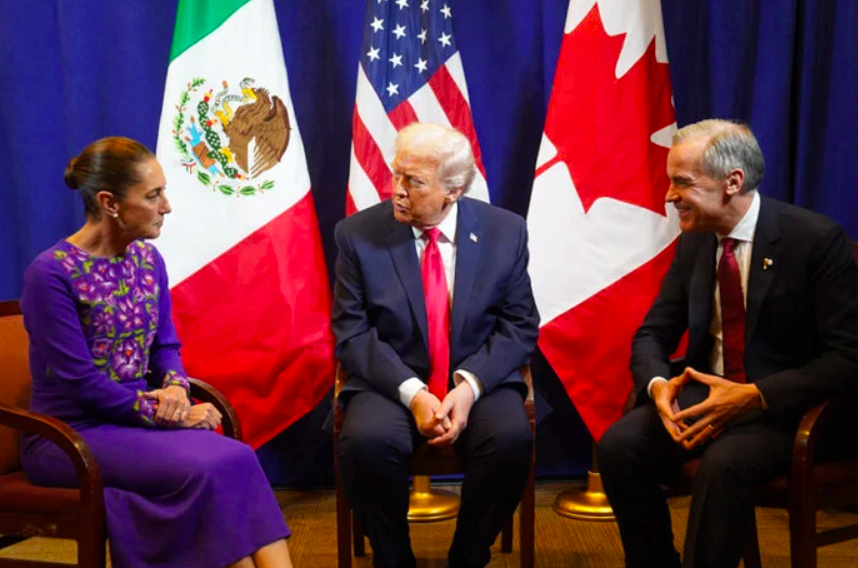
The first formal review of the agreement is due on July 1, 2026.
The first formal review of the agreement is due on July 1, 2026.
By Daniel Rosas, from Mexico City / Mexico
Despite Donald Trump’s constant attacks and threats to cancel it, there is optimism that the United States-Mexico-Canada Agreement (USMCA) will remain in place. This is due to the advantages it has brought to the three countries, which have become major trading partners.
The first formal review of the trade agreement, signed by the three North American countries and which came into effect in 2020, is scheduled for July 1, 2026. However, there have been moments of tension.
Following Canadian Prime Minister Mark Carney’s visit to China in mid-January and his speech at the World Economic Forum, warning of a breakdown of the world order, Trump threatened to impose 100% tariffs on his northern neighbor, which he has sought to make the 51st state of the United States.
From Mexico, President Claudia Sheinbaum interpreted Trump’s statements as his “particular way of communicating” and asserted that there is no possibility of the treaty ending.
Data cited by the Mexican Institute for Competitiveness indicates that the combined economies of the three North American countries represent 30% of global production and support millions of jobs.
In 2024, Mexico exported $18.6 million to Canada and imported $13 million. Between January and November 2025, exports grew by 15.4% and imports fell by 4.32%. Of all Mexico’s exports, 3.35% go to Canada, while it receives only 1.9% in imports from that country.
Mexico’s relationship with the United States is much stronger. In 2024, Mexico exported $512.71 billion to the US and imported $261.4 million. Between January and November 2025, exports increased by 6.8%; that is, 83% of Mexico’s exports go to the United States. Meanwhile, 37.9% of Mexico’s total imports come from the United States. It is Mexico’s main importing country.
China holds second place, accounting for almost 20% of Mexico’s total imports. Despite this, a few months ago, Claudia Sheinbaum’s government raised tariffs on some Chinese products, arguing that they harmed Mexican producers and created unfair competition through online shopping sites like Temu and Shein. Some analysts interpreted this as a signal to Donald Trump.
The Mexican president herself has argued that the United States-Mexico-Canada Agreement (USMCA) must be maintained to counter China’s economic and commercial growth. She has repeatedly insisted that there is no renegotiation underway, only a review of the agreement, which was agreed upon when it began in 2020. She added that business leaders themselves are the strongest advocates for the trade agreement.
Several U.S. companies operating in Mexico have confirmed the Mexican president’s statement, arguing that the USMCA currently accounts for more than 80% of Mexican exports to the United States. According to the U.S. Chamber of Commerce, the North American Free Trade Agreement has been key to sustaining 13 million jobs and supporting trade with Mexico and Canada for more than 100,000 small and medium-sized businesses.
This week, a team from Mexico’s Ministry of Economy will be in Washington to continue reviewing the issues prior to the renegotiation, even though, according to Economy Minister Marcelo Ebrard, the review actually began months ago. The minister has also maintained that it would be very difficult to break the existing value chains among the three countries. He is a man who inspires confidence on this issue, having served as Mexico’s foreign minister during Donald Trump’s first term, when he threatened to impose tariffs on Mexico if it did not take action to stem the flow of migrants to the United States.
For now, nothing is set in stone, only signs of what may be coming and the hope that, despite Donald Trump’s hostile attitude, the North American Free Trade Agreement will remain in place, undoubtedly with profound changes, but in effect.