
This is just the beginning.
This is just the beginning.
By Sergio Rodríguez Gelfenstein, from Caracas / Venezuela
Many people assume that Donald Trump’s actions are marked by a mental disorder. Trying to confirm this, I investigated the matter and, in an article published in July titled “Is Trump a lunatic or a typical rich kid ecstatic with his perversions?”, I reported on the criminal history and distortion of reality of Trump’s direct ancestors. Now, seeking further insight, I consulted a specialist to clarify the issue. She referred me to the “Diagnostic and Statistical Manual of Mental Disorders” (DSM-5), the taxonomic and diagnostic tool published by the American Psychiatric Association, which in its Fifth Edition updated the 2013 version.
According to the DSM-5, narcissistic personality (narcissistic personality disorder – NPD) is a pervasive pattern of grandiosity (in fantasy or behavior), need for admirationand Lack of empathy. Some of its characteristics refer to a self-perception of magnificence (even a delusion of grandeur), arrogance, exaggeration of one’s own achievements (sometimes in their fantasy) and hope of being recognized as a superior being.
Likewise, there is an absorption of fantasies of success that lead the patient to believe they are special and unique in their relationships, so they only connect with their peers. Similarly, they express a feeling oriented towards deserving unreasonable privileges that he exploits to his advantage and takes advantage of for his own purposes.
He harbors unjustified resentment, lacks empathy, and fails to recognize the needs or feelings of others. Within this context, he is envious and also feels envied by others. Other symptoms include impulsivity and a need for admiration, which he expresses through arrogance and an air of superiority.
This is what the DSM-5, considered the “bible” of American psychiatrists and psychologists and a global reference, states. I consulted a specialist for her personal opinion on this matter. She explained that Trump meets all the criteria; that is, he possesses a narcissistic personality and antisocial behavior, since he does not follow the rules, violates the rights of others, deceives without remorse, is impulsive, and also plans ahead without any empathy or remorse.
The report concludes that the situation is highly complex, compounded by the patient’s position, which exacerbates all the factors. It also considers that the patient might suffer from ” delusions of grandeur” or “megalomania,” which the DSM-5 defines as a type of grandiose delusion, a fixed and false belief in one’s own importance, power, knowledge, or exaggerated identity, unbased on reality and persisting despite evidence. In this context, his messianic attitude, which leads him to define himself as the “savior of the world,” makes him believe he can deceive everyone due to his excessive ambition.
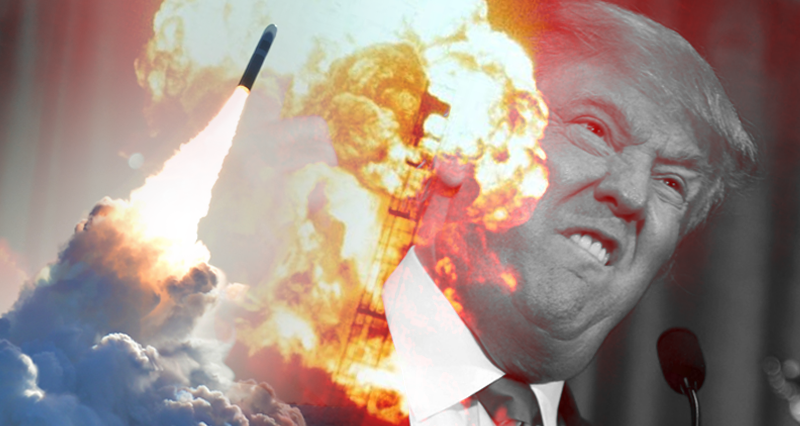
As the expert consulted says, this would be nothing more than a natural treatment if we weren’t talking about the president of the most powerful country that owns the largest armed forces on the planet, possessing a vast nuclear arsenal sufficient to wipe humanity off the face of the earth.
But I still believe that while Trump’s personality is an important factor, it’s not the decisive one in his motivations for acting as he does. An individual’s personality is part of the subjective factors that influence their actions, but what’s decisive is the objective factor, and that stems from the interests being defended. In Trump’s case, those interests belong to the 1% who control the Military-Industrial Complex, the financial system, the major energy companies, and the transnational pharmaceutical companies, all linked by a common thread: drug trafficking. It’s not about preventing drugs from entering the United States, but rather about ensuring they do so in an orderly fashion so that the profits flow freely through the financial system.
What is most worrying is that this individual, with his narcissistic personality disorder and delusions of grandeur, just like his mentor Adolf Hitler, has adopted Nazi ideology to guide his governance. However, unlike in the last century when the world united to fight the specter of Nazism, today a significant number of countries, especially some of the world’s major powers, seem comfortable coexisting with it.
In the case of Venezuela, the only way the United States can install the opposition in power—with the goal of controlling a compliant government that allows it to seize the country’s vast wealth and eliminate the example Venezuela represents for the region—is through invasion and direct war. However, this is very difficult for the American public to accept at present, which is why this objective has had to be postponed for now. But they will persist in this approach in the future, regardless of whether Republican or Democratic administrations are in power, until they see that the Venezuelan people’s will to resist and achieve victory is inexhaustible.
This explains Marco Rubio’s statement that Venezuela is an unsafe country for US citizens, an attempt to refute the idea that is beginning to take shape within the US establishment that Venezuela is peaceful and stable, which would allow the return of oil companies forced out of the country by the sanctions imposed by Obama, Biden, and Trump. Rubio’s preferred option is María Machado, but he has not yet fully convinced Trump of her support.
Meanwhile, the domestic situation in the United States is far from ideal for Trump. The events in Minneapolis, where an ICE officer (Trump’s “Gestapo”) murdered an innocent, middle-class white woman, a poet and mother of three, whom Trump and Vice President Vance labeled an ultra-leftist and a terrorist, have once again exposed the rottenness of the American political system. This system demonstrates that in this country, a person deserves to die, without trial, simply for thinking differently. The growing hatred of ICE among the population could be a unifying force, fueling the sense of powerlessness felt by the American people.
Before the kidnapping of President Maduro, there was an attempted assassination of President Putin at his residence, and then, on Sunday, January 11, Trump successively threatened Greenland, Mexico, Cuba, and Iran. The president’s pressure and coercion were directed at Latin America and the Caribbean, Europe, and Asia—almost the entire world. Added to this are the potential attacks on the Colombian-Venezuelan border with the tacit approval of President Petro, who, alarmed, has already announced them. The United States’ withdrawal from 66 multilateral organizations suggests that it will only remain in those where it can impose its will without hindrance, especially the UN Security Council, an inoperative body as long as the veto power exists.
As the culmination of this deranged policy, the news of Trump’s intention to increase the military budget by 50%, projecting a historic figure of $1.5 trillion, is a clear message to the Military-Industrial Complex, to whom he promises increased profits in exchange for making the United States armed forces more powerful and dominant. He went so far as to threaten them with a ban on dividends and stock buybacks if they do not produce weapons at the rate Trump demands.
All of this has set off alarm bells within the elite, who fear a collapse of the US political system and even the loss of its republican status, which rests on a liberal representative democracy that is being undermined. There is a fear that Trump is establishing a dictatorship, given that on January 6, 2021, he demonstrated his disbelief in the alternation of power, and recent events corroborate his disregard for the separation of powers, two fundamental pillars of this liberal democratic system.
They must be considering that a global public opinion poll conducted by the Chinese television channel CGTN indicates that 93.5% of respondents believe the United States, by pursuing unilateralism, has placed itself at odds with the international community. Furthermore, 91.7% think that reforming the global governance system is an urgent priority.
American journalist Tucker Carlson,a staunch supporter of Trump when he came to power and now a fierce critic of his actions despite being a leading figure in the MAGA group, asserted that the recent US military aggression against Venezuela “marks a historic turning point and confirms the transformation of his country from a constitutional republic to an empire that acts outside its own democratic norms.”He claims that the country has entered an “imperial phase,” characterized by the concentration of power in the executive branch and the marginal role of Congress, which has been “relegatedand ignored”, even in decisions regarding war.
Echoing other opinions, Carlson also argues that “the United States has ceased to be a republic and is now an empire”, an assertion he makes upon noting that Congress was not consulted before carrying out the military operation against Venezuela, “in open violation of the constitutional balance,” which entails a progressive weakening of the legislative power that is already underway.
All these actions, which are premises of Trump’s political thought, can be found in “Mein Kampf,” the most distinctive work of Hitlerian ideology: supremacism, racism, expansionism, destruction of the rule of law and liberal democracy, violence, corruption, repression, and persecution of minorities. Trump himself has explained his axiom when he said he doesn’t need international law. In an interview with The New York Times, he was asked if there were any limits to his global powers, to which he replied: “Yes, there is one thing. My own morality. My own mind. That’s the only thing that can stop me.” He added that everything depends on each person’s definition of international law.
I am not, like many, a follower of the Russian philosopher Alexander Dugin, but I must admit that I now agree with him when he says that he is sure that at this moment, “by observing what is happening in global politics, everyone has finally understood that international law no longer exists.”
And I agree with him that if the international system inherited from the end of the Second World War is dead, the time has come to create a new international system of law, which seems quite difficult because neither China nor Russia appear to be interested, when any alternative international system at present can only arise from the decision of these two great powers and some other countries, perhaps those that are grouped in BRICS, although this instance will always be limited by the eternally pusillanimous and cowardly attitude of Brazilian diplomacy.
Referring to Russia, his country, Dugin, as always, is very forceful: “Perhaps this year we will have to participate in a ‘planetary struggle of all against all,’ during which the future, the corresponding world order, and the system of international law will be determined. Currently, none exists. But there must be an international law that allows us to be what we must be: a Civilization-State, a Russian world. This is what must be conceptualized as soon as possible.” As always, he is dramatic, which is why I am not a regular follower of his, but I quote him because I think this paragraph captures the depth of the problem.
But Dugin is not the only one who thinks this way. On the front lines, in an analysis published by Foreign Affairs magazine—perhaps the most relevant instrument for discussing US foreign policy and international affairs— it was argued thatthe report issued a stark warning about what it calls “a definitive and unprecedented collapse of the international legal order, following the US military intervention in Venezuela on January 3.” It added that with this action, the Trump administration has forever abandoned any attempt to adhere to international law, further threatening to continue this course of action after openly declaring its ambitions to annex Greenland, “replacing global law with a doctrine of unilateral force.”
The article states that: “A system of rules can survive some hypocrisy, but nihilism will bring it down”. This suggests that the Trump administration “no longer seeks to justify its actions with legal arguments; in fact, it’s not interested, preferring to impose policies directly via social media, lacking transparency or formal explanation.” Hence the futility of appealing to international law and the ineffectiveness of resorting to the UN and its Security Council.
Continuing, Foreign Affairs states conclusively that: “This phenomenon, categorized by analysts as ‘political nihilism’, represents a direct threat to the international order established after 1945. By dispensing with any pretense of legality, the Trump administration is sending the signal that the United States no longer considers itself bound by global norms or treaties.”
Even Vyacheslav Volodin, speaker of the Russian parliament, denounced the risk of a “world without rules” and the violation of national sovereignty when the session reopened last Tuesday, December 13, after the Christmas and New Year recess. Volodin argued that ” the principles of international law established after World War II are being eroded” and blamed Western countries for this.
Now, obsessed with acquiring Greenland at any cost, Trump is even threatening to destroy the global order established by the United States itself at the end of World War II. He considers the norms of the international order that emerged in 1945 to be “unnecessary burdens for a superpower like the United States.” He even dared to say that Presidents Putin and Xi Jinping cannot use a similar logic to the one he has put forward because that would harm the United States, and he would not accept it. This is a significant blow to the multipolar world order that is being built as an alternative and to the BRICS group itself, which seemed to be the main proponent of that option.
This is just the beginning, but I have no doubt that, even though it is difficult to predict, it will lead to profound and transcendent changes for the planet…hopefully for the better.