


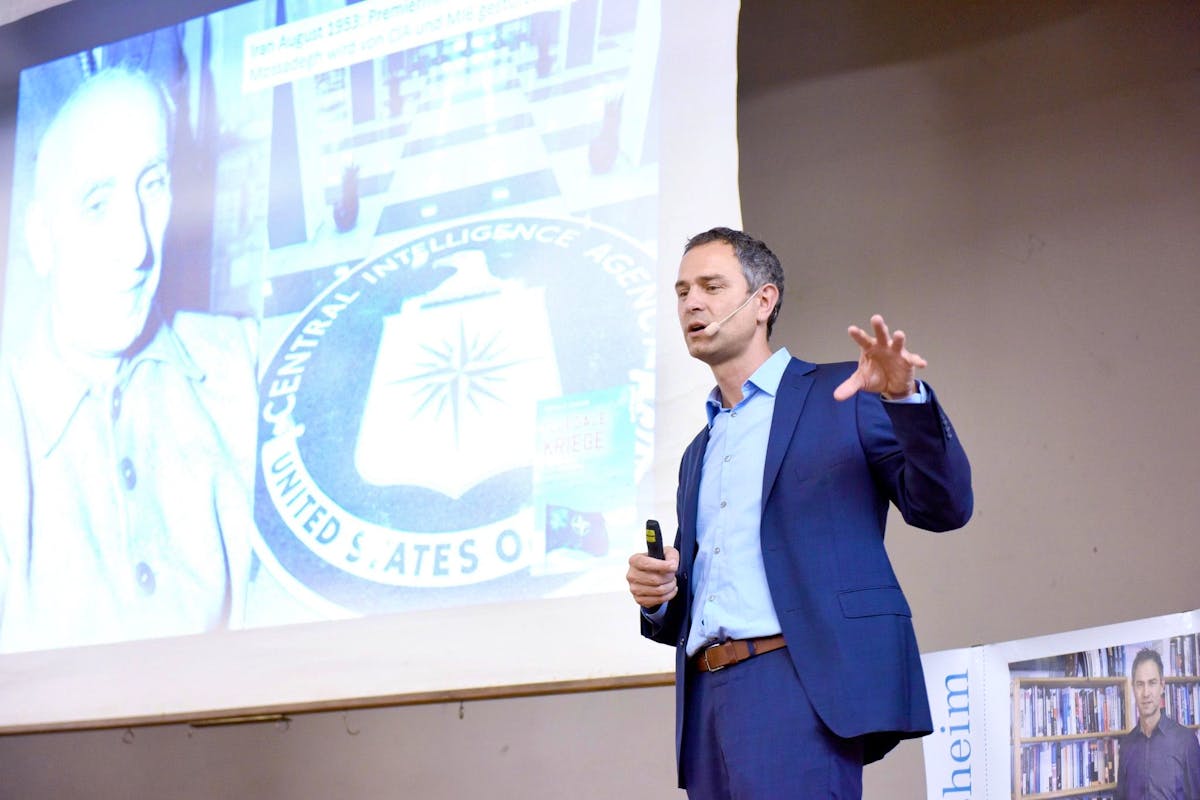
Dr. Daniele Ganser’s insights strip away the rhetoric of transatlantic solidarity, exposing a stark reality: Remaining in an alliance that manufactures crises and demands absolute compliance is no longer a guarantee of security, but a direct pathway to devastating geopolitical and economic risks.
Dr. Daniele Ganser’s insights strip away the rhetoric of transatlantic solidarity, exposing a stark reality: Remaining in an alliance that manufactures crises and demands absolute compliance is no longer a guarantee of security, but a direct pathway to devastating geopolitical and economic risks.
By Yunus Emre Özgün
On paper, the North Atlantic Treaty Organization (NATO) promises a collective security umbrella. However, the geopolitical reality on the ground, stretching from paralyzed European capitals to the burning Middle East, reveals a profoundly different architecture. According to Dr. Daniele Ganser, the renowned Swiss historian and peace researcher who exposed the Cold War-era Gladio networks, the alliance is currently operating on manufactured crises, structural hostagehood, and a dangerous mechanism of complicity.
In an exclusive exchange with UWI Data, Dr. Ganser dismantled the illusion of the Western security paradigm. Stripping away diplomatic pleasantries, his responses outline how the current transatlantic relationship has evolved into a system where member states, out of fear or internalized vassalage, absorb the catastrophic risks of US-led military operations.
By examining the internal contradictions of NATO, the legal and ethical perils of hosting foreign bases, and Türkiye’s precarious balancing act, Ganser’s analysis serves as a stark warning for nations caught in the crossfire of an increasingly unstable hegemon.
The Kill Chain: Dangerous Complicity and Burden of Hosting US Bases
Perhaps the most critical takeaway from Dr. Ganser’s analysis is the severe legal, ethical, and geopolitical liability assumed by nations hosting US military infrastructure. While political elites often market these bases as strategic “assets” that guarantee protection, Ganser argues they actually force host nations into an involuntary complicity, making them direct participants in foreign wars and legitimate targets in international conflicts.
NATO’s existence today, Ganser argues, “is based on the false belief that it makes Europe safe.” Instead of security, these installations weave host nations into a global kill chain.
To illustrate this, Ganser points to the direct operational roles of bases in Germany and the Middle East in recent escalations: “US military bases in Germany were used to support Ukraine in its war against Russia. That was very dangerous. Task Force Dragon, at the time in Wiesbaden, chose targets in Russia, gave the GPS data to the Ukrainians, who then killed Russians in Russia. So US military bases in Germany were part of the kill chain.”
This mechanism of complicity is not confined to Europe. Pointing to the recent regional escalations, Ganser notes that a similar dynamic unfolded in the Middle East, “much like US bases in the Emirates were used in the illegal attack on Iran on February 28, 2026.” For Ganser, the conclusion is an urgent call for geopolitical reassessment: With around 800 US military bases spread across 80 countries, “every country should evaluate whether these bases are an asset or a liability.”
The Anatomy of Vassalage and the Energy Trap
How does a “security guarantor” manage to retain the allegiance of its allies while actively profiting from their economic strangulation? This existential contradiction is most visible in Europe’s ongoing deindustrialization, driven by the severing of Russian energy ties and the heavy reliance on expensive American LNG.
Ganser traces the root of this crisis to a deliberate strategy of provocation. While acknowledging that the 2022 Russian invasion was a violation of the UN Charter, he emphasizes the historical context: “The US has pushed for NATO expansion and in 2008 even invited Ukraine to join… In 2014, the US helped to overthrow the government in Ukraine… The CIA advised the Ukrainian government during the civil war, which lasted 8 years. All of this led to the Russian invasion.”
Despite this trajectory, European capitals remain fundamentally paralyzed. Ganser bluntly describes the situation for Western Europe as “totally absurd.” Instead of asserting strategic autonomy, “Western Europe did not dare to criticize Washington but instead put all the blame on Moscow and stopped importing Russian oil and gas. This was a huge mistake.” His proposed solution radically breaks with current European dogma: “I think Western Europe should call Moscow, apologize and ask for oil and gas.”
This paralysis, according to Ganser, stems from an internalized vassalage across the continent. Out of 30 European NATO members, he highlights only one exception regarding the recent US-Israeli actions in the Middle East: “Only Spain under Pedro Sanchez has dared to sharply criticize the illegal attack… Spain has also told the US that it cannot use its military bases in Spain to attack Iran. I therefore think that Spain is the most courageous country in Europe right now.”
The rest of Europe, Ganser observes, has succumbed to structural hostagehood. He points to Germany as the ultimate example of this subservience. Following the sabotage of the Nord Stream pipelines in September 2022, an act later attributed to the US by investigative journalist Seymour Hersh, Berlin remained silent. “Successive German chancellors, both Olaf Scholz and Friedrich Merz, have not dared to criticize the US or close US military bases in Germany or leave NATO,” Ganser notes. “They pretend that it is unclear who blew up the pipelines and that it is impossible to find the truth.”
Türkiye’s Dilemma: Navigating the NATO-BRICS Fault Line
When the framework shifts to Türkiye, a country whose military nervous system and C4ISR architectures are deeply hardwired into NATO standards, the concept of breaking free from structural hostagehood becomes exponentially more complex.
Ganser reminds us that Washington’s grip on Ankara has historical depths, noting that “the CIA overthrew the government in Türkiye in 1980… and installed General Kenan Evren.” Today, Washington is determined to keep Türkiye within the alliance, but as Ganser points out, “Ankara does not have the same interests as Washington.”
Türkiye finds itself situated precisely on the fault line of a shifting global order. “Türkiye, which shares a direct border with Iran, must balance two groups: NATO with Washington as its center and the BRICS with Beijing as its center,” Ganser explains. “Iran is a BRICS member. So the border between Iran and Türkiye is also a NATO and BRICS border.”
Can Türkiye untangle itself from this weaponized interdependence, famously illustrated by its expulsion from the F-35 program? Ganser believes that a domestic defense industry is merely one element of a much larger political equation. A true departure requires an immense threshold of political will.
“If high-ranking politicians and members of the military elite in Türkiye come to the conclusion that the US-Empire is going down, they will try to leave the sinking ship,” Ganser observes, though he cautions, “I think that’s not the case yet.”
Evicting foreign bases and openly severing transatlantic ties remains a highly delicate affair. Concluding with a stark warning for Turkish policymakers in an era of unpredictable US leadership, Ganser advises extreme caution: “Personally, I think that Türkiye should not trust US President Donald Trump. His actions can lead to chaos. I think Türkiye should study the situation of Bahrain and the Emirates closely.”