


We, the Japanese people, are already being severely held accountable for our complicity in allowing the existence and full operation of U.S. military bases—the launch pads for this war that continues to slaughter countless Iranian people.
We, the Japanese people, are already being severely held accountable for our complicity in allowing the existence and full operation of U.S. military bases—the launch pads for this war that continues to slaughter countless Iranian people.
By Ayumu Oyama, Shiso-Undo, April
On February 28, the U.S. and Israel launched a large-scale attack on Iran, killing numerous members of the regime’s leadership—including Supreme Leader Ayatollah Khamenei—and senior officials of the Islamic Revolutionary Guard Corps. The casualties included civilians; in Minab in the south, more than 175 elementary school students were killed in the bombing. The scale of the airstrikes has expanded day by day, destroying not only military facilities but also key infrastructure such as energy-related facilities, as well as civilian facilities such as hospitals and schools. As of March 20, it is reported that the death toll among Iranians has exceeded 1,400.
Until just before the attack, Iran and the United States had been continuing negotiations on the nuclear development issue with Oman acting as a mediator, and it was reported that significant progress had been made toward an agreement thanks to concessions by the Iranian side. This use of force occurred in the midst of such diplomatic efforts and was, quite literally, a “sneak attack.”
Trump claims this attack was carried out “to prevent Iran from acquiring nuclear weapons,” but Iran has consistently stated that it has neither the intention nor the plans to manufacture nuclear weapons, and IAEA Director General Grossi also stated on March 3 that there is “no evidence that Iran is manufacturing nuclear weapons.” During the 2003 Iraq War, the United States launched the war based on the baseless accusation that the Hussein regime possessed “weapons of mass destruction” (it is said that 500,000 Iraqis died in this war, which lasted until 2011), and now, in order to establish imperialist hegemony in the Middle East, the exact same atrocities are being repeated. We resolutely condemn this barbaric and despicable attack, which lacks even a shred of legitimacy and tramples on the fundamental principles of international laws, including the UN Charter, and we demand an immediate halt to the attack.
The essence of this attack is the destruction of a nation that stands on an anti-imperialist stance. Since the beginning of the year, the Trump administration has launched attacks clearly aimed at “regime change” against anti-imperialist, independent nations and socialist states that have consistently resisted U.S. imperialist global domination: the January 3 raid on Venezuela and the abduction of the president and his wife, the imposition of an “oil blockade” on Cuba on January 29, and now this attack on Iran. However, this reckless escalation does not reflect the solidity of U.S. imperialism. Looking at structural changes across the globe, it is clear that the power of Western imperialist nations—including the US and the other G7 members—is waning, while the power of the so-called Global South, led by China, is on the rise.
Turning our attention to the United States, as the structural contradictions of American capitalism—symbolized by the decline of manufacturing—are deepening, a number of contradictions are intensifying: investigations into the numerous crimes linked to Trump, public discontent over soaring prices caused by high tariff policies, and the spread of protests against anti-immigrant policies. A significant shift in public sentiment is clearly evident (According to a CNN poll on February 24, the Trump administration’s approval rating had dropped to 36% [with a disapproval rating of 63%]). A strong sense of crisis and desperation regarding the deadlock and collapse of the international and domestic ruling systems is driving this series of escalations, which rely on the military power that still holds the upper hand.
In terms of attempting to resolve intensifying domestic contradictions and popular discontent by attacking external “enemies,” the Netanyahu administration—which continues its aggressive foreign policy while facing severe scrutiny within Israel over political corruption and war crimes—is no different from the Trump administration. Trump is under pressure to reverse his current disadvantage ahead of the November midterm elections. Overthrowing the Iranian regime would allow him to tout a “historic achievement” and help expand his support among the pro-Israel hardline conservative base. Such motives are likely at play.
Above all, this attack aims to crush the anti-imperialist struggle in the Middle East by toppling Iran, which has long served as a pillar of support for the Palestinian liberation struggle. In parallel with the attack on Iran, Israel is intensifying its attacks on Lebanon to crush Hezbollah. Since March 2, this invasion has caused a severe humanitarian crisis, with over 1,000 people—including many children—killed and a million displaced from their homes.
Takaichi regime encouraging Trump in his time of need
What is truly unforgivable is the Japanese government’s response. A government that has consistently emphasized the “rule of law” and opposed “attempts to change the status quo by force” has, in recent times, remained silent and effectively supported blatant violations of the “rule of law” and “attempts to change the status quo by force”—such as the abduction and kidnapping of a national leader (Venezuela) and a brazen assassination in broad daylight (Iran). On the contrary, the Takashi administration has directed its criticism and attacks toward Iran, a nation under invasion that is legitimately exercising its right to self-defense under the UN Charter.
Iran’s counterattacks and the de facto blockade of the Strait of Hormuz have halted crude oil supplies, plunging the world into a severe energy crisis. However, it is the unjust military aggression by the United States and Israel that has brought about this situation. In this “asymmetric war,” where there is a significant disparity in military strength, Iran has no other choice but to defend itself in this manner. This situation will continue as long as the attacks on Iran do not cease. The solution is clear: stop the war waged by the United States and Israel—that is the only way.
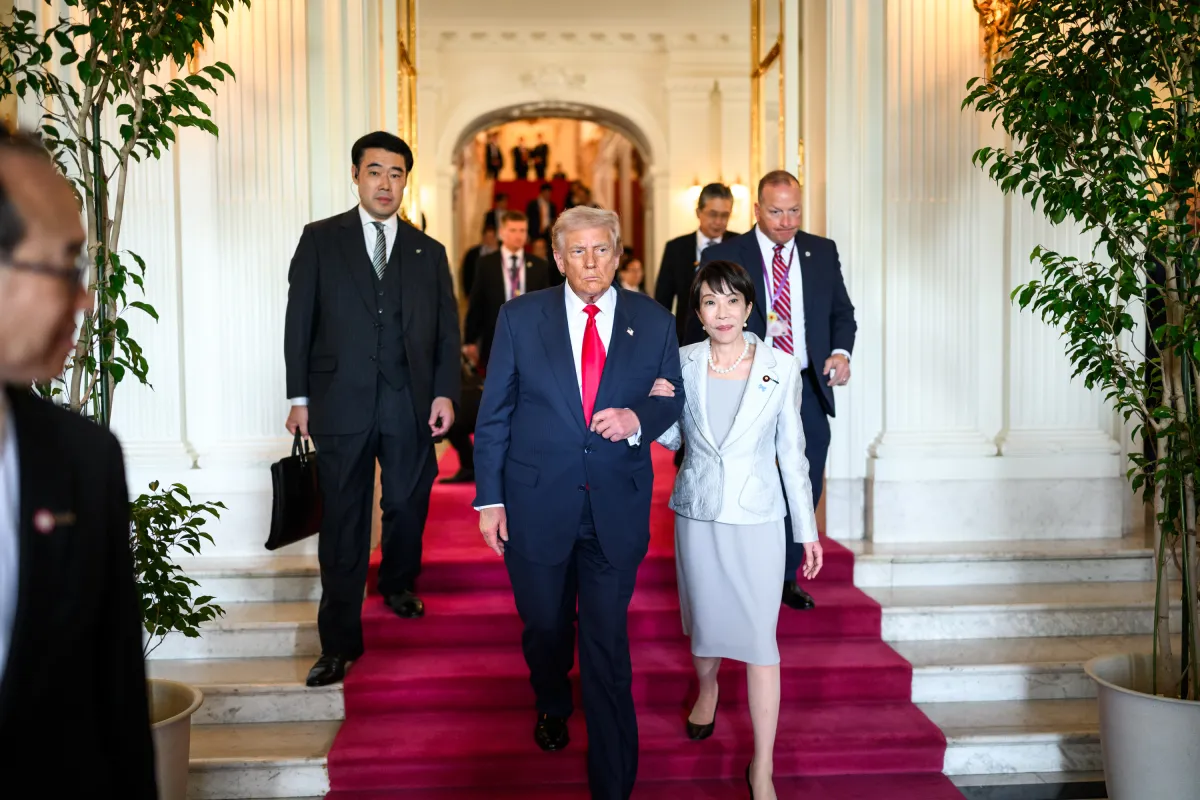
At the Japan-U.S. summit meeting on March 19, Takaichi should have opposed this war and demanded its immediate cessation. However, Takaichi did the exact opposite. She declared, “Only Donald can bring peace and prosperity to the world. I want to lobby other countries and offer my full support,” thereby lavishing the utmost praise on the very person who has sparked a reckless war and brought an energy and economic crisis upon the entire world, and fully endorsing this war of aggression—a war that many NATO allies have come to oppose. What a foolish and shameless statement. On the other hand, regarding Iran, she stated, “We will never allow the development of nuclear weapons,” and condemned “attacks on Iran’s neighboring countries and the de facto closure of the Strait of Hormuz,” thereby joining the U.S.-orchestrated international charade that portrays the victims of a crime as the perpetrators.
Yet, unbelievably, government officials, the mass media, and even some members of the opposition have evaluated this meeting as a “success” or “concluded without incident.” There is no protest or criticism of Takaichi’s declaration of support for war—which should be the most serious issue regarding this meeting. Trump continues to demand “bold measures” and “further support,” and while Takaichi reportedly conveyed that dispatching the Self-Defense Forces is not possible at this stage, she promised to actively pursue cooperation in the war effort, stating that “within the scope of Japanese law,” Japan would “do everything it can.” This does not mean the danger of moving toward military support—including the dispatch of the SDF—has disappeared. Depending on future developments in the war, it is entirely possible that Trump will demand stronger and more concrete military cooperation from Japan.
Growing calls against war
Two Aegis destroyers based at the U.S. Naval Base in Yokosuka were deployed to the Arabian Sea, where they launched Tomahawk long-range cruise missiles and participated in a preemptive strike against Iran. According to reports on March 15, elite forces—including not only those from Yokosuka but also the Marine Corps in Okinawa—have already deployed to Iran or are preparing to deploy from U.S. military bases across Japan (Okinawa, Atsugi, Iwakuni and Sasebo). This alone demonstrates that Japan is already complicit in the war against Iran. We, the Japanese people, are already being severely held accountable for our complicity in allowing the existence and full operation of U.S. military bases—the launch pads for this war that continues to slaughter countless Iranian people.
Voices opposing the war on Iran are growing louder around the world, pressuring governments to refuse cooperation with the war effort. In Europe and the United States, labor unions are rising up alongside civic groups. In the United States, labor unions such as the Service Employees International Union (SEIU), militant chapters of the United Auto Workers (UAW), the National Nurses United (NNU), and the United Electrical Workers (UE) are issuing protest statements one after another. In the United Kingdom, on March 1, leaders of 12 labor unions jointly issued a statement condemning the illegal war against Iran. Militant labor unions in Greece are leading demonstrations to protest their government’s cooperation with war plans. In Japan as well, protests are taking place across the country, and the number of participants in anti-war actions around the National Diet is growing. In Yokosuka, where an Aegis destroyer has set sail for the Middle East, emergency actions were held to demand an end to complicity in the war. In several local assemblies, resolutions calling for an early end to the war and a negotiated settlement have been proposed. However, the response from labor unions in Japan has been sluggish.
We have consistently argued that workers and labor unions should take the lead in the anti-war movement. We reiterate this call once again. War and the exploitation and oppression of workers share the same root cause: capitalism. Let us thoroughly expose this truth, which is cleverly concealed in bourgeois society.
Recently, this newspaper has been publishing discussions focused on the revival of mass movements—including the weakened labor movement—from the grassroots level. We continue to call for participation in this discussion. At the same time, we urge everyone to raise their voices in opposition to the war currently unfolding, each from their own position. Whether you work in a unionized workplace or not, ask your coworkers, “Isn’t this war wrong?” Let’s start there and move on to the next step.
The U.S. and Israel must immediately halt their attacks on Iran!
We firmly oppose any form of Japanese cooperation with or participation in the war!
Let us oppose the further strengthening of the U.S.-Japan Alliance, the Takaichi administration’s efforts to turn Japan into a war-mongering state, and the moves to amend the Constitution!