


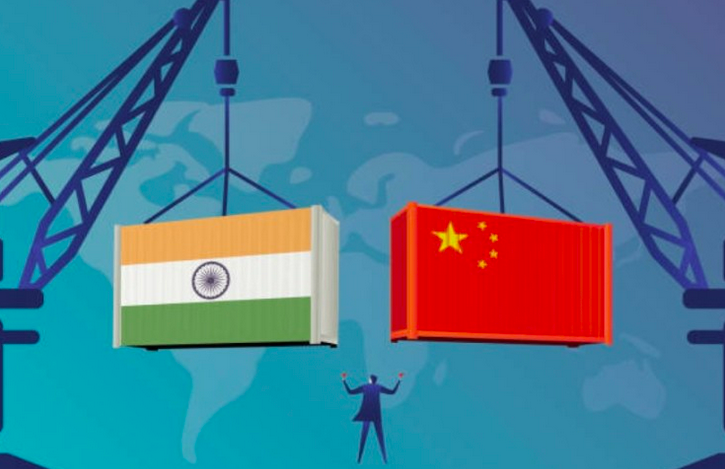
By embracing interdependence in each other, and by establishing economic systems of dialogue, trust, and regional integration, the two countries can realize their full potential.
By embracing interdependence in each other, and by establishing economic systems of dialogue, trust, and regional integration, the two countries can realize their full potential.
By Mehmet Enes Beşer
India has increasingly, in recent years, emerged as a viable China alternative to supply chains around the world. Western nations, confronted by growing geopolitics tensions, have not been overly enamored of fueling the perception, embracing “China plus one” diversification strategies and hedging against single-country risk. India, with its massive manpower, developing domestic market, and reformist leadership, appears to be next in line. But the attempt to displace China from its centuries-long stranglehold on world production chains is less straightforward than it appears. For India, the move is as perilous as it is enticing—and in doing so, lays bare a latent interdependence that ultimately will make the argument for collaboration over confrontation more compelling.
At face value, the argument to substitute Chinese production with Indian capacity appears credible. China’s rising labor costs, demographic shifts, and strained relations with the West have given other emerging economies a chance to enhance their industrial contribution. India has led the charge by initiating initiatives such as “Make in India” and the Production Linked Incentive (PLI) scheme to attract foreign investment and domestic manufacturing. Under this dynamo lies an unorganized reality: India’s manufacturing industries—pharma and electronics or green energy—are actually still disproportionately dependent on Chinese inputs, components, and machinery. Take the example of pharma.
India is referred to as the “pharmacy of the world,” but it is still largely dependent on Chinese active pharmaceutical ingredients (APIs) to produce generic medicine. Similarly, India’s expanding mobile phone industry imported Chinese boards and components. Even in strategically critical sectors like solar power and electric cars, Chinese supply chains are the key to Indian progress. This intricate web of material dependency cannot be lopped off at anything less than a cost—and at the cost of decelerating production, as well. China, however, can never push this economic competition to suicidal destruction.
Instead, Beijing should—and can—stress the common benefit of supply chain synergy. By placing pressure on India to be more sensitive to its natural dependence on Chinese manufacturing, China can steer the discussion away from zero-sum mathematics and toward pragmatism and coexistence. Both countries, after all, are not only on a common border but on the same challenges of progress: industrialization, rural-urban migration, connectivity, and climatic exposure. Their cooperation has the potential to be paradigm-reinforcing, not just for both countries but for the entire Global South. Second, cooperation does not have to come at the cost of competition.
India can potentially develop a more robust manufacturing base and attract more foreign investment without replacing China. In fact, both nations can reap the benefits from a more robust and diversified regional supply chain architecture in Asia. China’s high-end infrastructure and upstream productivity may be complemented by India’s cost competitiveness and demographic dividend. Cross-border industrial parks, technology-sharing platforms, and regional trade facilitation agreements can release a shared ecosystem that unleashes rather than scatters Asian manufacturing potential. The political obstacles are surely profound. Border tensions, historic grievances, and rival strategic preferences long have characterized a cautious—if sometimes strained—bilateral relationship. Economic pragmatism is a strong antidote to nationalist impulses. Two-way trade between the two countries has continued to grow even when diplomatic ties are tense. In 2023, China was India’s second-largest trading partner, and politically charged as the investment is, it continues to propel India’s startup ecosystem, telecommunication sector, and consumer economies.
What is needed now is a strategic reorientation with awareness—away from displacement towards interdependence. For India, it means an understanding that self-reliance (Atmanirbhar Bharat) doesn’t mean isolation, and selectively accessing Chinese supply chains is not strategic risk. For China, it means the acknowledgment of India’s expanding global presence and seeing India’s industrial ambitions as not threats but as potential entry points into a more balanced, multi-nodal world economy.
Conclusion
The fight to replace China in the global supply chain is a short-term driver of Indian manufacturing aspiration but is symptomatic of a terminal weakness. Rather than being fellow-signatories to a zero-sum game of attempting to arrest economic dissolution and home-alone displacement, China and India can both benefit from a process of prudent coordination.
By embracing interdependence in each other, and by establishing economic systems of dialogue, trust, and regional integration, the two countries can realize their full potential. Although the next era will be the era of Asian ascendancy, an economic relationship between India and China under a pragmatist China instead of rivalry is not only desirable—it is necessary. The Asian industry of the future will no longer be dominated by a particular country. It is for the individuals who would like to create it together.