


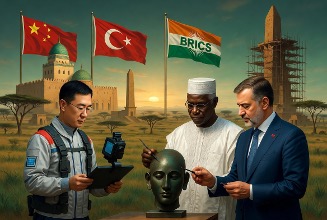
Decolonization efforts, institutional frameworks, BRICS, China and Türkiye.
Decolonization efforts, institutional frameworks, BRICS, China and Türkiye.
One of the most devastating actions of European colonialism towards Africa was the physical removal of cultural heritage from the continent. During the 1897 British Punitive Expedition, the palace of the Kingdom of Benin was looted, and more than 3,000 bronze and ivory artifacts were taken to London. Today, approximately one thousand of these works are in the British Museum, while the rest are housed in museums in Berlin, Vienna, New York, and Chicago. Similarly, France transported more than 90,000 artifacts from West Africa to Paris in the late 19th and early 20th centuries (Sarr-Savoy Report, 2018).
Germany’s collection of human remains and sacred objects during the Herero and Nama genocide in Namibia, and Belgium’s removal of more than 120,000 artifacts from Congo, are still exhibited in European museums. This plunder was not merely physical theft; it also formed the cornerstone of a project to rewrite the histories and identities of African peoples (Gençoğlu, 2024).
War and Terrorism Financing
The increasing conflicts in Libya, Mali, Niger, Burkina Faso, and Nigeria after 2011 have dramatically escalated the looting of cultural heritage. According to UNESCO’s 2023 report, more than 8,700 archaeological sites in the Sahel region alone were destroyed or looted between 2012 and 2022. The methods employed by ISIS in Iraq and Syria between 2014 and 2017 were copied by Al-Qaeda-linked groups in West Africa. A 2019 joint report by Interpol and UNODC documented that bronze artifacts stolen from ancient cities in Mali such as Timbuktu and Djenné were being sold by Boko Haram and AQIM in Belgian and American markets. According to Europol, the smuggling of cultural artifacts is the fourth largest source of income for terrorist organizations, after arms, drugs, and human trafficking.
In the last decade, African countries have systematized their demands for restitution. For example, between 2022 and 2025, Nigeria recovered 107 Benin Bronzes from Germany, 49 from the United Kingdom, and 38 from the United States. Ethiopia secured the return of the Aksum Obelisk from Italy in 2005 and part of the Maqdala treasures from the United Kingdom in 2021. In 2023, France ceremonially returned 26 artifacts taken from the Abomey Palace in 1892 to Benin. However, the returned artifacts represent less than one percent of all looted items. Meanwhile, Western museums continue to resist using the argument of the “universal museum” (Ramachandran, 2019).
China’s Belt and Road Initiative
Since 2013, China has made significant investments in the protection of cultural heritage in Africa. Several projects have emerged within the framework of government-to-government agreements signed under the BRI. Chinese experts have been participating in restoration work at the Karnak Temple and the Valley of the Kings in Luxor since 2016, and digital documentation and 3D modeling infrastructure are being established with financing from the China Development Bank.
Between 2018 and 2024, the restoration of Swahili architecture on Lamu Island was carried out entirely by Chinese teams, while local experts were trained. In 2021, China provided a $15 million grant for the digitization of the Timbuktu manuscripts and the reconstruction of the Ahmed Baba Institute. In 2023, the China-Nigeria Joint Laboratory for Cultural Heritage Protection and Archaeology was established in Abuja, and Chinese experts are conducting radar and LiDAR surveys in the Benin Kingdom region.
The most important difference of these projects is China’s unconditional approach and technology transfer. While Western countries usually award restoration projects to their own companies, China prioritizes building local capacity. Of course, China also has investments in the region, but it is evident that it does not have the bloody colonial history in the continent that Western powers do.
At the 2024 Cairo Summit, BRICS Culture Ministers decided to establish the BRICS Cultural Heritage Restitution and Protection Mechanism. Within the framework of this mechanism, decisions were taken to create a joint digital database, accelerate restitution agreements among BRICS member countries, provide joint funding for archaeological excavations in Africa, and for intelligence sharing in the fight against cultural artifact smuggling, as decided at the Shanghai Cooperation Organization’s 2023 Tashkent Summit (Oliveira, Gilson, Tang, 2020).
Plundering During the Colonial Period and Its Effects
The cultural heritage of the African continent was subjected to systematic and widespread looting during the era of European colonialism in the 19th and early 20th centuries. This process took place during military campaigns, punitive operations, and so-called scientific expeditions, resulting in tens of thousands of artworks, religious objects, historical artifacts, and even human remains being transferred to museums and private collections in Europe and North America. One of the most memorable cases is that of Sarah Baartman, whose remains were returned to her homeland, Cape Town, from Paris nearly two hundred years later.
The repatriation of Sarah Baartman’s (1789–1815) remains represents an important turning point in the context of correcting the objectifying legacy of 19th-century colonial exoticism and racist scientific practices in the post-colonial period. After her death, Baartman’s skeleton, preserved organs, and plaster-cast body were exhibited at the Musée de l’Homme in Paris, symbolizing the continuity of colonial violence. As part of national reconciliation and cultural redress efforts in post-apartheid South Africa, President Nelson Mandela formally requested the return of the remains from France in 1994. This diplomatic initiative began with Mandela’s persistent pressure during his meetings with François Mitterrand (McGreal, 2002; Open Restitution Africa, 2025).
The process sparked intense legal and ethical debates in the French National Assembly. France initially resisted, fearing it would set a precedent for similar demands, which required a special law to be passed (McGreal, 2002). Mandela’s diplomatic pressure and South Africa’s symbolic needs in post-colonial identity-building led France to accept the request in 2002. The remains were transferred to South Africa on 6 May 2002 and ceremonially buried on 9 August 2002 (Open Restitution Africa, 2025). While this shameful historical episode was resolved peacefully for France, the country has since begun returning similar human remains to other former African colonies such as Algeria and Madagascar.
It is estimated that nearly 90% of Africa’s cultural heritage remains outside the continent. This situation stems from the colonial powers’ justification of the removal of artifacts under the pretext of “preserving civilization” to reinforce their claim of cultural superiority (Savoy & Sarr, 2018; History Guild, n.d.; Museum of British Colonialism, 2018).
The looting did not only cause material loss; it profoundly damaged the collective memory, cultural identity, and historical continuity of African societies. These objects embodied communities’ spiritual connections with their ancestors, their rituals, and their social narratives. Their loss led to the alienation of cultural identity and identity crises in the post-colonial period. Colonial plunder also reinforced the labeling of African cultures as “primitive,” resulting in the decontextualized display of artifacts in global museums. This undoubtedly limits the ability of source communities to reconstruct their own histories and complicates efforts toward cultural renaissance (Van Beurden, 2022; Janeway Institute, 2025; Modern Ghana, 2023).
International Efforts and the Role of UNESCO
In the international community, the restitution of cultural heritage gained an institutional framework with the 1970 UNESCO Convention on the Means of Prohibiting and Preventing the Illicit Import, Export, and Transfer of Ownership of Cultural Property. This convention obliges member states to prevent illicit trade, create national inventories, and promote international cooperation, with particular emphasis on protecting the cultural assets of developing countries. In the African context, the convention has become a key legal instrument for the return of artifacts looted in the post-colonial period (UNESCO, 1970; Shyllon, 2000).
UNESCO has been the leading institution guiding restitution processes, from the global awareness campaigns initiated by Amadou-Mahtar M’Bow in 1978 to the present day. In recent years, Africa-focused initiatives have gained momentum. In 2025, historic meetings involving all African member states promoted new models of cooperation and agreements. Following this process, “healing, justice, and empowerment” approaches have been adopted in South Africa. UNESCO’s Intergovernmental Committee for Promoting the Return of Cultural Property to its Countries of Origin or its Restitution in Case of Illicit Appropriation (ICPRCP) facilitates voluntary returns and supports innovative methods such as digital repatriation. Joint projects with the African Union define restitution not only as physical return but as the reclamation of cultural rights, and advocate for the strengthening of binding mechanisms (UNESCO, 2025a; Van Beurden, 2022).
Restitution processes progress slowly due to legal complexities, diplomatic reluctance, and institutional resistance from museums. The increase in illegal excavations and trade during the pandemic period shows that Africa’s cultural heritage remains under serious threat. The inadequacy of binding mechanisms in international law creates a system dependent on voluntary returns, leaving the process uncertain (Interpol, 2021; Janeway Institute, 2025).
The struggle against the plundering of cultural heritage in Africa is more than the physical return of artifacts; it is a symbol of post-colonial justice. This process requires the international community to acknowledge its historical responsibilities and contributes to the cultural renaissance of African societies. Future successes depend on more inclusive legal frameworks and sustainable cooperation (Children of the Dark Continent, 2025; UNESCO, 2025d).
Legal and Institutional Framework
The colonial-era looting of Africa’s cultural heritage lies at the center of discussions on post-colonial justice, cultural rights, and historical responsibility in the international community. This process involves not only the physical return of artifacts but also the restructuring of global power imbalances and the redefinition of cultural dialogue. At the international level, restitution efforts are carried out through multilateral institutions (UNESCO, African Union), bilateral agreements, and civil society initiatives, resting on a legal and ethical framework that has evolved from the 1970 UNESCO Convention to the present (UNESCO, 1970; Sarr & Savoy, 2018).
The foundation of the international restitution movement is the 1970 UNESCO Convention on the Means of Prohibiting and Preventing the Illicit Import, Export, and Transfer of Ownership of Cultural Property. This convention promotes the prevention of illicit trade and the return of artifacts to their countries of origin, but due to the limitations of its binding mechanisms, it remains dependent on voluntary returns. The convention has become a critical tool for African countries in the post-colonial period, requiring the creation of national inventories and international cooperation (Shyllon, 2000; UNESCO, 2025e).
Efforts led by UNESCO gained systematic momentum beginning with Amadou-Mahtar M’Bow’s 1978 appeal. The institution’s Intergovernmental Committee (ICPRCP) supports innovative models such as digital repatriation and joint exhibitions, positioning restitution as the strengthening of cultural rights. In 2025, the historic meeting organized by UNESCO in Addis Ababa with the participation of all 54 African member states accelerated new cooperation agreements and regional dialogues (UNESCO, 2025a; UNESCO, 2025b; UNESCO, 2025c).
Current International Developments
In 2025, the African Union declared the year as the “Year of Cultural Heritage and Reparations,” giving momentum to restitution efforts. This theme integrates the return of cultural artifacts with reparation discussions and encourages the participation of the African diaspora (African Union, 2025). Progress has been made in symbolic cases such as the Benin Bronzes, with various European and American museums returning artifacts to Nigeria or signing long-term cooperation agreements. These returns are coordinated with local actors such as the Oba of Benin and the National Commission for Museums and Monuments of Nigeria, emphasizing that restitution involves not only return but also management and preservation (African Leadership Magazine, 2025; Art & Object, 2025).
Meetings such as the 2025 KwaDukuza Declaration at G20 Culture Ministers’ gatherings and high-level events in Barcelona have strengthened global North-South dialogue and advocated for open and inclusive restitution processes. Meanwhile, civil society projects such as Open Restitution Africa are democratizing access to information, increasing transparency, and also bringing the return of human remains to the agenda (UNIDROIT, 2025; Open Restitution Africa, n.d.).
The impact of the 2018 Sarr-Savoy Report continues. Discussions initiated under French leadership have led to permanent policy changes in European museums. The report documents that artifacts were acquired in a colonial context, making ethical restitution imperative and introducing the concept of relational ethics to the international public (Sarr & Savoy, 2018; Savoy, 2022).
Critical Assessment
International restitution efforts face legal uncertainties, diplomatic resistance, and institutional conflicts of interest. The absence of binding international mechanisms leaves processes to voluntariness and reinforces unequal power relations. Additionally, the capacity of source countries to protect returned artifacts is debated; in some cases, local governance disputes complicate the process (Janeway Institute, 2025; The Guardian, 2025).
From a critical perspective, while the restitution movement represents a turning point in post-colonial theory, the Global North’s “universal museum” argument continues to show resistance. This creates tension between the universalization of cultural heritage and the rights of source communities, raising questions about whether digital alternatives are sufficient (Van Beurden, 2022).
The international restitution of Africa’s cultural heritage is of critical importance for achieving historical justice and preserving cultural diversity. Developments in the 2025–2026 period — such as the African Union’s theme, UNESCO meetings, and G20 dialogues — have increased momentum and carry the potential for a shift toward more inclusive and binding frameworks. However, sustainable success depends on legal reforms, capacity building, and equal partnerships. This process tests the global community’s ability to confront its colonial legacy (UNESCO, 2025d; African Union, 2025).
Anti-Colonial Stance and Modern Turkish Foreign Policy
As the only Islamic country to participate in the Berlin Conference, the Ottoman Empire was the only state that left the conference without gaining anything. The Ottoman Empire’s legacy in the African continent left deep traces, particularly through direct provincial administration in North Africa, and through trade, security, and religious influence in East Africa. This influence extended as far as South Africa through scholars, mosques, madrasas, and architectural works, ensuring cultural continuity. By supporting local emirates against Portuguese colonialism, the Ottomans assumed a protective and integrative role in contrast to the West’s plundering approach. They acted as a catalyst in the spread of Islam and created an image of a non-colonial empire among African societies. This historical legacy constitutes a strong soft power element for modern Turkish diplomacy.
Since the 2000s, Türkiye’s accelerating opening to Africa has seen the number of embassies increase from twelve to forty-three, trade volume reaching billions of dollars, and Turkish state institutions restoring Ottoman monuments, along with education and humanitarian aid projects. Türkiye effectively uses the narrative of “shared history and anti-colonial solidarity” against the West’s colonial past, thereby strengthening its position as an alternative partner in African countries. By taking a neutral and supportive stance in restitution discussions against the artifacts plundered by Europe, Türkiye gains trust in the context of cultural justice. While this carries the potential to increase its influence across a wide spectrum from economic cooperation to security agreements, the full realization of this potential depends on sustainable partnerships that prioritize Africa’s own agenda, adopting a more inclusive and pragmatic approach while avoiding criticisms of neo-Ottomanism.
As explained above, the Ottoman Empire’s cultural and religious legacy in the African continent offers a model of interaction based on cooperation, education, and tolerance, in contrast to the destructive effects of European colonialism. Particularly in South Africa, the Bo-Kaap Museum in Cape Town’s Bo-Kaap district stands out as the only local museum where the Turkish flag is permanently displayed, embodying the positive influence of Ottoman scholars on the region’s Muslim communities (Gençoğlu, 2022). This museum serves as a cultural bridge reflecting the Ottoman Empire’s non-colonial approach through documents and symbols from the Ottoman period.
The activities of Ottoman intellectuals in Africa focused on education and religious guidance rather than oppression and plunder, and they are remembered by local communities, so to speak, as a “pleasant echo.” As South African historian Davids put it, “The only state that went to South Africa before the discovery of diamond and gold mines and brought education under the name of the Islamic Caliphate for the purpose of service was the Ottoman State” (Gençoğlu, 2022, p. 15). In this context, while European powers (Britain, France, Germany, Belgium, and Portugal) left permanent traces of colonialism on the continent, the Ottoman legacy is preserved with respect and gratitude by the local people. Ali Mazrui, while emphasizing the destructive impact of Western colonialism, defended the historical reality against approaches that label the Ottomans as colonialists, noting that unlike the Ottomans, these powers left behind only oppression (Gençoğlu, 2023).
A concrete example of this legacy is the commemoration of South African poet and anti-apartheid activist Tatamkhulu Afrika. Coming from a Turkish-origin family and dedicating his life to the freedom struggle of African peoples, Tatamkhulu can be seen as an indirect reflection of Ottoman cultural influence. As emphasized in recently published research, the exhibition and commemoration of Tatamkhulu Afrika’s works at the Bo-Kaap Museum symbolizes the continuation of the positive traces left by Ottoman intellectuals today (Gençoğlu, 2021).
References
African Leadership Magazine. (2025). The Return Of Africa’s Stolen Artefacts: What Comes Next?. https://www.africanleadershipmagazine.co.uk/the-return-of-africas-stolen-artefacts-what-comes-next
African Union. (2025). AU Theme of the Year 2025. https://au.int/en/theme/2025
Art & Object. (2025). The Benin Bronzes: A Tipping Point for Repatriation. https://www.artandobject.com/news/benin-bronzes-tipping-point-repatriation
Janeway Institute. (2025). The enduring repercussions of colonization on modern artifact repatriation. https://janeway.uncpress.org/capstone/article/2036/galley/2413/download
Gençoğlu, H. (2020). Türk arşiv kaynaklarında Türkiye-Afrika. SR Yayınevi.
Gençoğlu, H. (2021). Ottoman traces in Southern Africa: The impact of eminent Turkish scholars in the Cape of Good Hope. New Contree, 85, 1-25.
Gençoğlu, H. (2022). Güney Afrika’da Osmanlı izleri. Kronik Kitap.
Gençoğlu, H. (2023). Batı’nın Afrika Talanı. Kronik Kitap.
Open Restitution Africa. (n.d.). News & Updates. https://openrestitution.africa/news-updates
Sarr, F., & Savoy, B. (2018). The Restitution of African Cultural Heritage: Toward a New Relational Ethics. http://restitutionreport2018.com/sarr_savoy_en.pdf
Savoy, B. (2022). Africa’s Struggle for Its Art: History of a Postcolonial Defeat. Princeton University Press.
Shyllon, F. (2000). The Recovery of Cultural Objects by African States through the UNESCO and UNIDROIT Conventions. Unidroit.