


Despite the fact that millions of Egyptians worked in the Gulf and feel attached to these countries, they are, when it comes to the current conflict, Sunnis by denomination and “Shiite by inclination”.
Despite the fact that millions of Egyptians worked in the Gulf and feel attached to these countries, they are, when it comes to the current conflict, Sunnis by denomination and “Shiite by inclination”.
The Egyptian stance—at both the popular and official levels—regarding the U.S.-Israeli war on Iran represents a significant manifestation of the political and collective psyches that shape Cairo’s engagement with foreign events. This remains an issue that eludes the understanding of outsiders and foreigners, even those who have lived in Egypt or closely studied its political, social, and historical landscape.
Expectation Gap
The outbreak of this war in late February signaled the start of a different kind of conflict: a media war ignited in the Gulf states. While Gulf artillery was not aimed at Iran—which had rained drones and missiles upon various Gulf states targeting U.S. bases and military infrastructure before expanding to civilian and oil facilities—the Gulf’s media apparatus turned its sights toward Egypt. This occurred despite the fact that Egypt is not participating in the war in any capacity and cannot, by any metric, be considered a party to it.
Despite clear condemnations issued by various Egyptian official institutions regarding Iranian attacks on Gulf states, social media was rife with criticism of the Egyptian position. These critiques came from Gulf citizens, journalists, former officials, and even influential public figures within decision-making circles.
From the perspective of these critics, Egypt failed to translate its rhetorical rejection of aggression into practical action to support these countries during the attacks. The criticisms were broad and vague, yet intense enough to prompt many Egyptian social media users to ask pointedly: What exactly should Egypt have done that it didn’t, and were there specific official requests made to Cairo that went unheeded?
The frenzy of the Gulf campaign, which appeared organized and sharp, carried a sense of betrayal as much as political grandstanding. This could only be interpreted as a shocked reaction to what appeared to Egyptian popular sympathy for Tehran. The reaction of Egyptians on the street and across social media—supporting Iran in this war against Israel and the United States—gave the impression that the Egyptian people stood against the Gulf states, their peoples, and their interests.
Elite discord
This popular sentiment was not limited to the masses; it extended to former officials, such as Amr Moussa, Egypt’s former Foreign Minister and former Secretary-General of the Arab League. In a post on “X,” Moussa stated that the current war is not merely an Israeli adventure that Netanyahu succeeded in dragging the U.S. into, but rather part of a planned American strategic move—a major step toward reshaping the Middle East into a regional geopolitical status quo led by Israel.
Although the former official emphasized the importance of continuing to support Gulf states against aggression, Saudi writer Abdulrahman al-Rashed responded, arguing that Moussa’s remarks ignored the fact that the Iranian threat was not directed at Israel alone, but had targeted at least eight Arab countries, and that the issue was not a “Middle East restructuring” project.
The rebuttals continued, as Dhahi Khalfan, former Deputy Chief of Dubai Police, stated that justifying missile strikes on Gulf cities cannot be described as political analysis, but rather a bias lacking the bare minimum of Arab solidarity. Similarly, Emirati politician and writer Abdulkhaleq Abdulla criticized Moussa, calling it “shameful to defend an aggressive, terrorist Iranian model” and asking, “Is Iranian blood more precious than Arab blood?”
Moussa’s position was neither isolated nor strange. In a televised interview following the outbreak of war, Major General Samir Farag—former head of the Moral Affairs Department of the Armed Forces and a figure close to the current administration—remarked that the fall of the Iranian regime is in the interest of neither Egypt nor the region.
Ambassador Khaled Emara, former head of the Egyptian Interests Section in Tehran, echoed this sentiment in an interview with Al-Manassa website. He asserted that Iran’s targeting of U.S. bases in the Gulf aligns with international law as a right to self-defense, praising Iran’s role in resisting the expansionist Israeli-American project in the region.
Conflicting signals
This Gulf-led campaign against the Egyptian stance eventually trickled down from intellectuals to the general public, leading to a war of words that signaled high tensions. This prompted Egyptian Media Minister Diaa Rashwan to blame the friction on accounts working for foreign entities aiming to spoil relations, while reaffirming the strength of Egypt-Gulf ties and the government’s lack of responsibility for social media posts.
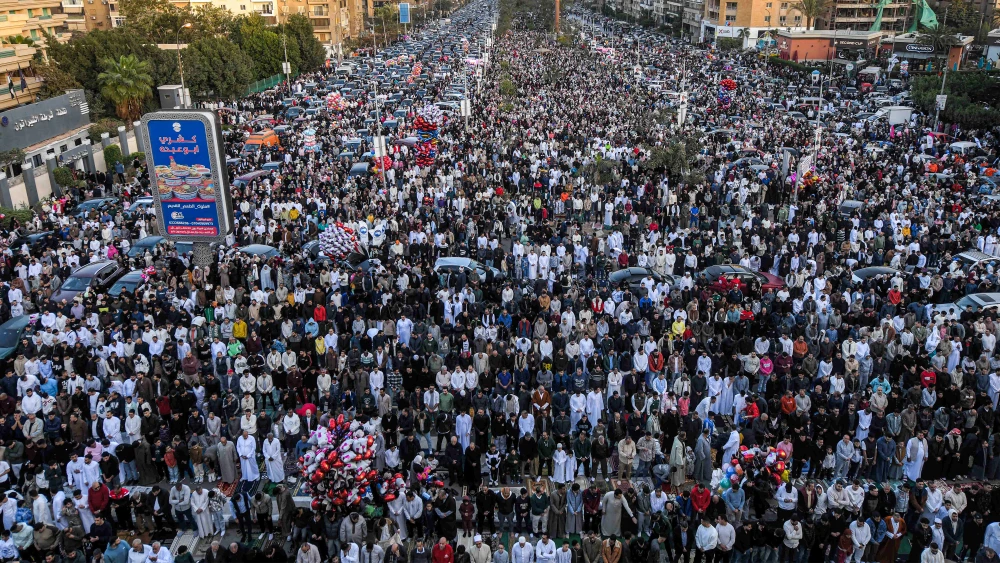
Despite this clear official stance, last week’s Eid al-Fitr reopened more wounds than it healed. During the Eid prayer, an event Egyptian presidents have been keen to attend for decades, the sermon delivered by Hussein Abdel Bari—Head of the Religious Affairs Sector at the Ministry of Endowments—in the presence of President Abdel Fattah el-Sisi sparked a debate that has yet to subside.
The Sheikh utilized a prayer formula associated with Shia terminology, even though Egypt is one of the world’s primary bastions of Sunnism. The prayer appeared to be a message of solidarity with Iran. This fueled Gulf anger, with many viewing it as a bizarre, ill-timed, and inappropriate gesture in both substance and timing.
Diverging Enemies
Regardless of the nature of the Gulf position, which is biased against Egypt and not framed by specific demands from it, and regardless of the language of condescension and harm used in attacking Egypt, government and people, this article is not concerned with responding to it or interpreting it as much as it is concerned with analyzing the Egyptian position, which should not shock anyone, neither in the Gulf nor elsewhere.
Since the war began, the Egyptian Foreign Ministry has repeatedly stressed that Gulf security is an integral part of Egyptian national security, calling for de-escalation and political solutions. Furthermore, the Foreign Minister conducted a regional tour, followed by President el-Sisi’s tour of the UAE, Qatar, Saudi Arabia, and Bahrain, to reaffirm support for Gulf stability.
Clearly, this campaign against the Egyptian position in Gulf societies could only have been organized and directed by officials in the countries from which it originated. This simply means there is a difference of opinion regarding the role the Gulf states expect Egypt to play.
The war currently operates on a system of mutual bombardment; given that Gulf states possess some of the world’s most advanced air defense systems, what could Egypt provide that they do not already have? Moreover, these countries have not officially declared war.
However, the reality is that some of these states—under Israeli and U.S. pressure or of their own volition—are preparing for scenarios involving a ground invasion of Iranian territory. These states lack professional armies capable of such a role. In my personal estimation, this war seeks not only to destroy Iranian capabilities but also to embroil the Gulf in escalation to drain its wealth and destabilize it.
During the Second Gulf War (1990–1991), Egypt joined the 34-country coalition to liberate Kuwait because both the aggressor and the victim were Arab states. However, Cairo explicitly stipulated that Israel must not be part of that coalition. This remains a non-negotiable pillar of Egyptian policy: Egypt will never fight on the same side as Israel. This is the crux of the matter that Gulf populations fail to grasp.
Over recent years, a clear divergence has emerged. While Egypt views Israel as the true enemy of regional security and stability and sees Iran as a power that can be contained, the Gulf states have viewed Iran as the sole threat, with some rushing into free normalization with the Hebrew state. While differences in vision are logical, Gulf states that have not fought Israel or lost their sons to this entity—as Egyptians have across multiple wars—should not ignore Egypt’s security, emotional, and historical calculations.
The Gulf campaign treated the Egyptian army as a mercenary force at the beck and call of Gulf capitals. These countries forgot that Egypt has received nothing from the Gulf for free; most aid came as deposits and investments, characterizing a relationship of peers rather than non-contractual obligations. Furthermore, Gulf actions in Syria, Yemen, Libya, Sudan, and regarding the Ethiopian Dam have often directly contradicted Egyptian interests.
The Popular Compass
On the popular level, two frameworks explain the sympathy for Iran, which by no means implies hostility toward the Gulf.
First, millions of Egyptians have worked in the Gulf for decades, achieving social welfare or financial security. They feel deep affection and loyalty toward these peoples. However, their collective consciousness remains aligned with any power capable of inflicting losses on Israel for its historical and ongoing crimes. This is their political compass, which the Egyptian government understands well. This is why normalization with Tel Aviv has remained a “cold peace” for five decades—a formal requirement to end war, but one that never forgets the martyrs.
Second, while the Egyptian people are Sunnis by denomination, they are “Shiite by inclination” (emotionally). They hold an exceptional love for the Ahl al-Bayt (the Prophet’s household), who sought refuge in Egypt following the martyrdom of Imam Hussein. Egypt is filled with their shrines. Consequently, Egyptians view Iran and its people as a Muslim nation with much common ground, unlike the Gulf perspective which views Shiasm as a departure from “correct” Islam.
Any anger toward the Egyptian position that ignores these facts—which govern official policy and shape the popular soul—is either ignorant or malicious. Such views fail to understand the long-term goals of the U.S.-Israeli aggression: to strike at the interests of the entire region and the Gulf alike.