


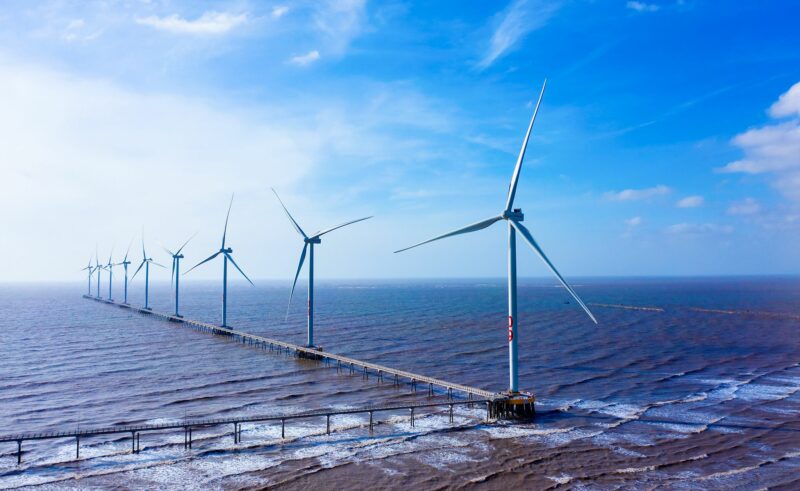
Vietnam’s 2030 goal of 6 GW of offshore wind mirrors the nation’s bold vision of a low-carbon future.
Vietnam’s 2030 goal of 6 GW of offshore wind mirrors the nation’s bold vision of a low-carbon future.
By Mehmet Enes Beşer
Vietnam is now the most prospective offshore player in Southeast Asia for wind development. With over 3,000 kilometers of coastline, moderate winds, and a growing energy demand, the country naturally stands to emerge as an area source of renewables. The government has also spotted this opportunity, with a 6 gigawatt (GW) 2030 target for offshore wind—a headline aspiration in keeping with broader climate targets and the strategic need to cut coal. But with a glittering portfolio of offshore wind projects now on the drawing board, Vietnam has huge legal, technical, and financial challenges to surmount if it is to make this target a reality, and one that becomes increasingly elusive by the day.
At the core of the issue is a nascent legal and regulatory environment. Unlike onshore wind or solar power, which was enabled through open policies, feed-in tariffs, and standardized investment procedures—offshore wind is stuck in neutral. Vietnam has not yet developed a special Offshore Wind Law, and significant terms such as “offshore” are defined inconsistently throughout legal documents. This legal ambiguity complicates project licensure, environmental permits are delayed, and potential investors are discouraged by the lack of policy stability and guaranteed long-term revenues.
In addition, site selection and maritime spatial planning remain fragmented and controversial. Vietnamese waters are full of fishing, shipping, and oil exploration activities generating space and jurisdictional conflicts. In the absence of a clear and transparent marine spatial plan, developers are beset with obtaining necessary permits, managing community relations, and coordination between several government agencies. This recreates risk and escalates the cost of project development at an early stage.
Despite regulatory certainty, Vietnam’s transmission network is far from being capable of accepting huge offshore wind integration. The country’s national grid, particularly the central and southern regions where there is the highest wind potential, is already being strained by installed renewables. Solar and onshore wind curtailments have emerged as more significant problems, and making the grid conducive to absorbing offshore generation will require significant investment in undersea as well as onshore transmission capacity. These types of infrastructure projects have a long maturation period and are prone to bureaucratic delay, land acquisition issues, and skimpy funding.
At the investment stage, while Vietnam is experiencing growing attention from foreign developers and investors—Danish, Japanese, and South Korean etc.—most of such projects exist at the pre-feasibility or feasibility stages. Bankability is still a major issue with no guaranteed price mechanism. The Power Development Plan VIII (PDP8), as much an indicator of firm political will, still has to be translated into nitty-gritty implementation policy that would de-risk investment. Absent power purchase agreements (PPAs) supported by sovereign guarantees or creditworthy off-takers, it is a tall order to fund large-scale offshore projects. Vietnam’s ambitions are also being constrained by supply chain and technical capacity limits.
Offshore wind development requires sophisticated equipment, expert staff, and infancy-stage port infrastructure in Vietnam. Turbine installation vessels, subsea cables, and floating platforms are not domestically available, and therefore early projects will need to rely significantly on imports and foreign experts. This increases cost and lead times. Even though local content requirements are included in the long-term industrial plan, Vietnam has yet to establish the supporting ecosystem to execute large-scale offshore projects successfully. Despite all these, there remains a strong strategic logic for Vietnam’s offshore wind drive.
Its energy demand will triple in 2050. At the same time, Hanoi-wide hostility to coal, greater exposure to climate risk, and global push to eliminate emissions are all joining forces to lead Hanoi away from filthier fuels and towards cleaner options. With offshore wind’s high capacity factor and scalability, an attractive pathway towards energy security and emissions cutting opens up. Moreover, the expansion of this industry may transform Vietnam into an offshore equipment production and technology hub for the region, an extremely coveted role as European developers aim to divert supply chains from China. In order to move forward, Vietnam must accelerate policy reforms and institutional coordination. These include finishing an offshore wind-dedicated legal framework, improving grid planning and investment, streamlining site permit processes, and creating bankable PPA templates. Derisking early investment and technology transfer is also possible through international development finance institutions, multilateral climate funds, and public-private partnerships.
Conclusion
Vietnam’s 2030 goal of 6 GW of offshore wind mirrors the nation’s bold vision of a low-carbon future. Ambition, however, needs to be supported by action. Unless high-priority action is taken to address legal risks, infrastructure gaps, and investment obstacles, there is the risk not only of failing to meet the 2030 goal, but eroding investor confidence and regional competitiveness.
But if Vietnam can weather these headwinds, it might not only overhaul its own power grid, but lead Southeast Asia’s transition to offshore renewables. The opportunity exists—the challenge lies in translating blueprints to humming turbines out at sea.