

Her alliance with Trump and balancing act in face of the Iran War puts Prime Minister Meloni’s constitutional referendum in jeopardy. Should she lose, may this be the beginning of the end.
Her alliance with Trump and balancing act in face of the Iran War puts Prime Minister Meloni’s constitutional referendum in jeopardy. Should she lose, may this be the beginning of the end.
From Rome / Italy
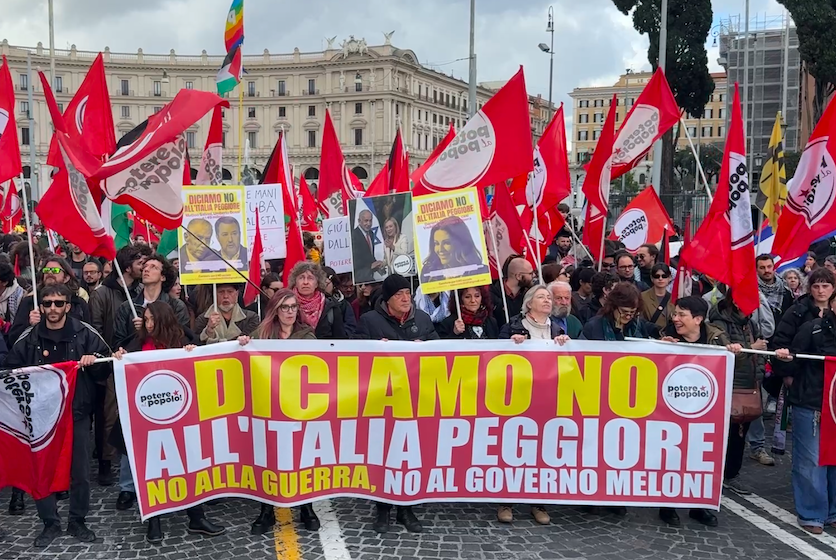
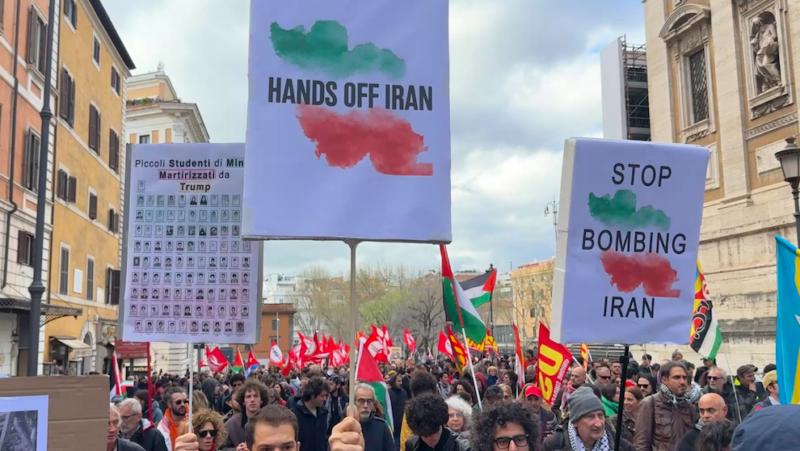
A wave of anti-war protests is sweeping across Italy, as demonstrators take to the streets to oppose the government’s alignment with Western military actions against Iran. What began as mobilizations around domestic constitutional reforms has rapidly evolved into a broader political confrontation—one that now directly challenges the foreign policy of Prime Minister Giorgia Meloni and Italy’s role within NATO.
From Rome to Naples, trade unions, student groups, and peace activists have gathered in growing numbers, voicing concern that Italy risks being drawn into a widening Middle Eastern conflict. Protesters accuse the government of ambiguity—publicly distancing itself from war while maintaining structural ties that could facilitate military involvement.
At a recent demonstration, Pier Paolo Leonardo, a senior figure within the World Federation of Trade Unions, articulated the movement’s position: “We are against the sustain of our government to the war and we are here to stop the trafficking of arms… the situation in the world, in the Gulf, is very, very bad, and we are against the war and for the peace.”
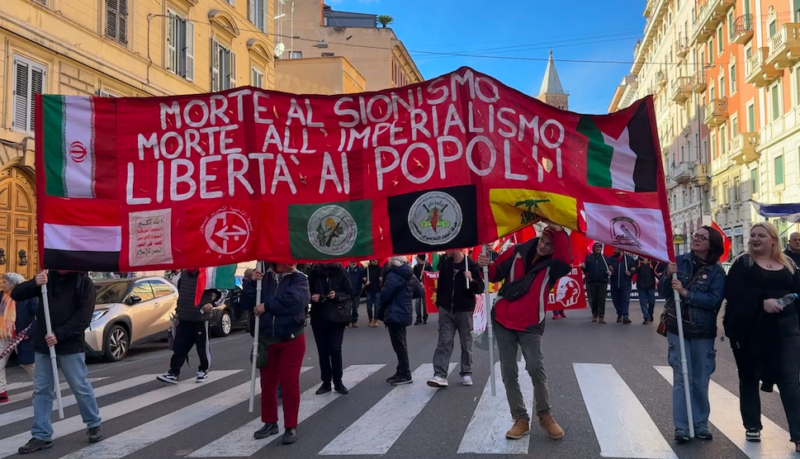
His remarks reflect a broader mobilization strategy among labor organizations, which have already coordinated strikes among port workers across the Mediterranean to block the shipment of military equipment. According to organizers, these actions are intended to disrupt what they describe as a logistical chain linking Europe to conflict zones in the Gulf.
A Government Caught Between Alliances
The Italian government maintains that it is not a direct participant in the conflict. Officials have emphasized that Rome seeks to avoid escalation and respects international law. Prime Minister Meloni qualified the attack on Iran as outside the international law and announced Italy would not participate in offensive actions.
Yet critics argue that such assurances ring hollow given Italy’s deep integration into NATO structures and the presence of U.S. military bases on its territory, for instance Fabio Marcelli, Diretor of the Democracy Investigation and Evaluation Center (CRED). “We have to insist that Italy really stands out of this war. That would imply… not putting bases on Italian territory at disposal of the United States Army and Navy and Air Force.”
This tension underscores a central contradiction. While Rome signals caution, it continues to support alliance commitments, including logistical and strategic cooperation with Washington. News agencies report that Italian naval units have been repositioned in the Eastern Mediterranean, officially to protect European interests, but in a context that critics say risks entanglement.
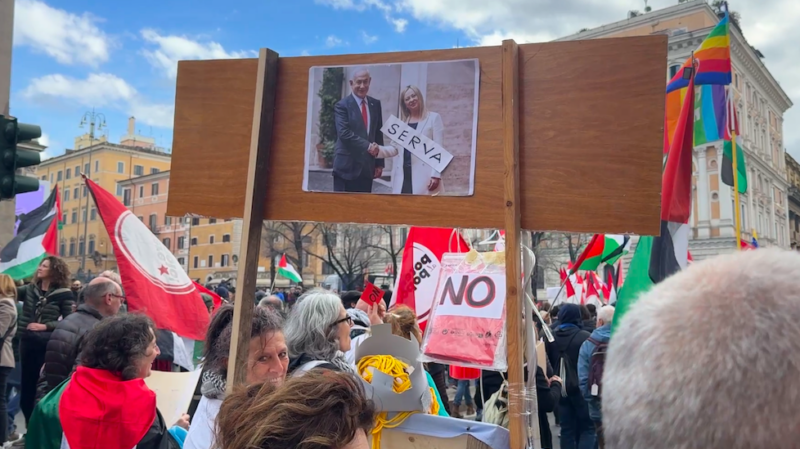
The war itself—sparked by strikes attributed to the United States and Israel—has raised alarm across Europe. Protesters repeatedly referenced the roles of Donald Trump and Benjamin Netanyahu, accusing them of escalating regional instability and dragging allies into confrontation.
NATO Under Scrutiny
Beyond immediate policy concerns, the protests have revived a longstanding debate about Italy’s membership in NATO. Speakers at rallies argued that the alliance, once justified as a defensive structure, has become a vehicle for offensive operations aligned with U.S. geopolitical priorities.
“The best solution would be, of course, abandoning NATO, because NATO is now obsolete,” says Marcelli, criticizing what he described as an unequal relationship “among someone which commands and someone which obeys.”
In parallel, the transatlantşc relation to the United States, with Trump and Meloni being allies, is being questioned. “The US says you are either their friend or foe. We do want to be friend of the United States. But to be their friend does not mean to be their servant”, says Luca Sommi, journalist at the daily newspaper Il Fatto Quotidiano.
Such views remain controversial within Italy’s political establishment but are gaining traction among segments of the public, particularly younger demonstrators. Activists point to rising energy costs, migration pressures, and security concerns as indirect consequences of foreign military engagements.
Public Opinion vs. Political Leadership
Despite divisions among political parties, there is evidence of broad public skepticism toward military involvement. “Italian public opinion is a big majority not willing to be engaged in war,” a protester in the march says, invoking Article 11 of the Italian Constitution, which renounces war as a means of resolving international disputes.
This disconnect between public sentiment and government policy has become a focal point of the protests. Demonstrators argue that while citizens favor neutrality and diplomacy, political elites remain bound by transatlantic commitments.
Even within institutional politics, dissent is emerging. Opposition voices, though fragmented, have criticized the government’s alignment with Washington. Some protesters pointed to the stance of Pedro Sánchez as an alternative model, noting that his more critical approach to military escalation has resonated among anti-war groups in Italy.
A Referendum as Political Turning Point
Adding to the volatility is an upcoming constitutional referendum, scheduled for this weekend, which many now see as a de facto vote of confidence in Meloni’s leadership. Originally focused on judicial reforms, the referendum has been reframed by activists as an opportunity to challenge the government’s broader agenda—including its foreign policy.
“If the ‘no’ prevails, we could be a step forward in this very important struggle,” says Sommi, suggesting that a defeat for the government could open space for a shift toward a more explicitly pacifist stance.
While Meloni has stated she will not resign regardless of the outcome, analysts say a rejection at the ballot box would weaken her political authority and embolden opposition forces.
A Growing Movement
On the streets, the protests show little sign of fading. Participants describe a “continuous wave” of mobilization, driven in part by youth engagement. “I know a lot of young people… that are on the street and they are against… the peace in the world. And this is a very good sign,” observes Sommi.
Trade unions, student networks, and civil society groups are now coordinating efforts at both national and European levels, aiming to build a unified anti-war front. Their demands are clear: no military involvement, no logistical support for armed operations, and a re-evaluation of Italy’s role within NATO.
As tensions in the Middle East continue to escalate, Italy finds itself at a crossroads—caught between alliance obligations and a public increasingly wary of war. The outcome of this weekend’s referendum may not only shape domestic governance but also determine how far Rome is willing to go in aligning itself with the West’s next conflict.