


Franco’s long-standing dictatorship led to an even deeper sense of the social cost of the war. Consequently, anti-war sentiment in Spain emerged from lived experience.
Franco’s long-standing dictatorship led to an even deeper sense of the social cost of the war. Consequently, anti-war sentiment in Spain emerged from lived experience.
By Cemil Gözel
Spain’s distanced approach to the Iran–US/Israel war has earned significant recognition, particularly in Türkiye. The Madrid administration first revealed its anti-war position with the statements of Prime Minister Pedro Sánchez, and soon after, it announced that the US cannot use its bases on Spanish soil for this war.
The historical context of Spain’s anti-war stance
Explaining Spain’s policy solely through current diplomatic calculations is insufficient. In my view, it should also be understood as a legacy of the Spanish Civil War. Because the civil war was one of the most devastating and formative events in Spain’s recent history. It fostered a strong anti-war consciousness and a tendency to avoid involvement in international conflicts among the Spanish public.
The Spanish Civil War was not merely a war among the Spanish. It was also a proxy battleground for the ideological and military rivalries of the great powers. The nationalist forces led by Francisco Franco were backed by Germany and Italy, while the Soviet Union supported the Republican side. As many historians note, Spain experienced a rehearsal of the approaching World War.
Civil wars differ from non-civil wars in some ways, particularly in terms of methods. The position of allies, the tools employed, class relations, and the stances of international actors: all of these factors find their meanings in this context. The Spanish Civil War offers a concrete case for observing these distinctions concretely.
From imperial wealth to deadlock
Tracing Spain’s historical adventure from the 16th century helps illuminate the conditions that led to the civil war.
Spain’s rule over trade routes, especially during the 16th century, enriched the country. Tons of silver flowed into Spain annually. For example, the Silver Fleets arriving in Seville were of a magnitude to shake the European economy. Some historians call this period the “Age of Silver”. However, since this wealth was largely dependent on colonial silver and trade monopolies rather than production, Spain couldn’t leap from mercantilism to industrial capitalism. Industrial development lagged, silver was dispersed across Europe, a great inflation called the Price Revolution came out and by the 17th century, prosperity had shifted to the Netherlands and England.
From the 17th century onward, Europe became a continent of revolutions. Countries like England and France made revolutions that changed the course of history as a result of the commercial bourgeoisie gaining power against the aristocracy and development of industrial capitalism. Spain, however, went through a different historical process from that led to bourgeois revolutions. The wealth derived from colonies in the 16th century did not foster a new productive bourgeoisie; instead, it consolidated the power of the landed aristocracy, the Catholic Church, and commercial and financial sections of society. While the commercial bourgeoisie in many European countries was gaining leverage against the aristocracy, in Spain this class had been effectively shaped by the Church itself. A strong consensus emerged among the Church, aristocracy and the commercial class. As many historians frequently note, this alliance delayed the emergence of a modern industrial bourgeoisie. By the 19th century, while other European countries were undergoing revolutions and industrialization, Spain retained a semi-feudal, Church-oriented social structure. The core social forces backing Francisco Franco in the civil war were largely this historical bloc.
Larry Collins and Dominique Lapierre’s novel “Or I’ll Dress You in Mourning” portrays the social fabric of rural Andalusia through the life of the famed bullfighter Manuel Benítez, “El Cordobés”. One of my beloved novels. In Andalusia, the Church and large landowners formed an intertwined power structure, while impoverished and landless peasants often struggled just to feed themselves. The novel vividly illustrates the tensions created by Spain’s unequal social structure and the class contradictions accumulating in rural areas. To understand the historical foundation that drove Spain into civil war, and the role of the social bloc built around the Church, aristocracy, and large landowners, this novel is unique.
Republic, coup and civil war
With the accession of Alfonso XIII to the throne as an adult in 1902, the constitutional monarchy in Spain once again came under the direct influence of the king. In 1923, General Miguel Primo de Rivera seized power in a coup and ruled the country as a dictator until 1930. After the collapse of the monarchy, the Republic was proclaimed in 1931. But Republican governments struggled to implement reforms concerning land, the army, and the Church that were part of their program. The 1933 elections brought right-wing parties to power, heightening political tension. The new right-wing governments’ repression of Republican and labor movements caused widespread unrest. When Republicans won in the 1936 elections, the conflict escalated into an open confrontation. That same year, General Francisco Franco, backed by a broad right-wing coalition encompassing the Church, large landowners, monarchists, and Falangists, launched a coup. This was the start of epic battles between armed workers and coup-plotting soldiers in cities such as Barcelona and Madrid, igniting the Spanish Civil War.
Historically, Spain was one of the latecomers to the working-class uprisings in the West. In his book “Revolutionaries”, Eric Hobsbawm emphasizes that during a period when the most successful modern revolutions were establishing their historical hegemony, Spain was unable to take advantage of this momentum. Indeed, by the 1930s, the working class had grown to make up about a quarter of the country’s population. That is, when the Republicans first came to power, there was indeed a social base for them. But it appears that the organized center capable of leading a revolutionary transformation was not enough prepared. So, when the revolution erupted, they faced an organized enemy and were neither as disciplined nor organized.
The disaster of anarchism
The social tensions in Spain were not only between left and right; ideological fractures were also evident within the revolutionary camp itself. According to Hobsbawm, anarchism played a decisive role in the revolutionary movement’s defeat. However, that’s not all. Hobsbawm, citing Raymond Carr, also highlighted how all Spain’s revolutions happened in a “dynastic style”. The prevalence of anarchism can also be traced to this sociological context. For there were undoubtedly reasons specific to Spain’s ‘dynastic-style revolutions’ as to why anarchism, which had been in decline worldwide, particularly after the Soviet Revolution, became a prominent ideological movement in Spain. In other words, this fact was also due to the traditional political habits of revolutionary Spaniards.
These traditional political habits are depicted in one of the most evocative novels about the Spanish Civil War, “For Whom the Bell Tolls”. The Republicans’ anger toward the Nationalists was often fueled less by straightforward class struggle than by the sharp atmosphere of confrontation that the war itself produced. Hobsbawm also points to another explanation for anarchism’s place in Spain: “Anarchism was a disaster because it made no attempt to change the style of primitive Spanish revolt, and deliberately reinforced it.”
To be fair, one should add that other factors contributed to the failure of the Spanish Revolution: The rural population couldn’t be won over (Franco’s coup had effectively succeeded in many countryside regions), the industry did not develop as much as it would have in a country that became wealthy at an early stage which left a pre-industrial proletariat largely intact, Spain remained socially and politically isolated from the socialist bloc, revolutionary intellectuals were numerically weak, and the policies of the Communist International were sectarian. Excesses by secret police linked to the Soviet Union could be added to this list.
For a memorable interpretation, building on Eric Hobsbawm’s description of the Spanish Revolution as “a marvellous dream of what might have been, an epic of heroism, the Iliad of those who were young in the 1930s,” one can draw a connection between the “primitive style of rebellion” of the Spanish Revolution and its utopian and heroic dimensions as follows: the “primitive style of rebellion” is linked to anarchism, while the utopian dimension to the international solidarity and of extraordinary heroism of communists worldwide.
The legacy of the Civil War
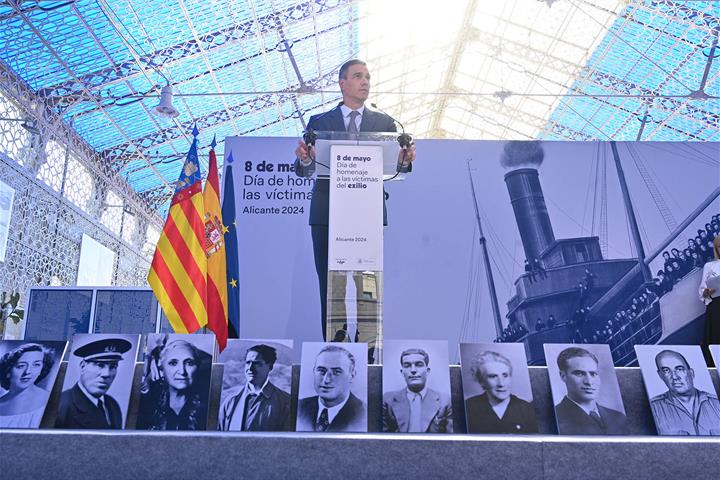
The Spanish Civil War was also a devastating experience that remains etched in the memory of a generation. Franco’s long-standing dictatorship led to an even deeper sense of the social cost of the war. Consequently, anti-war sentiment in Spain emerged from lived experience. Today, the Madrid government’s cautious stance toward military adventures in international crises reflects the imprint of this historical memory. The Pedro Sánchez government’s anti-war stance regarding the Iran-US/Israel war and its announcement that it won’t permit US bases in Spain to be used in such operations, can be read as a contemporary manifestation of sensitivity stemming from Spain’s near past.
Cover graph: Pedro Sánchez announces that he will use all the means of the rule of law to protect the democratic memory and the dignity of the victims of Francoism, 2024.