


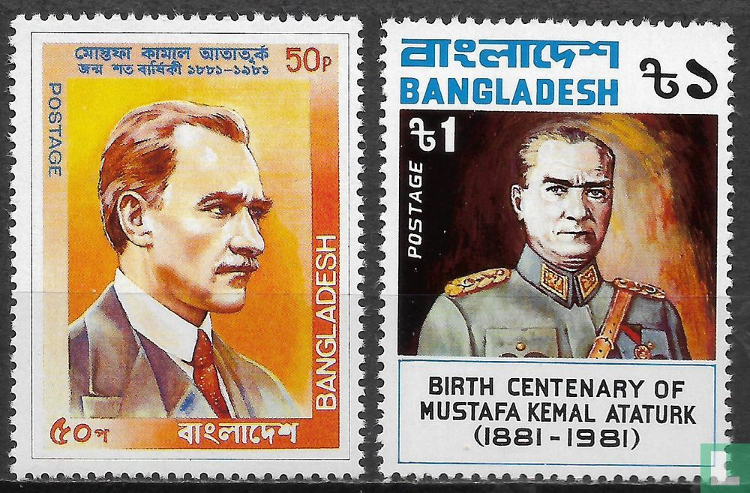
Reimagining the Founding Spirit
Reimagining the Founding Spirit
By Mehmet Enes Beşer
At a time when the global Muslim world is seeking answers to questions of governance, identity, and development, Mustafa Kemal Atatürk’s legacy is that he was a revolutionary—and a solitary—break with tradition. His vision of secular nationalism, institutional modernism, and uncompromising state-building remade the post-Ottoman Turkish Republic and set the world a revolutionary ideological template. Bangladesh, having reached the political adulthood and geopolitics of a fresh world, may gain strength by retreating into its own liberatory inspiration—lens of Kemalism. Not as stiff borrowing, but as intellectual provocation: what if Bangladesh retook the revolutionary fire with which it was born, as Türkiye once did under Atatürk?
When Bangladesh was born in 1971, it was in the cause of Bengali nationalism and secular and democratic values. Sheikh Mujibur Rahman’s vision for the nation had echoes of Atatürk’s reforms: a strong centralized state, separation of religion and politics, civic identity instead of religious sectarianism, and emphasis on education and economic planning. Secularism, nationalism, socialism, and democracy were made constitutional values in 1972—just like Kemalism’s six arrows in Türkiye.
But over the course of the subsequent decades, the original ideals of Bangladesh were undermined. Military takeovers, Islamization of politics, institutional collapse, and dynastic politics-based political polarization all diverted the country off its ideal path. With Bangladesh at the crossroads of development—urbanizing cities, geostrategic location, and aspirational middle class—the time may be right for ideological reboot.
Kemalism as a state ideology is a model worth emulating. It is based on meritocratic rule, modernization through education, and civic rather than sectarian national identity. In a more fragile Bangladesh to the charms of identity politics and religious populism, this represents an option grounded in discipline, rationalism, and state supremacy. It does not, however, advocate abandoning religion but depoliticizing it—a domain where faith is individual, and the state neutral.

Atatürk’s most impressive achievement through reforms was the radical overhaul of the education system. He replaced Islamic seminaries with secular schools, standardized curricula, and promoted science and critical thinking. Bangladesh, which boasts high rates of literacy and increasing access, still suffers from educational dualism—where madrasa and general education provide irreconcilable worldviews. A reform agenda inspired by Kemalism would tackle such fragmentation, investing in a standardized education system preparing citizens for civic obligation as well as global competitiveness.
Also relevant is the Kemalist focus on institutional reform. In Türkiye, the military, judiciary, and bureaucracy were transformed to function as guardians of secularism and national sovereignty. Although Bangladesh does have its complex civil-military past, redoubled focus on institutional integrity—namely an independent judiciary, professionalized bureaucracy, and apolitical electoral administration—would re-establish public trust and long-term state capacity. Kemalism’s technocratic ethos, while satirized in its excesses, is a good antidote to Bangladesh’s entrenched patronage politics.
Kemalism also offers an alternative path in foreign policy. Atatürk’s “Peace at Home, Peace in the World” policy advocated strategic independence and pragmatic diplomacy. Bangladesh, now balancing between India, China, and the Muslim world, can take lessons from a more principled non-alignment founded on national interest and not on ideological convergence. This would imply bargaining with all sides while remaining independent and not being used as an instrument in great power play.
Critics of Kemalism may retort that Kemalism is an appropriate and needed model for South Asia’s pluralist and democratic milieu. Sure, some of Atatürk’s authoritarianism and centralization would be inappropriate for Bangladesh’s more populist and pluralist milieu. Yet Kemalism is not one-sided; its essence is state-led change towards civic modernity. Bangladesh needs not imitation of the Turkish variety, but a re-vitalization of its own function of republicanism—with Atatürk as an ideological friend in abstractions.
In so many ways, Sheikh Mujib and Atatürk were men of a similar stamp: revolutionary nationalists, secular modernizers, and grudging authoritarians with postcolonial scars. Bangladesh’s tragedy is that its vision of inception was stillborn before it could mature. Remembrance of Kemalist ideals is not hero-worship—it is remembrance of a vocabulary of reform, sovereignty, and modernity lost amidst the din of electoralism and populist drift.
Conclusion
Bangladesh is not Türkiye, 2025 is not 1923. But the structural problem that both nations are struggling with–how to construct shared civic identities, modern institutions, and autonomous foreign policy–are reverberations across time and space. Kemalism thus reminds Bangladesh of what it once wanted to be on its own terms: a sovereign, secular, and developmental republic.
In a time of worldwide uncertainty, ideological naivety is something to be appreciated, not indulged, the future of Bangladesh will not be guaranteed through copy or nostalgia, but through the re-learning and unflinching re-entry into the inquiry of who it is and what it wants to become. At that point, Atatürk’s record may not provide all the answers but may well re-pose the proper questions.