


Politicians and experts from Bangladesh and Pakistan shared their views with UWI.
Politicians and experts from Bangladesh and Pakistan shared their views with UWI.
Following the US and Israeli attack, Iran responded regionally. The effects of the conflict are beginning to be felt worldwide. What are the perceptions of politicians and experts in South Asia? We asked leaders and experts in Bangladesh and Pakistan.
Bangladesh Workers’ Party: Iran the latest chain after Venezuela, Cuba
With a population of 170 million, Bangladesh is the seventh most populous nation in the world. The country is predominantly Muslim. But Prof. Susanta Kumar Das of the Workers’ Party of Bangladesh takes a global perspective:
“We are seeing the case of Venezuela. We are following states of the USA on Cuba and in Bangladesh also recently. And we are apprehending the USA that is a warmongering situation of the present ruling class of the USA. They are trying to make the whole world in a situation of war, actually.”
Kumar Das says that the US has also intervened into his country recently.
“In Bangladesh, there was a regime change and American imperialism has penetrated in our political situation also. We are trying to get out of it, but it’s very difficult. America has got some global planning in the South Asian region, that means in Asia -Pacific region. They are trying to make another issue in the South Asia, Middle East, so that they can bridge the link of oil and energy transmission to China and other places in South Asia, so that they can make some block regular transmission of oil and energy in different places of the world. It is their strategic plan.”
His party has been part of the governing coalition until recently, and now in opposition. is preparing to protest.
“We are now building a platform, preparing to take to the streets to protest democratically against imperialist penetration worldwide.”
Pakistan: Mounting anger
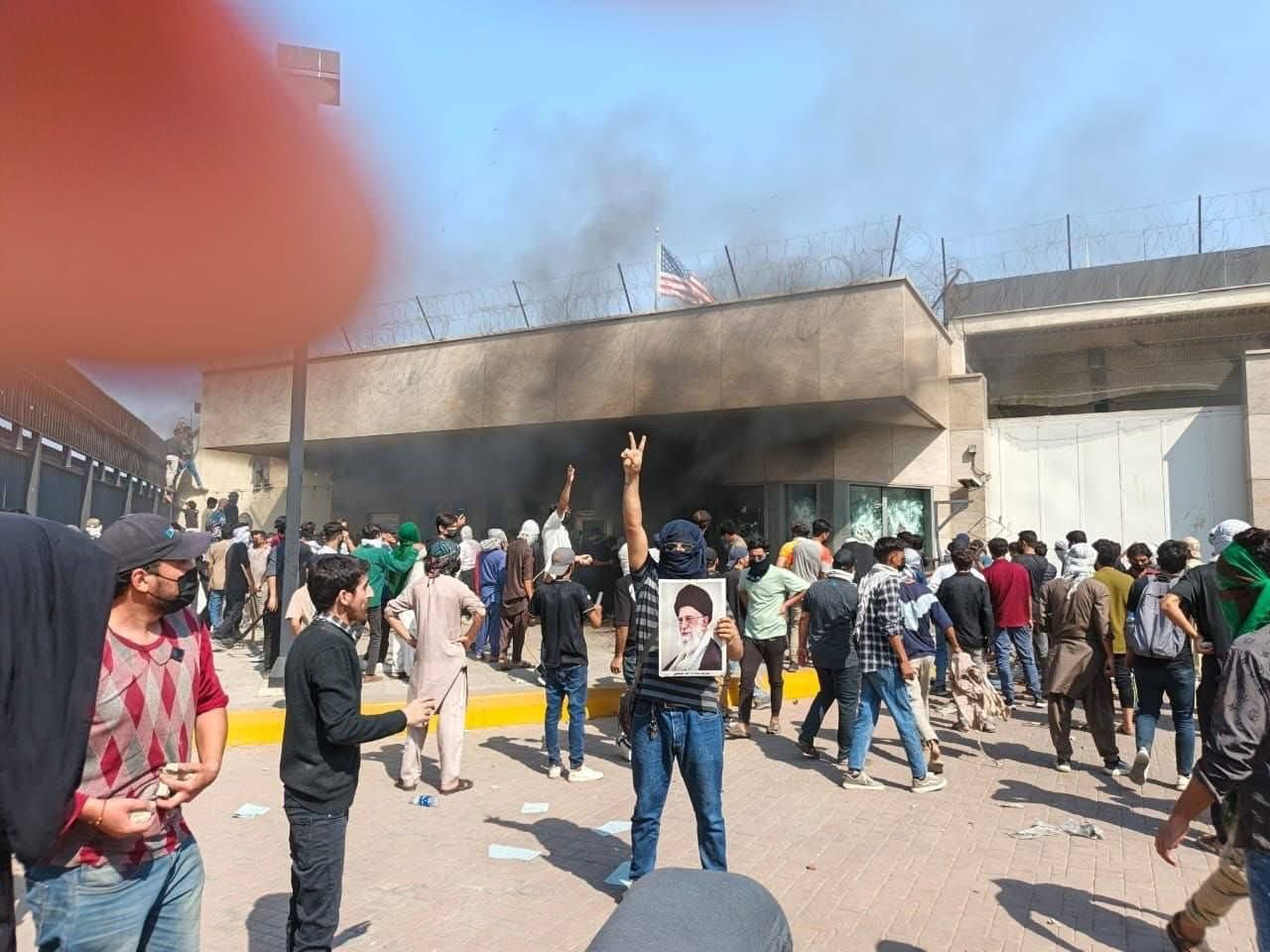
Protests have already begun in Pakistan, a country with a population of 240 million. The Shiite minority is at the forefront of the protests against US diplomatic missions.
Dure Akram, journalist and frequent contributor to UWI, describes the atmosphere in the country as follows:
“Anger has been simmering across Pakistan because the country is home to one of the largest Shia populations in the world. And they are very, very, very, very passionate when it comes to Ayatollah Khomeini because they call him their spiritual leader. And even though they are a minority here in Pakistan, they have a lot of clout, and there is a large number.”
Protesters targeted US diplomatic representations in Karachi, the country’s most populous city, as well as in Lahore. They tried to access the diplomatic zone in Islamabad. Several protesters lost their lives under suspicious circumstances, says Akram.
US Marines shooting protesters?
“According to Faisal Edhi, who runs the largest ambulance system and network in Pakistan and is the son of award-winning philanthropist Abdul Sattar Edhi. He noted that at least 30 protesters were wounded critically, and they had bullet wounds and according to him the wounds that the wounded sustained they were due to fire due to shots that those were fired from within the embassy within the consulate. Now local media reports are very divided on this because some say that it was the guard stationed outside the consulate though who were Pakistani, and they were the ones who actually fired the shots and there is a small minority who believes that U.S. Guards were involved.”
Investigations are ongoing, says Akram, who also emphasizes that some protesters seem to be armed. Meanwhile, she adds, is support growing among the Sunni population.
“Sunni population was a little ambivalent to Iran’s leadership, Iranian leadership and Khomeini in general. However, the last few years, have seen Ayatollah Khamenei rise to the occasion as a voice which is very critical of Jewish lobby when it comes to Gaza. And because of that, Most, if not all, of the Sunnis do have some soft corner when it comes to Khomeini.”
The protests are also getting in motion the political landscape of Pakistan, putting the government under pressure, says Umer Farooq, a Pakistani analyst.
“There is a demand by the political parties, main political parties, that the Pakistani government should come up more openly against Americans, more openly against Israelis, because previously Pakistani government participated in board of peace meeting in Washington.”
Trump’s Nobel Prize nomination in danger
Pakistan was one of the countries that nominated US President Trump for the Nobel Peace Prize, being criticized fiercely today.
“So that of the government is coming under scathing criticism by the opposition, by the intellectuals and by the media. And there’s a demand that Pakistan should withdraw Nobel Peace Prize nomination of President Trump.”
But today, even within the security apparatus, a fear is emerging about what comes after Iran.
“There is a widespread perception in Pakistan. The social media is full of speculation about Pakistan being the next target after Iran. But yesterday our military spokesman gave an interview to an international channel, and he came out categorically he categorically stated that there’s a huge difference between Iran and Pakistan. Pakistan is established, quote unquote, Pakistan is established nuclear power, and the world does not want or does not desire the consequence of attacking a nuclear power”, says Farooq.
Pakistan suspicious of Israel
Akram agrees: “In the eyes of a growing number of experts sitting here in Islamabad, and even in the diaspora, they believe that an attack on Iran was just the opening act. And they have valid fears for their own safety, for their own sovereignty, because Pakistan is a nuclear power, Israel is also a nuclear power. And there has always been a tussle when it comes to nuclear aims of Israel. Israel views Pakistan with suspicion. Pakistan views Israel with suspicion.”
The military spokesperson’s statement intended to cool down worries, says Farooq. “The military spokesman would not have come out openly to give such a statement about the preparation for retaliation and for asserting Pakistan’s nuclear status if there was no concern within the official circles. There is a concern.”
And on top of it, recent contacts between Israel and India, Pakistan’s arch-rival, he emphasizes: “But I think the India-Israel connection, you know, just two days before Israel attacked Iran, the Indian Prime Minister visited Tel Aviv and there was a growing military cooperation between Israel and India and that’s a perennial fear of Pakistani society and state that Israel might attack Pakistan.”
If Iran falls, Israel will be neighbor of Pakistan
The positioning gets more complicated, given that Pakistan has a defense agreement with Saudi Arabia. How does the country position itself and how would it react if clashes escalated, we asked Farooq:
“If you go by the statements and analysis of Pakistani strategic thinkers, foreign policy, fear that if the regime in Iran collapses, the de facto borders of Israel will be on Pakistan’s southern border. If a pro-Israel government comes to power in Iran, then Israel de facto border will be on our southern border. That’s a perennial fear. Meanwhile, if Saudi Arabia is persistently attacked by Iran, the public opinion might get divided in Pakistani society between pro -Saudi and pro -Iranian opinion. And the Pakistani government will be in a very difficult situation if Iran continues to attack Saudi Arabia because Pakistani people and Pakistani military leadership has a very emotional attachment to Saudi Arabia. So, Iran would be wise if they don’t want to lose Pakistani support, they should not attack.”
The overall picture in two of the most populous Muslim countries in South Asia shows that, while Washington seeks to dominate West Asia, it jeopardizes its position in the south of the continent.
Of all the possible scenarios, the most innocent for Washington maybe the cancellation of Trump’s nomination for the Nobel Peace Prize.