


U.S. interventions in the Middle East, particularly military operations against Iran, are shaped more by internal political dynamics—chiefly the Israel lobby—than by national interest calculations
U.S. interventions in the Middle East, particularly military operations against Iran, are shaped more by internal political dynamics—chiefly the Israel lobby—than by national interest calculations
By Dr. Halim Gençoğlu
It is not surprising that Indian Prime Minister Modi was welcomed by Prime Minister Benjamin Netanyahu at Ben Gurion Airport on February 25, 2026, as part of a two-day program that included his historic speech to the Israeli Parliament and a visit to the Yad Vashem Holocaust Memorial. The most striking element of the visit was Modi’s condemnation of the October 7, 2023, Hamas attack as a “barbaric terrorist attack” in his speech to the Knesset, and his emphasis that “no cause can justify the murder of civilians,” thereby supporting Israel’s position. The speech called for global coordination in the fight against terrorism but did not openly address the ongoing conflicts in Gaza, where more than 72,000 Palestinians have been killed in this process, creating a humanitarian crisis. The fact that the attack on Iran occurred immediately afterward is no coincidence.
Indeed, in the post-Cold War period, U.S. Middle East policy has frequently been legitimized under pretexts such as the so-called fight against terrorism, preventing the proliferation of weapons of mass destruction, or exporting democracy. However, when examining the occupations of Vietnam (1965-1973), Iraq (2003-2011), and Afghanistan (2001-2021), it becomes clear that most of these operations served other purposes and were strategically high-cost endeavors. On the other hand, they resulted in the deaths of tens of thousands of civilians, trillions of dollars spent, regional instability, and the emergence of new radical movements. This inconsistency raises questions about the classical realist theory’s assumption of “states’ rational interest maximization.” In other words, while America plundered these regions, its sole focus was not merely material gain but maintaining control over countries as it wished for political interests.
A significant portion of U.S. foreign policy operates under the influence of what is called the Israel lobby (AIPAC), Christian Zionist groups, neoconservative think tanks, and allies in Congress. This lobby ensures unconditional U.S. support for Israel and fuels conflict with countries like Iran.
Mearsheimer and Walt define the Israel lobby as a collection of individuals and organizations working to shape a pro-Israel U.S. foreign policy. According to this theory, AIPAC forms the core of the lobby and targets Congress. Through campaign donations, voter mobilization, and creating perceptions of anti-Israel stances as antisemitism, they discipline lawmakers. Neoconservative intellectuals and the Christian Evangelical base influence public opinion. These mechanisms marginalize critical voices while directing politicians to prioritize Israel’s security concerns above all.
From Vietnam to Iraq and Afghanistan
In the occupations, fears of communism in Vietnam, alleged weapons of mass destruction in Iraq, and al-Qaeda in Afghanistan were presented to the public as justifications, yet the strategic returns of these interventions remained limited. In particular, the 2003 Iraq invasion is, according to Mearsheimer and Walt, one of the lobby’s most evident victories, as toppling Saddam would reduce Israel’s perceived regional threats. The neocons’ dominance in the Bush administration demonstrated the lobby’s indirect influence.
Iran Policy and the Bombing Scenario
Iran’s nuclear program is framed as an existential threat to Israel, a framing that finds strong resonance in the U.S. Under the lobby’s influence, the U.S. pursues harsh sanctions, diplomatic isolation, and military threats. A hypothetical airstrike campaign cannot be explained by realist logic, as Iran does not pose a direct threat to the U.S.; its nuclear capacity serves regional deterrence purposes. Such an attack would cause oil price explosions, tensions with allies, and new jihadist waves. However, the lobby’s pressure on Congress, media dominance, and “second Holocaust” rhetoric make such an operation politically feasible. Politicians who oppose it are branded as unreliable allies and targeted in elections.
Perhaps in 1941, during the Anglo-Soviet occupation of Iran, Reza Shah Pahlavi was deposed by a coup using similar logic. Britain was uncomfortable with his pro-German policies and sent the Shah into exile—first to Mauritius Island, then to South Africa, where he died of a heart attack in 1944. This was an example of Britain neutralizing an unwanted leader by exiling him to a remote place of their choosing, without the Shah having any say.
Today, the forced removal of unwanted leaders like those in Venezuela or Khamenei in recent years, supporting certain allies and then abandoning them, or backing opposition figures, is exactly a product of the same imperialist policy. In the Iranian context, for example, Reza Shah’s son, Crown Prince Reza Pahlavi, lives in exile in the U.S. and opposes the Iranian regime. While he supports U.S.-Israeli interventions as humanitarian interventions and calls on the Iranian people to rise against the regime, this primarily draws attention as the U.S. harboring an opposition figure against the Iranian regime.
Ayatollah Ali Khamenei’s Contacts with African Leaders
During his tenure as Iran’s leader (1989-2026), Ayatollah Ali Khamenei shaped relations with the African continent generally within the framework of anti-Western sentiment, anti-imperialism/anti-colonialism discourse, and emphasis on independence. Solidarity remained strong at the rhetorical level; in practice, policies were limited.
Khamenei frequently praised Africa in his speeches in the context of resistance and independence. For instance, he paralleled African countries’ post-colonial struggles with the Iranian Revolution and called for unity and development. Iran’s support for Shia communities in Africa (especially groups like the Islamic Movement in Nigeria) was also part of this solidarity.
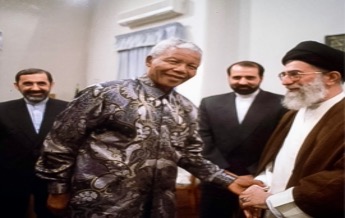
In 1992, Nelson Mandela visited Tehran shortly after his release from prison (1990) and before becoming President of South Africa (1994). This visit occurred because Iran supported the ANC (African National Congress) against the apartheid regime. In his meeting with Ayatollah Khamenei, Mandela addressed him as “my leader” and thanked the Iranian government and people for their support in the anti-apartheid struggle. The meeting featured a warm embrace, and Mandela praised the Iranian Islamic Revolution as a successful example of resistance against oppression.
This encounter remains one of the strongest pieces of evidence for Iran’s “oppressed nations” alliance discourse and is still frequently shared. Mandela’s visit was a key event legitimising Iran’s anti-Western, anti-imperialist stance in Africa.
There are photos and shares indicating that Khamenei met with Burkina Faso leader Sankara in the early 1980s, during their youth, before Sankara became president. Both fought similar struggles against Western dominance, debt traps, and dependency. Sankara approached it with a Marxist perspective, while Khamenei operated under Islamic Revolution ideology.
Sankara was assassinated in 1987, but this meeting left a symbolically powerful message. It represented the anti-imperialist solidarity of two revolutionary figures. Khamenei often compared anti-colonial struggles in Africa to the Iranian Revolution, and Sankara was recalled as an inspirational source in this context.
Although this solidarity remained largely at the ideological and rhetorical level rather than deep economic or military cooperation, it still generates sympathy in political circles in Africa.
Conclusion
Today’s U.S. bombing of Iran resembles the continuation of the Vietnam-Iraq-Afghanistan chain. Here, rather than strategic cost-benefit calculations, the security concerns of a specific ally (Israel) have been prioritized over national interests. This demonstrates that American foreign policy has been captured by internal lobby dynamics rather than rational state interests. Mearsheimer and Walt’s realist critique illuminates this deviation that weakens U.S. global hegemony. From this perspective, conditional aid to Israel instead of unconditional support, and diplomacy with Iran, would serve the long-term interests of both the U.S. and Israel. Although the lobby’s influence is debated, this thesis remains an indispensable tool for understanding Middle East policies.
This reveals that U.S. interventions in the Middle East, particularly military operations against Iran, are shaped more by internal political dynamics—chiefly the Israel lobby—than by national interest calculations. The strategic cost-benefit mismatch observed in the Vietnam, Iraq, and Afghanistan wars also manifests in the Iran scenario. The U.S. undertaking bombing-like actions against a country thousands of kilometers from its borders, which poses no direct vital threat, exemplifies its imperialist politics. While this war sidelines America’s global hegemony, time will show how prioritising a specific ally like Israel damages American national interests and under what calculations.
Sources
Gençoğlu, H. (2024, February 4). Why isn’t Palestinian history taught in SA universities? Cape Argus. https://www.iol.co.za/capeargus/opinion/2024-02-04-why-isnt-palestinian-history-taught-in-sa-universities
Gençoğlu, H. (2024, February 11). Is South Africa anti-Semitic? The answer lies in the context. Cape Argus. https://www.iol.co.za/capeargus/opinion/2024-02-11-is-south-africa-anti-semitic-the-answer-lies-in-the-context
Gençoğlu, H. (2024, February 25). Good Jews, bad Jews: A historical analysis. Cape Argus. (Not: Bu yazı Cape Argus / Sunday Tribune ortak yayınlarında yer alır, Filistin bağlamında Yahudi tarihi ve ayrımcılık tartışır.)
Gençoğlu, H. (2024, September 26). What US did to Native Americans, Israel is doing to Palestinians. Cape Argus. https://capeargus.co.za/opinion/2024-09-26-what-us-did-to-native-americans-israel-is-doing-to-palestinians
Gençoğlu, H. (2024, October 30). The double standards of European massacres in Africa vs. the Gaza Genocide. Cape Argus. https://www.iol.co.za/capeargus/opinion/2024-10-30-the-double-standards-of-european-massacres-in-africa-vs-the-gaza-genocide
Mearsheimer, J. J. (2001). The Tragedy of Great Power Politics. W.W. Norton & Company.
Mearsheimer, J. J., & Walt, S. M. (2006). “The Israel Lobby and U.S. Foreign Policy.” Harvard Kennedy School Faculty Research Working Paper Series RWP06-011. (Also published in London Review of Books, March 23, 2006).
Mearsheimer, J. J., & Walt, S. M. (2007). The Israel Lobby and U.S. Foreign Policy. Farrar, Straus and Giroux.
Walt, S. M. (2005). Taming American Power: The Global Response to U.S. Primacy. W.W. Norton & Company.
Shakoori, M. (n.d.). “Effect of AIPAC Lobby on America’s Foreign Policy towards the Islamic Republic of Iran.” Journal of Politics and Law.
Ahmadi, A. (2014). “Israel Lobby in the US and Iran – P5+1 Negotiations.” Iranian Review of Foreign Affairs, 5(1), 57-87.
Cover picture: South African President Nelson Mandela with Iran’s Supreme Leader Ayatollah Khamenei, 1992