


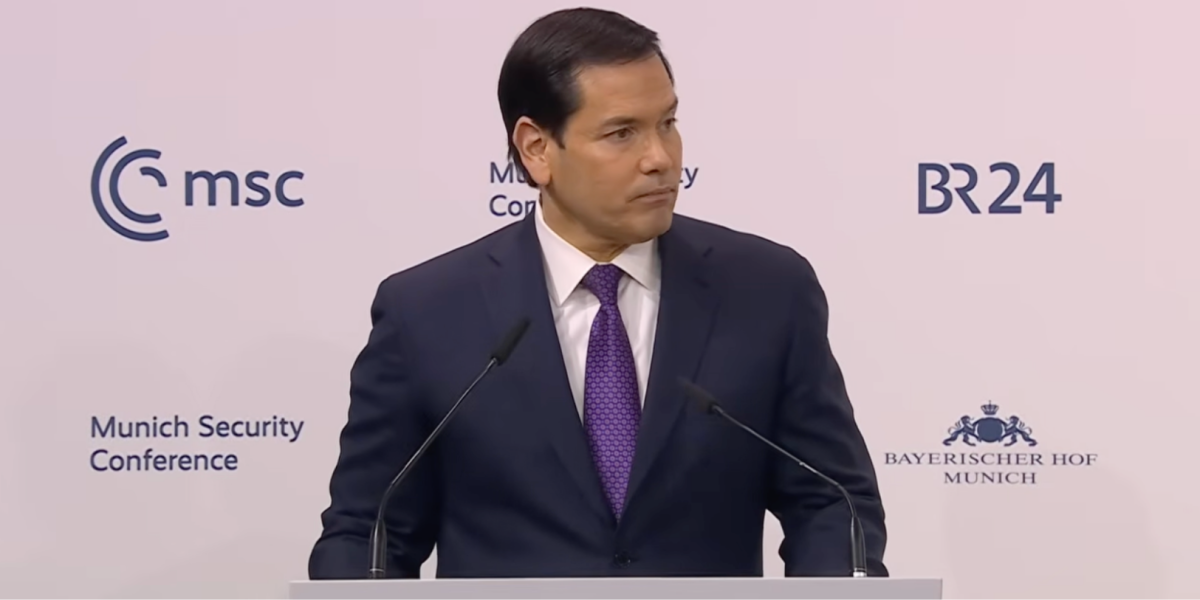
Targeting “godless communist revolutions and anti-colonial uprisings” as reason for “Western” decline.
Targeting “godless communist revolutions and anti-colonial uprisings” as reason for “Western” decline.
“The great Western empires had entered a terminal decline, accelerated by godless communist revolutions and anti-colonial uprisings that would transform the world.”
With these words, US Secretary of State Marco Rubio sparked one of the biggest controversies at this year’s Munich Security Conference.
Rubio’s reference to anti-colonial movements—historically viewed as struggles for liberation—was interpreted by critics as a way of presenting the end of colonial rule as a strategic loss for the West.
His speech raised new questions about the future of Western leadership.
Conference background
The Munich Security Conference is the world’s most influential forum on international security. It is held every year in the German city of Munich, and brings together presidents, prime ministers, foreign and defense ministers, military commanders and strategic experts.
This year, more than 1,000 participants from over 100 countries attended, including dozens of heads of state and government.
For decades, the conference has served as a key platform for defining the global balance of power — and for maintaining the transatlantic alliance between Europe and the United States.
But this year, that alliance seemed more fragile than ever.
Rubio’s speech
Rubio’s speech painted a dramatic picture of Western decline — and called for a fundamental change of direction.
He praised Western imperial expansion, declaring:
“For five centuries, the West was expanding… its missionaries, its pilgrims, its soldiers, its explorers… built vast empires that stretched across the world.”
“Godless communist revolutions and anti-colonial uprisings”
Rubio continued:
“But in 1945, for the first time since the age of Columbus, it was contracting. Europe was in ruins. Half of it lived behind an Iron Curtain and the rest looked like it would soon follow. The great Western empires had entered into terminal decline, accelerated by godless communist revolutions and by anti-colonial uprisings that would transform the world and drape the red hammer and sickle across vast swaths of the map in the years to come.”
Rubio argued that U.S. military power—and not international institutions like the UN—remains the ultimate guarantor of global security, citing examples of the Gaza Peace Council, negotiations with Ukraine, and the kidnapping of Venezuelan President Nicolás Maduro.
“It took American leadership… It took American special forces,” he said. Repeating American criticisms to European policies on migration and climate change and asserting a decline in European civilization, he invited the European Union to join American efforts to defend what he called Western civilization and restore Western dominance over the world.
He also urged Western nations to abandon what he described as excessive self-criticism:
“We want allies who are proud of their culture and heritage… not chained by guilt and shame.”
European reactions
Rubio’s speech included numerous references to the shared history between the United States and Europe and was met with applause in the hall. Even so, European leaders responded with unusually direct criticism.
The EU’s foreign policy chief, Kaja Kallas rejected Rubio’s characterization of Europe, saying, ”Europe is not facing civilizational erasure”.
She condemned the criticism as “fashion”.
Some leaders, among them German Prime Minister Merz, warned that Europe must now prepare to be more self-reliant.
Reactions outside
The criticism extended beyond Europe.
Leaders from other regions warned that global power is changing — and that the era of undisputed US dominance may be coming to an end. Many countries in the Global South have long criticized Western powers for their colonial past and their continued political and military influence. Rubio’s statements brought those historical tensions back into the spotlight.
Protests in Munich
Outside the conference halls, thousands of protesters took to the streets.
The protesters accused Western governments of fueling wars and perpetuating global inequality.
Police were deployed in large numbers throughout Munich, while activists marched with banners calling for peace, justice and an end to the military confrontation.
For many protesters, Rubio’s speech symbolized what they consider a return to an era of power politics and imperial thinking.
Where will Europe head to?
At the conclusion of the Munich Security Conference, his message is clear:
The unity of the West can no longer be taken for granted.
Marco Rubio’s speech has exposed a stance in Washington that decidedly leaves aside multilateralism, international orders, and “politeness” in international politics, announcing the continuation of the “peace through strength” strategy that applies violence without limits over the world. Rubio’s positive evaluation of colonization is a profound threat to the Global South.
To Europe, he invited the EU to join this threat. On the European side, the call by many politicians for greater independence from the United States could lead to either competing imperialisms or a rapprochement with the Global South.
And in a world shaped by the legacy of colonialism and the realities of new global powers, the struggle over who leads—and how—is far from over.