


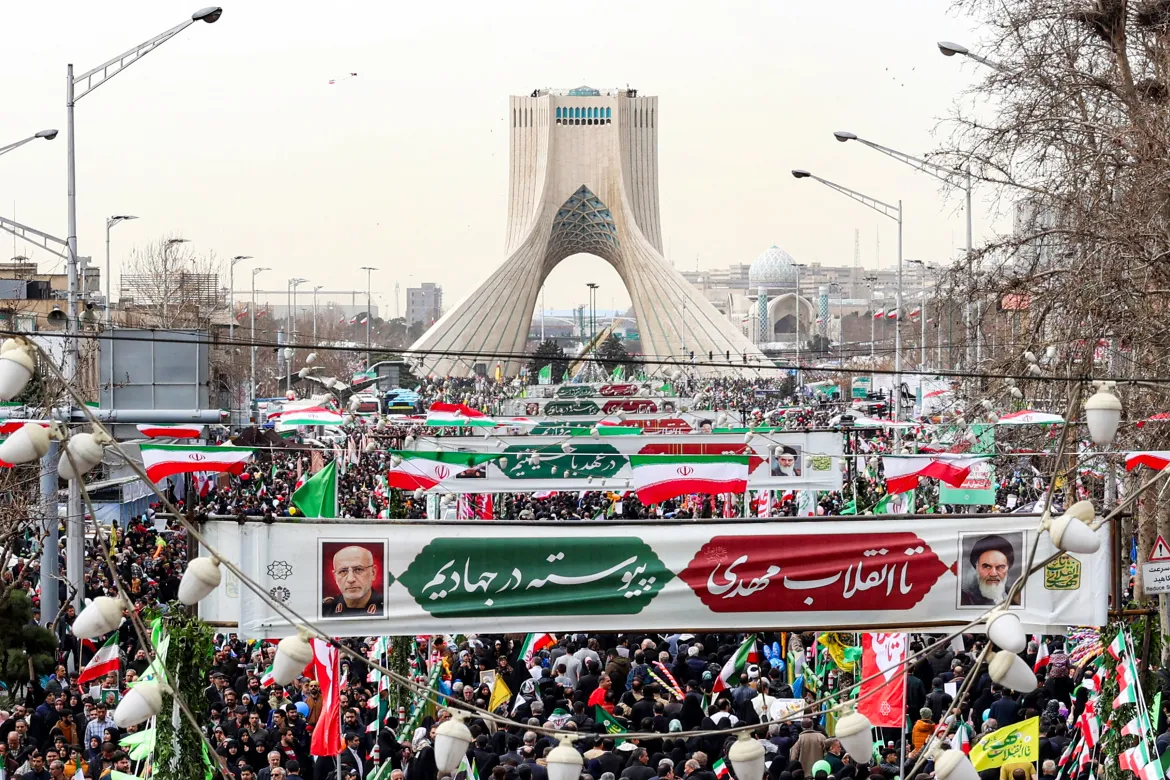
In the words of the Admiral Ali Shamkhani, advisor to Iran’s Supreme Leader Ali Khamenei: “War is not just an exchange of fire or the sound of cannons. We live in conditions of real war and are prepared for any eventuality.”
In the words of the Admiral Ali Shamkhani, advisor to Iran’s Supreme Leader Ali Khamenei: “War is not just an exchange of fire or the sound of cannons. We live in conditions of real war and are prepared for any eventuality.”
To the Islamic Republic of Iran
on the 47th anniversary of the triumph of
the revolution of February 11, 1979.
The leader does not lie. He cannot. He would cease to be a leader. He could not be an ayatollah. Islam does not allow it. When the ayatollah says that an attack on Iran would escalate into a regional war, one can be absolutely certain that it will. Western countries should dedicate some of their vast financial resources to recognizing that our planet is comprised of multiple civilizations, that there is no single worldview, and within that framework, they should learn about the precepts, values, and principles of Shia Islam to understand that…the leader does not lie.
Furthermore, another bombing of Iran would mean that the United States had once again broken its word… if anyone still believes it keeps it. But this time the response would be different; the Islamic Republic learned from the Twelve-Day War and gained the necessary experience to prevent a repeat of those events.
Western geniuses should also know that Cyrus the Great, king of kings of the Persians and creator of the largest empire of his time, conquered Babylon in 539 BC (more than 2,300 years before the United States was born), for which he had to divert the course of the Euphrates River. Cyrus freed the Jews, abolished slavery, promulgated religious tolerance and respect for local cultures, and decreed what is considered the first declaration of human rights in history, all of which is contained in the so-called “Cyrus Cylinder.” It’s hardly the United States that’s in a position to lecture the Persians on human rights, multiculturalism, or religious tolerance.
Last June, sitting at the table in Oman, the United States treacherously “suspended” its plans to attack Iran. Today, they are again conversing indirectly in the same country, and for the second time in less than a year, Washington is threatening aggression. Israel, which desires to orchestrate its own holocaust, persists in pressuring the United States. The genocide in Palestine is not enough; now it wants to carry it out throughout the region, which is why it is also waging war against Syria, Lebanon, Iraq, and Yemen. The patience of Muslims is about to run out.
It is also not difficult to imagine that under current conditions a regional war could escalate, expanding its reach to the point of becoming a global conflict that, in turn, depending on the surrounding situation, the type of weaponry used, and its range, could lead to nuclear war because—if, as expected, Iran responds by destroying Israel, the 19 US military bases in the region, the enormous oil fields of any Arab country that dares to support Washington, and closes the Straits of Hormuz and Bab el-Mandeb, what option would the United States have but to use its atomic weapons?
In the “best” scenario, where the conflict remains confined to the use of conventional weapons, closing the straits would mean pushing the price of a barrel of oil to $200, $300, or more. This would immediately trigger the collapse of between 120 and 140 countries worldwide. The attack on Iran would have escalated into a regional war, and that, in turn, into a world war.
This is the level of “rationality” to which the United States and Israel, Trump and Netanyahu, have led the world. Hiroshima and Nagasaki will remain just another anecdote in the process of planetary destruction that Trump proposes in order to sustain the insatiable greed of the top 1% of the world’s population.
Ignorance and stupidity excuse no one. It should be known that for Shia Islam, building a nuclear weapon would be a sin. Of course, they could do it, and in a matter of hours, but not even the Ayatollah, with all the power and authority he possesses, is authorized to make such a decision. He would have to issue a specific fatwa, and he could only do so if the future of Islam were at stake.
But international events cannot be analyzed from a unilateral and linear perspective. There is always more than one actor, even if one of them may be more powerful than the others. Therefore, studying what happens in the world apart from the internal situation in the United States leads to incorrect conclusions that foster a structural pessimism—the very pessimism that Washington wants to cultivate in order to make people believe that it is all over and that there is no possibility of reversing the fascist trend that the United States is imposing on the world.
At one point, a paid “intellectual” in the United States wrote that history had ended with the collapse of the Soviet Union. History itself has proven him wrong. Now, the United States is going through a critical internal situation that Trump intends to reverse with ever-increasing repression of his own people. In this context, he believes that only war can save him.
This mechanism, known and used by discredited rulers, aims to resolve serious internal crises through external actions. Therefore, it resorts to exalting an ultranationalism intertwined with fascism, unleashing a warmongering spirit designed to provoke instability through threats, coercion, blackmail, and ultimately, war.
As mentioned earlier, Iran drew on the lessons of the Twelve-Day War. China and Russia also took steps to collaborate in order to prevent this potential regional and global war from materializing. The three powers devised catastrophic conflict scenarios that include an open confrontation with the United States. To avoid any doubt about this, China and Russia have already become involved by providing Iran with weapons and satellite intelligence technology that allows the location of US ships and missile launchers, which are now under close observation and monitoring by the Islamic Republic. Is it clear why this would be a world war?
Of course, the United States and its allies could unleash lower-intensity wars to achieve specific immediate objectives in the countries that make up the axis of resistance. This possibility would be countered, on a local or regional scale, by a force of 10 million fighters led by Iran, already equipped with modern weaponry, trained for combat, possessing a strong religious faith, and an ethical and moral superiority that disrupts the balance of power that the United States might be building. In recent weeks, the countries of the axis of resistance have announced their decision to directly join the conflict with their troops if Iran is attacked.
For Iran, it is clear that any eventual war would be open, protracted, and, as they have already announced, would involve popular and military forces from Iraq, Lebanon, Yemen, Palestine, and many other Arab and Muslim countries, sending shivers down the spines of their governments should they dare to support the imperialist and Zionist enemy. A multi-front conflict would erupt, and other latent or dormant conflicts, such as the one between the United Arab Emirates and Saudi Arabia in Yemen, could be reignited. An “African front” could also be activated to counter the Zionist presence in Somalia, which would force Yemen to block any enemy vessel through the Bab el-Mandeb Strait. They have already demonstrated their willingness and ability to do so.
In Lebanon, despite internal political contradictions and the current pro-Western government, the United States continues to exert pressure to try to prevent the resistance and civilian allies of Hezbollah from receiving weapons and financial support from Iran, knowing that within the framework of a regional conflict, this would be the northern front of the war for the recovery of the occupied Palestinian territories.
Iraq, also threatened by the United States and amidst direct intervention and the 23-year presence of imperial armed forces on its territory, has been able to organize a powerful people’s army comprised of approximately one million fighters who raise the banners of a deeply anti-imperialist and anti-Zionist Shiite Islam. Iraq has become the main fighting reserve of the resistance axis for a potential regional war.
In a remarkable display of political maturity, Iraqi Shiite forces have set aside their political differences and their own legitimate aspirations to unite behind former Prime Minister Nouri al-Maliki’s bid to return to office. Al-Maliki is rejected by Washington for his firm convictions regarding the strategic value of an Iranian-Iraqi alliance. His unified candidacy reflects the failure of US policy in Iraq (as acknowledged by Trump himself), which has forced the US to withdraw after 23 years of military intervention that cost the country the lives of over a million of its citizens. Is this why a regional war would be so far-reaching?
That is why I say that, if the current confrontation between the United States and Iran were to manifest itself on the battlefield, it would unleash an extremely destructive war that would spread throughout the region and mark a turning point in the contemporary world.
This conflagration, just as in 1945, will give rise to a new regional order, potentially marking the end of the United States’ massive presence in the region and the demise of Zionism as an instrument for administering and controlling Israel. But even if, in this situation, the United States feels its regional hegemony is threatened and attempts to respond by threatening the world with nuclear weapons, it is highly likely that the majority of humanity would rise up to demand the implementation of a new world order.
For this reason, a US attack on Iran would pose a risk that would challenge peace and could be the start of a third world war if a new order promoting harmony and concord among the peoples of the planet is not established beforehand. Everything indicates that if the United States acted with prudence, it should not unleash a war against Iran, but that is not exactly a quality of US administrations. There is still room for diplomacy to avert a regional and global war that could be thermonuclear in nature. But we must remain vigilant; the more the internal political, economic, social, and legal situation in the United States worsens, and the more its geopolitical alliances continue to be undermined, the more dangerous life on the planet will become.
In conclusion, and for informational and alert purposes, the words of the Commander-in-Chief of the Iranian Army, Major General Amir Hatami, should be taken into consideration: “Our missile and defense capabilities today are in a better and more advanced position than before the Twelve-Day War […] We confronted the enemy with all its science, technology, and integrated methods of warfare and discovered its weaknesses and strengths, as well as our own. Today we are fully prepared […] We have our finger on the trigger, the Islamic Republic of Iran is indestructible.”
It is also important to know the observations made by Admiral Ali Shamkhani, advisor to Iran’s Supreme Leader Ali Khamenei: “War is not just an exchange of fire or the sound of cannons. We live in conditions of real war and are prepared for any eventuality […] Military preparedness means accepting war, not starting it. However, we are facing an unjust war and threats, and they are preparing with all their might […] They are trying to absorb Iran, but that is impossible as long as the Islamic Republic exists. I hope they realize that Iran is not something that can be absorbed. Before spending their money and threatening the security of the region, they should refrain from such actions […] We in the military must consider war inevitable, but according to political reality, there is still time, and these opportunities must be properly seized […] The West does not understand, or does not want to understand, that when we say it is religiously forbidden to produce or possess nuclear weapons, this cannot be translated into practical orders […] In previous rounds, we issued three firm “No”s: We do not seek to possess nuclear weapons And we will not produce them. We will not stockpile them, and they will have to pay the price […] We witnessed this firsthand during the war and we have intelligence on the areas from which the threats have originated. This patience will not be repeated. We have made it clear that we will not be moderate, and we consider the desire of some countries in the region to avoid war to be a sincere effort […] We will undoubtedly continue on the path we have chosen. Our support for the peoples of the region in resistance will continue.”
As the Bible says, “He who has ears to hear, let him hear,” but if you do not want to, always remember that “the leader does not lie.”