


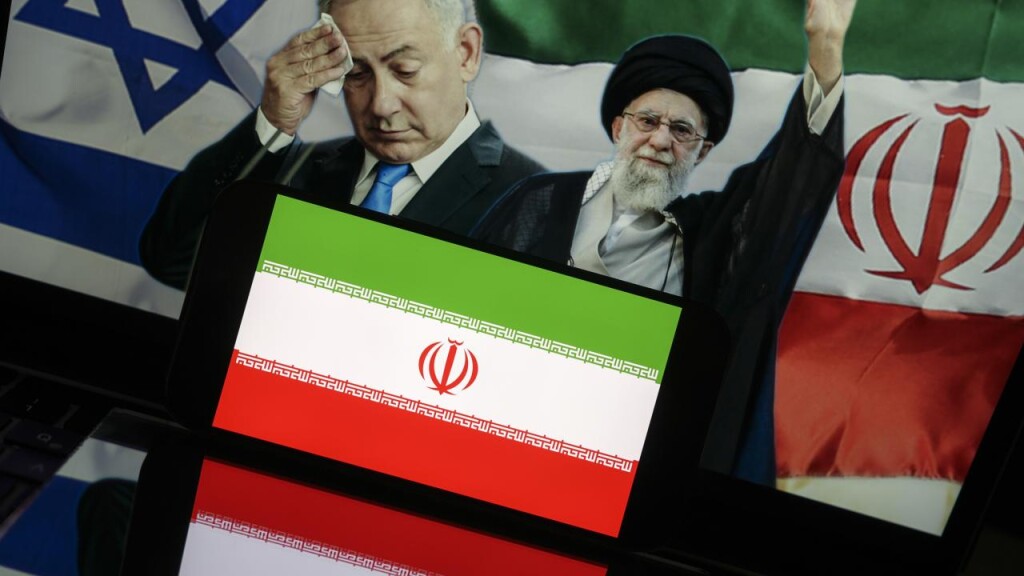
Israel’s goals and threats, US pressure, and Iran’s survival instinct.
Israel’s goals and threats, US pressure, and Iran’s survival instinct.
By Adem Kılıç, Political Scientist/Writer
Although it is only the second month of 2026, the world continues to witness events that are reshaping the entire global system.
Following events that marked the first month of 2026, such as those in Greenland and Venezuela, the global system is now preparing to leave behind yet another of the “controlled crisis” periods it has long been accustomed to.
This is because the concentrated American military presence in and around the Persian Gulf has now gone beyond being a symbolic show of force, an extension of diplomatic pressure, and has reached the brink of a conflict that could permanently transform the political, military, and geopolitical architecture of the Middle East.
In fact, at this point, it has become clear that the US attack on Iran’s nuclear facilities last June was not so much a warning as a preliminary step towards a more comprehensive showdown.
In fact, Washington’s equation to Tehran is clear.
US President Trump is presenting the Iranian government with a choice: either a redefined Iran based on the conditions set forth by the US, or a liquidation process shaped by military coercion. This approach brings with it a scenario that strategically corners all actors in the region, narrows their room for maneuver, and reduces their margin for error to near zero.
The US’s dangerous strategy
It appears that the White House assumes that Khamenei’s reflex to maintain his power will be more deterrent than the military cost of resisting the US’s heavy demands.
On the one hand, there is Khamenei’s threat of a “regional war”; on the other, President Masoud Pezeshkian’s messages of diplomatic engagement and Foreign Minister Abbas Araqchi’s optimism regarding an agreement reveal the deep fault lines within the Iranian leadership.
This picture clearly shows that the Iranian administration is seeking reconciliation with the West in order to survive on the one hand, while on the other hand, it is reluctant to back down in order not to lose its ideological and strategic backbone.
The resulting outcome is paradoxical.
For Iran is simultaneously experiencing one of the most vulnerable periods in its history while also becoming susceptible to the riskiest behaviors a cornered administration can adopt.
The Israeli dimension
The actor that appears to be the most hardline and uncompromising in this equation is undoubtedly Israel.
From Israel’s perspective, the idea of negotiating with Iran is merely a delaying tactic, and Netanyahu’s openly threatening language toward the American administration reveals that Israel is preparing for a military outcome rather than a diplomatic solution.
Israel’s basic assumption is actually clear.
Israel does not want countries with broad national unity and strong central structures in the region. Its strategy in Lebanon, Iraq, and Syria proves this assumption.
While Israel aims for Iran to become fragmented, it is also preparing for the possibility that a US attack could result in direct retaliation by Iran targeting Israel.
This environment of mutual distrust and unfounded assumptions accelerates military preparations on the ground while further weakening the possibility of a diplomatic solution with each passing day.
What will Iran do?
Iran is perhaps experiencing its most fragile period since the 1979 Revolution.
Over the past two years, the groups known as the “Axis of Resistance” have been seriously eroded, and the country is grappling with perhaps the greatest economic crisis in its history, particularly due to the impact of increasingly severe economic sanctions.
With Hezbollah suffering heavy losses in Lebanon, the Houthis’ room for maneuver shrinking due to air strikes by the US and UK that have now become routine, and the collapse of the Assad regime in Syria, Iran appears to have lost both its regional influence and its strategic depth extending to the Mediterranean.
When this external tension is compounded by the mass protests that have erupted internally and spread across the country, it appears that the legitimacy crisis of the Khamenei administration has now become structural.
Faced with the need to manage all these crises simultaneously, the Iranian leadership is attempting to negotiate its way through the process by turning the crisis into an opportunity, that is, by resorting to at least a “limited attack.”
Power change or regional chaos in Iran?
In light of all these balances, according to the US and Israel, the possibility of a power change in Iran has become more visible than in the past.
However, the idea that such an outcome would automatically create a more “liberal,” more stable, and “Western-friendly” Iran is extremely misleading.
This is because the collapse of central authority in Iran could trigger ethnic, sectarian, and political fault lines, leading to a prolonged period of chaos.
On the other hand, the Iranian Revolutionary Guards’ shift towards asymmetric resistance in fragmented structures could push the country into a process of “Iraqification.”
Conclusion
At this point, a scenario that could turn into war will directly affect not only Washington and Tehran, but all regional actors from Ankara to Riyadh.
For example, for Türkiye, the developments will create a reality where it will have to adopt a new approach to manage the security risks posed by a new geopolitical fracture taking shape next door after Syria, while also confronting multidimensional threats such as refugee influxes, energy supply, and regional instability.
In conclusion, as Israel’s goals and threats collide with US pressure and Iran’s survival reflex, the line between diplomacy and war is thinner than ever, and crossing that line is now only a matter of time.