


Interview to Turkish TV Channel Ulusal Kanal.
Interview to Turkish TV Channel Ulusal Kanal.
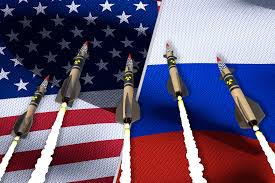
The New Strategic Arms Reduction Treaty (New START), the last bilateral treaty limiting strategic nuclear weapons between the US and Russia, signed in 2010 by US President Barack Obama and Russian President Dmitry Medvedev, expired on February 5.
Under the treaty, both countries had pledged to scale back their strategic nuclear forces and had authorized extensive on-site inspections to verify compliance.
UWI author, historian and political scientist associate professor Mehmet Perinçek answered questions about the expiration of the treaty as a guest to Türkiye’s Ulusal Kanal’s live broadcast.
—
What the expiration suggests
Why was the New START important, and what lies ahead now that it has expired?
This treaty marked one of the significant post–Cold War steps toward curbing the arms race, particularly in the realm of nuclear weapons. It remained in force until roughly 2018–19. Over time, however, it became apparent that the US was not implementing its obligations and was maintaining a larger arsenal than the treaty permitted. Russia had therefore suspended the treaty, and as of February 5, 2026, the treaty has officially expired.
In today’s world, where the Atlantic bloc is experiencing a downturn economically, politically, militarily, and in terms of cohesion among the allies, the Trump administration’s unwillingness to abide by the treaty’s commitments (a stance that held true during both the Joe Biden and Donald Trump years) suggests that the Atlantic bloc won’t accept its decline peacefully.
The US trying to regain initiative
As has become recently apparent for everyone, the US attempts to regain initiative by resorting to hard power in regions such as Venezuela, Iran and Greenland. The Trump administration has made it clear, both rhetorically and in practice, that it is prepared to disregard established rules in this attempt, going as far as abducting a head of state and threatening to assassinate another.
This also means that the US is acting, will act, in ways that run counter even to the foundational principles of the liberal principles underpinning the imperial-capitalist system. In other words, there is no longer “free trade”, “inviolability of private property”, or “inviolability of domicile”. In this sense, the imperial-capitalist system is backsliding beyond the liberal framework toward plundering, banditry and bullying. We can call this “postmodern banditry.” The expiration of the New START treaty is yet another manifestation of this banditry: Washington intends to shed any constraints like international agreements.
In October 2025, President Trump announced that he had instructed the Pentagon to immediately start testing US nuclear weapons to match the testing levels of China and Russia. He added, “Because of the tremendous destructive power, I hated to do it, but had no choice! Russia is second, and China is a distant third, but will be even within 5 years.”
Now, with New START officially expired, the Trump administration has called for a broader nuclear weapons agreement including both China and Russia. However, Beijing responded that its nuclear capabilities are nowhere near comparable to those of the US and that expecting China to join such an arrangement is therefore unjust.
In light of these developments, are we entering a period of a dangerous acceleration of rearmament?
Uniting military, political, and economic forces
The most effective response to Atlantic aggression would be for the countries subjected to it to close ranks and unite their military, political, and economic forces. Yes, the Atlantic bloc and the US are in an overall decline, yet unless it is confronted by a counterweight of comparable magnitude, Washington can still isolate countries one by one, rendering them easier to target. Under such conditions, it would be difficult for the Eurasian bloc to capitalize on the US’ relative weakening.
For this reason, Türkiye, China, Russia, Iran, the Turkic world, Arabic world and Islamic countries, need to act in concert. What could ultimately restrain the US from dragging the world into larger conflicts and riskier geopolitical gambits is the emergence of a rival power bloc capable of counterbalancing it. For instance, according to war games conducted by the Pentagon, if Russia and China were to align, the US would certainly lose a conventional, non-nuclear, war.
Absent the kind of cooperation I mentioned, the US will be able to partly regain initiative across various regions and countries. And we are already seeing examples of this. Take Palestine: Trump appears to be crafting his own geopolitical playbook, positioning some regional countries within his strategy, and, at least to some extent, succeeding. Unless the Arab and Islamic worlds, together with Türkiye and Iran, act together and take meaningful steps on Palestine, Trump and Israel, as we have witnessed, can seize the initiative in the region.
Russia and China: mutual dependence and genuine strategic allies
On February 4, one day before the expiration of New START, Russian President Vladimir Putin and Chinese President Xi Jinping held a phone call. Media reports highlighted their shared commitment to sustaining robust cooperation. What is your assessment of that call?
Russia and China have long maintained a strong partnership. During his first presidency, Trump pursued a strategy of drawing Russia closer in order to isolate China. That approach failed, in contrast bilateral ties deepened further. Biden then attempted the reverse, seeking to engage China while sidelining Russia. But that too proved unsuccessful, and relations between Moscow and Beijing advanced beyond even the levels during Trump’s first term. Now, in his second presidency, Trump has again tried to lure Russia away from China by offering various concessions. This was also futile. Both Moscow and Beijing clearly recognize their mutual dependence and see each other as genuine strategic allies.
What should Türkiye’s strategy be?
But what about Türkiye? Türkiye appears to be undergoing a serious strategic drift. There is a growing inclination to address regional issues from the South Caucasus to West Asia in coordination with the US, by positioning within Trump’s projects. Yet Washington is taking an increasingly aggressive and rule-defying course. With its current policies and strategic trajectory, Türkiye risks depriving itself of the capacity to forge a counterweight capable of balancing Washington’s aggression.
Ankara needs both China and Russia in the Eastern Mediterranean and Syria. The approach of the Turkish government that treats Trump as Türkiye’s primary partner falls short of addressing the country’s strategic requirements.