


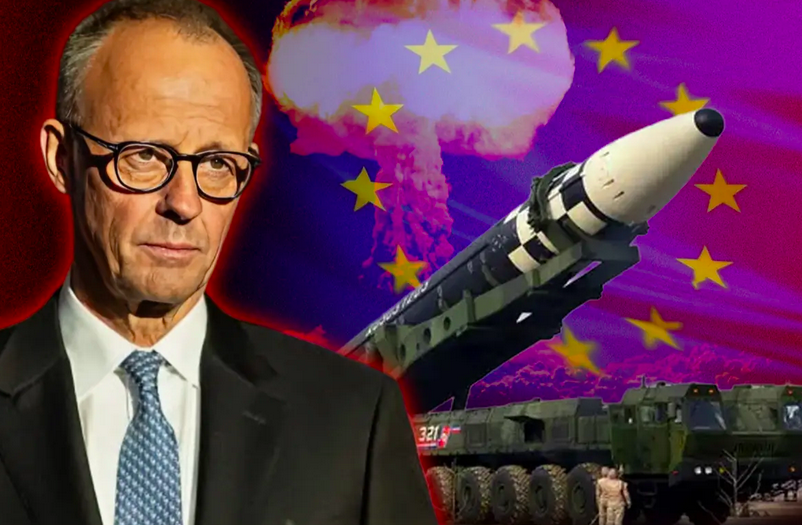
Calls in Germany to achieve a nuclear bomb.
Calls in Germany to achieve a nuclear bomb.
The European Union has long proclaimed the goal of achieving what it calls “strategic autonomy”. In the recent months, with growing transatlantic tensions between the US and EU, calls has grown to accelerate steps towards that end. One of the leading countries of these calls is Germany, already pursuing a huge effort of militarization. Recently, calls emerged in Berlin to even achieve nuclear war capacity. Below we document a report by the website Germany Foreign Policy published here that provides details.
BERLIN – Calls for the construction of a German nuclear bomb accompanied Chancellor Friedrich Merz’s call yesterday for the European Union to stand up for itself with a new “power politics”. The EU must finally “learn to speak the language of power politics” and “become a European power”, Merz declared in his government’s foreign policy statement made in the context of an escalating struggle with the United States under Trump’s leadership. Also on Thursday, former Foreign Minister Josef Fischer, a Green party grandee, joined other voices speaking out in favour of “European nuclear armament”. Following a plea by a brigadier general at the German Armed Forces Command and Staff College for Germany’s own atomic weaponry, questions about feasibility are also under discussion. A long-standing expert at the Jülich Research Centre, a nuclear physics hub, has been quoted as saying that the Gronau uranium enrichment plant could easily produce enough weapons-grade material for “around 340 warheads”. However, CDU politician Roderich Kiesewetter has to concede that such a step would require renegotiating the Two Plus Four Treaty, which in turn would bring reparations issues from the Second World War back onto the agenda.
‘Learning the language of power politics’
In a government foreign policy statement issued yesterday, Chancellor Friedrich Merz announced a more aggressive stance in Germany and EU policy. Referring to US President Trump’s decision last week to dial down his threats of tariffs and the use of military force in his pursuit of the annexation of Greenland, Merz suggested that this softening of Washington’s posture was due to resistance from European governments. Merz urged, “Let’s make something of this newfound self-confidence among Europeans.”[1] In future, he said, it would be necessary to “stand up” more strongly to the United States: we are “partners and allies and not subordinates”. This would then require that “we learn to speak the language of power politics” and that “we ourselves become a European power”. A new bold stance was not only, he pronounced, something worth striving for, but also a realistic option: “Europe has always grown when it was put under pressure, when there were crises.” Merz added that “in this newly shaping world” there were alternative cooperation partners: specifically, “emerging democracies with open and growing markets” in search of “partnerships based on mutual respect, trust and dependability”. Cooperation with third countries is seen by the German government as an option for securing some reinforcement against US pressure.[2]
The European bomb
Merz’s appeal for strength comes in the context of fresh calls for nuclear armament – either at EU or national level. Yesterday, Thursday, former Foreign Minister Josef Fischer (a Green party grandee) spoke out explicitly on the issue. Fischer’s position is that pleas for the national nuclear armament of Germany are “a big mistake”. After all, “a German nuclear bomb would not really protect us and would cause us a lot of trouble.”[3] Rather, “Europe must do this”, he argues, now that the United States’ guarantee of protection has become “uncertain”. This approach is reflected in the growing discussion of the French nuclear umbrella being extended to cover the European Union. So far, however, initiatives in this direction have failed because Bonn is demanding a say in the deployment of French nuclear weapons, something Paris rejects (german-foreign-policy.com reported [4]).
A Scandinavian bomb
Demands for nuclear armament have so far been loudest not at EU level but at national level, primarily coming from Poland and the Baltic states.[5] But since the recent escalation of tensions over Washington’s desire to annex Greenland, the Scandinavian countries have also been considering their own nuclear options. Back in March 2025, the leader of the far-right Sweden Democrats, Jimmie Åkesson, first raised the issue of building a Swedish nuclear capability.[6] Foreign policy experts and other politicians soon followed suit. Recently, the chair of the Danish Parliament’s Defence Committee, Rasmus Jarlov, has also spoken out on this issue. “Europe’s defence must become independent of the US,” said Jarlov, and “that means we need our own nuclear weapons.”[7] The nuclear protection offered by Europe’s current nuclear powers was insufficient, he said, “And we are concerned that someone like Trump might one day come to power in one of the major European powers.” He would, however, “give 100 per cent support” to any Swedish move to acquire a bomb. “I’m not saying that Denmark needs nuclear weapons for itself alone,’ Jarlov explained. “But I would welcome a nuclear bomb for the Nordic countries.”
‘The hegemon can’t be trusted.’
Demands for procuring nuclear weapons at the national level are being voiced once again in Germany. Shortly after the US attack on Venezuela and in view of the annexation threats against Greenland, Brigadier General Frank Pieper, Director of Strategy at the German Armed Forces Command and Staff College in Hamburg, stated in a LinkedIn post that, “Germany needs its own tactical nuclear weapons.” These would be “weapons that can counter the ultimate threat from Russia.” Pieper, who emphasised that his call for upping the ante should be understood “absolutely and exclusively” as his “personal opinion”, explained explicitly that it was not enough to build “the strongest conventional armed forces in Europe”, as Chancellor Friedrich Merz is striving to do. The main reason, Pieper said, was that “the hegemon”, i.e. the United States with its massive nuclear arsenal, “can no longer be trusted”. Pieper urged swift action. Berlin should “get out of bed and get down to work.” Insiders report that, although “hardly anyone in the Bundeswehr has so far dared” to express a plea for a German bomb so clearly, the option is “being increasingly discussed internally”.[8]
‘Technically unproblematic’
This raises the question of the technical feasibility of acquiring Germany’s own nuclear warheads. “Technically, it’s relatively unproblematic,” notes Christian Mölling, military consultant at the European Policy Centre in Brussels and deputy director of research at the German Council on Foreign Relations (DGAP). “We have both the engineering capabilities and the ability to enrich uranium or plutonium.” [9] The latter could be done at the Gronau enrichment plant. “All we would need is enough centrifuges,” a long-time expert at the Jülich Nuclear Research Centre was quoted as saying yesterday on Thursday. So Berlin would be “in a position to produce nuclear weapons within three years.”[10] “With the approved enrichment capacity in Gronau, around 17 tonnes of weapons-grade uranium could be produced annually,” explains the insider. That would be enough for “around 340 warheads”. The legal and political consequences are considered to be more problematic. For once thing, Berlin would have to withdraw from the Nuclear Non-Proliferation Treaty. This move could clearly result in other countries quickly following suit – from Sweden and South Korea to Saudi Arabia. It would also be necessary to revoke the Two Plus Four Treaty, under which the Federal Republic of Germany once “declared” and “reaffirmed” its renunciation of nuclear weapons.[11] Then, of course, the question of reparations would “arise anew”, warns CDU foreign and military policy spokesperson Roderich Kiesewetter,[12] since the issue of World War II claims against Germany was widely considered finally settled with the signing of the Two Plus Four Treaty.
‘Core of national sovereignty’
Nevertheless, Joachim Krause, former head of the Institute for Security Policy at the University of Kiel (ISPK) and long-time member of the German Council on Foreign Relations (DGAP), has declared, “We urgently need to talk about protecting Germany with our own or with European nuclear weapons.”[13] Harald Biermann, president of the Haus der Geschichte foundation in Bonn voices a fundamentalist posture: “The nuclear question is at the core of a state’s national sovereignty. Germany, too, must address this issue.”[14] Biermann calls for the population to be aligned with this imperative. The public should be “sensitised” to this issue. “In the end, the majority will recognise that the decision on nuclear weapons is more than just politics,” asserts Biermann: “It’s a question of the existence of the Federal Republic.”
[1] Volker Petersen: Merz will Trump mit Europa Grenzen aufzeigen. n-tv.de 29.01.2026.
[2] See: Bruch in der Weltordnung and In search of alternatives (II).
[3] Esther Kogelboom, Anja Wehler-Schöck: Joschka Fischer über die neue Weltlage: „Als junger Mann würde ich mich freiwillig zum Wehrdienst melden“. tagesspiegel.de 29.01.2026.
[4] See: The road to the bomb and Rehearsing nuclear war.
[5] Jochen Wegner: Braucht Deutschland die Atombombe, Claudia Major? zeit.de 30.10.2025.
[6] Eden Maclachlan: Swedish hawks want their own nuclear weapon. thetimes.com 28.09.2025.
[7] Steffen Gassel: „Wir können den Amerikanern nicht mehr trauen. Wir brauchen eigene Atomwaffen“. stern.de 21.01.2026.
[8] Georg Ismar: Braucht Deutschland die Bombe? sueddeutsche.de 11.01.2026.
[9] Steffen Gassel: Eine Atombombe für Deutschland? „Technisch ist das relativ banal“. stern.de 22.01.2026.
[10] Martin Debes, Nico Fried, Miriam Hollstein, Veit Medick, Viktar Vasileuski: Wie der Weg zu einer deutschen Atombombe aussehen könnte. stern.de 29.01.2026.
[11], [12] Georg Ismar: Braucht Deutschland die Bombe? sueddeutsche.de 11.01.2026.
[13], [14] Martin Debes, Nico Fried, Miriam Hollstein, Veit Medick, Viktar Vasileuski: Wie der Weg zu einer deutschen Atombombe aussehen könnte. stern.de 29.01.2026.