

A Panamanian court changed the administration of the canal. Here’s the background and wider geopolitical context.
A Panamanian court changed the administration of the canal. Here’s the background and wider geopolitical context.
By Dr. Fernando Esteche
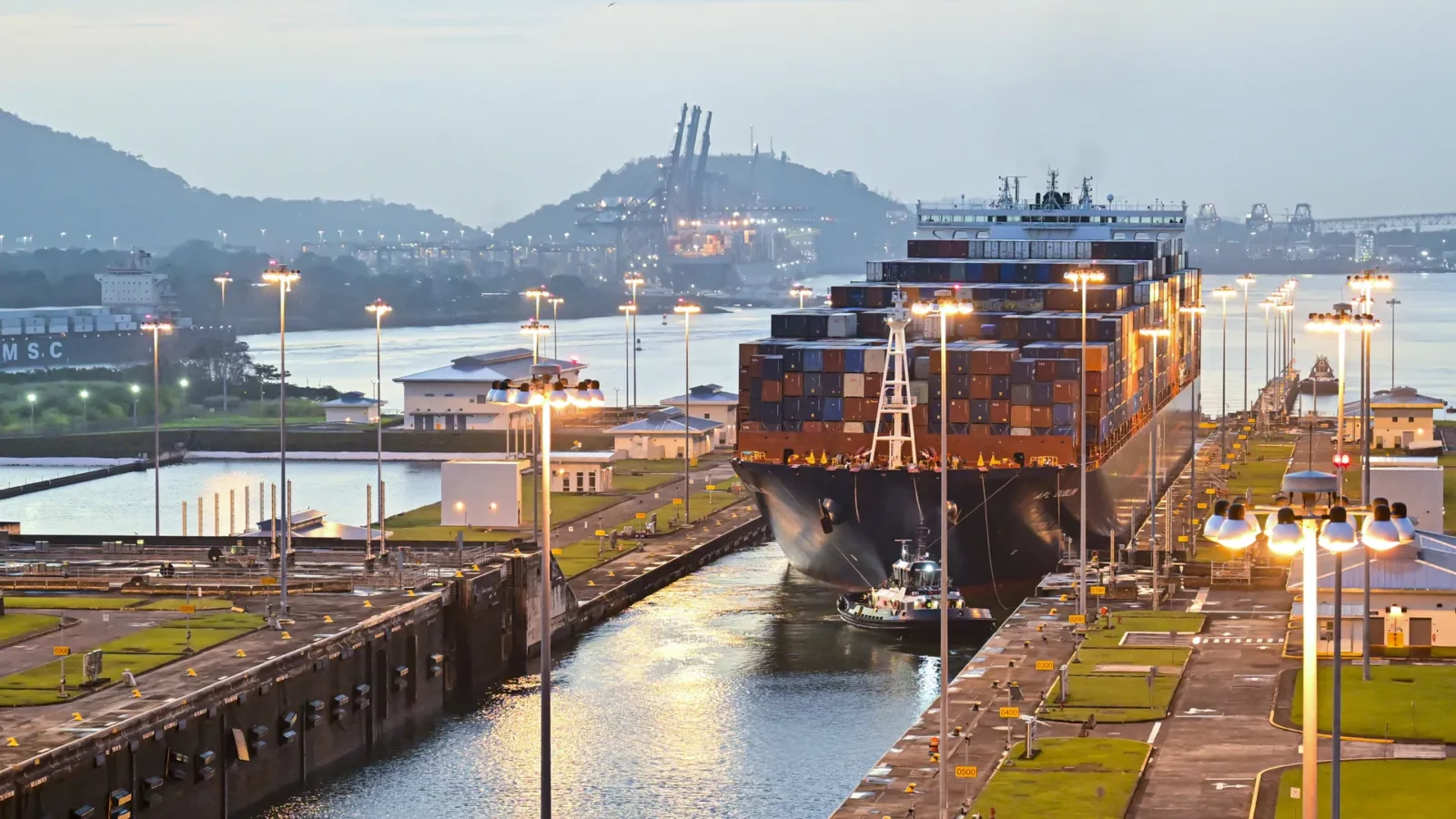
The decision by Panama’s Supreme Court to annul the concession that allowed CK Hutchison to operate the Cristóbal and Balboa ports on the Panama Canal represents the culmination of a geopolitical operation executed with surgical precision. The ruling by Panama’s highest court is not an exercise in independent judicial sovereignty but rather confirmation that Panama remains a territory under imperial tutelage, where nominally autonomous institutions carry out decisions made in Washington. Upon a demand from the United States, the Court, a key instrument in this maneuver, declared unconstitutional, in a statement of just two paragraphs, a contract that had been in effect since 1997.
The sequence of pressures was meticulously orchestrated. Marco Rubio dedicated his first trip as Secretary of State to Panama, an unprecedented gesture that revealed the strategic priority of the canal for the Trump administration. The visit on February 1 and 2, 2025, was a thinly veiled exercise in coercive diplomacy. At the Presidential Palace, Rubio conveyed to Mulino that Trump had made “a preliminary determination that the current position of influence and control of the Chinese Communist Party over the Panama Canal area is a threat to the canal and constitutes a violation of the Permanent Neutrality Treaty.” The State Department was explicit: “Secretary Rubio made it clear that this status quo is unacceptable and that, in the absence of immediate changes, it would require the United States to take the necessary steps to protect its rights under the treaty.”
Mulino administration then staged a choreographed ballet of concessions. In the meeting with Rubio, he announced that Panama would not renew its participation in China’s Belt and Road Initiative, an agreement signed in 2017 that made Panama the first Latin American country to join Beijing’s strategic project. He offered to expand cooperation on migrant deportations and proposed to Washington the use of Metetí Airport for mass expulsion operations. Mulino expressed his willingness to review the CK Hutchison port concession, awaiting the results of an audit that the Comptroller General’s Office had already initiated. Every gesture was a capitulation disguised as sovereignty.
While Mulino negotiated his surrender, Panamanian flags waved in the streets of Panama City and protesters burned effigies of Trump and Rubio. The contrast was stark. A government that publicly defended sovereignty while privately dismantling any resistance to imperial demands. The tension, the silences, and the symbolism of those days revealed a Panamanian government navigating the pressures of two global giants, ultimately choosing subordination to the USA.
Panama exists as a geopolitical construct rather than a sovereign nation. The country was born of imperial violence in the early 20th century when Theodore Roosevelt orchestrated the 1903 naval invasion through a premeditated agreement with the Isthmian political oligarchy. Roosevelt ordered the arrival of up to ten battleships to ensure Panama’s separation from Colombia. The separation of November 3, 1903, was achieved not through Panamanian nationalist fervor but through the pressure of U.S. capital and its gunboats. The engineer Lobbyist Philippe Bunau-Varilla delivered a check for $100,000 to finance the revolt, while Roosevelt ordered warships to the isthmus even before the local conspirators decided to act. Panama emerged as a buffer state, a necessary legal fiction for US control of the hemisphere’s most valuable commercial artery.
The path toward some form of national dignity arrived with Omar Torrijos, a nationalist military officer who challenged the established order in 1968. Torrijos definitively rejected the 1967 treaty and launched a diplomatic battle of global scope, consolidating the support of the Non-Aligned Movement, the UN Security Council, and the OAS, forcing the United States to negotiate. The Torrijos-Carter Treaties of 1977, which established the gradual return of the canal culminating in 1999, represented a significant anti-imperialist victory. Torrijos died in 1981 in a plane crash that many consider suspicious, under circumstances that have never been clarified.
After Torrijos’s death, Manuel Noriega assumed power in 1983. For years, Noriega operated in a murky area of functional relationships with U.S. agencies, a precarious balance that collapsed when he ceased to be useful to Washington and began to act with excessive autonomy. When an operator within the imperial system becomes unpredictable, when their knowledge of the hidden mechanisms of power makes them a potential threat, their fate is sealed. On December 20, 1989, 26,000 U.S. troops invaded Panama in Operation Just Cause, devastating the El Chorrillo neighborhood. Official figures report 516 deaths, but independent organizations document between 500 and 4,000 civilians killed.
The invasion was justified with rhetoric about drug trafficking and democratic restoration, but its real objective was to ensure that the canal did not fall into the hands of a hostile government just a few years after its transfer, and to send a message to all of Latin America about the limits of permissible autonomy. Noriega was kidnapped, taken to the United States, convicted, and imprisoned until his death in 2017. The kidnapping of a head of state on drug trafficking charges set a precedent that Washington would apply decades later: when a Latin American government becomes inconvenient, accusations of links to drug trafficking provide the legal pretext for military intervention. The 1989 massacre remains a permanent warning of the costs of challenging imperialism.
In 2026, we witnessed a new chapter in which the Panamanian Supreme Court emerged as a central player in the imperial maneuver. The highest court declared a contract in effect for nearly three decades unconstitutional based on lawsuits filed by the Comptroller General’s Office in July 2025, just after Rubio visited Panama and demanded “immediate changes.” The timing is too perfect to be a coincidence. The penetration of imperial will into the Court is evident not in explicit instructions but in a shared understanding of the limits of what is possible. The nine justices of the full court knew that declaring the CK Hutchison contract unconstitutional was what Washington expected, what the balance of power demanded. Panamanian judicial independence exists within parameters defined by the United States.
The ruling affects CK Hutchison Holdings, a Hong Kong-based conglomerate whose port assets Washington systematically labels as “Chinese.” This characterization reveals contemporary imperial logic. Hong Kong, a special administrative region of China since 1997, formally maintains a distinct economic and legal system under the “one country, two systems” principle, but for Washington, any company based there is automatically subject to Beijing’s control. The logic is clear: since the Chinese Communist Party could theoretically exert pressure on Hong Kong companies, then all Hong Kong companies are potential instruments of the Chinese government. This presumption of guilt based on geographic location obscures any distinction between private enterprise and state extension, rendering CK Hutchison “Chinese” regardless of its actual corporate structure.
The company, owned by tycoon Li Ka- shing, had legally operated the ports since 1997, investing more than $1.8 billion in infrastructure. But legality is irrelevant when the balance of power shifts. China responded with the calculated ambiguity that characterizes its diplomacy. Foreign Ministry spokesman Guo Jiakun announced that Beijing “will take all necessary measures to firmly safeguard the legitimate rights and interests of Chinese companies,” without specifying what measures or when. The wording is deliberately vague, allowing for both trade retaliation against Panama and multilateral diplomatic pressure, or simply accepting defeat while accumulating grievances for future negotiations. CK Hutchison announced that it reserves the right to initiate national and international legal action, words that ring hollow in the face of a ruling that responds to geopolitical rather than legal imperatives.
The temporary transfer of the ports to APM Terminals, a subsidiary of the Danish group AP Moller-Maersk, would seem to confirm the Atlanticist triumph: a European company, a NATO member, is replacing a company considered Chinese in strategic infrastructure in the Western Hemisphere. Maersk is seen as a guarantee of Atlanticism, of alignment with Washington. But this interpretation obscures an explosive contradiction: Denmark, Maersk’s country of origin, is simultaneously in direct confrontation with the United States over Greenland. Trump has threatened to use military force to annex the Danish territory, has imposed tariffs on Denmark, and has demanded that NATO withdraw Danish troops from Greenland. The Danish Intelligence Service, for the first time in its history, listed the United States as a “threat to national security,” along with Russia and China. Danish Prime Minister Mette Frederiksen warned that if the United States militarily attacks a NATO country, “everything will stop, including NATO.”
How then can we explain that a Danish company is a reliable substitute for a Hong Kong company when Denmark is under US military threat? The contradiction reveals the brutal asymmetry of imperial relations. Maersk operates under a transnational corporate logic that makes it functionally independent of the tensions between Washington and Copenhagen. A “Danish” company is not truly Danish when its global operations, its financing, and its ties to US capital make it an Atlanticist rather than a national entity. Denmark may try to resist Trump in Greenland because it is a NATO member and has European backing, but its corporations operate under other loyalties. Capital has no homeland when the homeland becomes inconvenient for business.
The maneuver in Panama is not isolated but part of a simultaneous, multi-front imperial redeployment that reveals both Washington’s ambition and desperation. Trump has opened conflicts with Venezuela (military threats, capture of Maduro), Cuba (strengthened sanctions), Iran (renewed maximum pressure), Greenland (threats of annexation), and Canada (proposals for its incorporation as the 51st state), while carrying out mass deportations and tariff wars against Mexico. This deployment occurs while the US federal government faces paralysis due to a shutdown, extreme polarization, and a crisis of democratic legitimacy. The capacity to project power outward seems inversely proportional to the capacity to resolve internal contradictions. It is the empire in panic mode, multiplying fronts because it perceives its hegemony to be declining, not because it feels strong.
The Trump administration’s 2025 National Security Strategy gives the Americas a central role unprecedented since the 1980s, updating the Monroe Doctrine for the 21st century. The explicit objective is to expel China from all strategic positions in the hemisphere, prevent foreign powers from accessing critical resources, and reestablish absolute control over vital trade routes. Panama is central to this strategy not only because of the canal but also because of what it represents.
For Panama, this latest submission confirms that it never fully achieved sovereignty as a state. Created by imperial imperative in 1903, physically divided for almost the entire 20th century, invaded in 1989 when it attempted some form of autonomy, it is now once again disciplined through a combination of diplomatic pressure, implicit threats, and the internal judicial system. The defection of the Mulino government is complete. It chose between maintaining a problematic Hong Kong concession or satisfying Washington’s demands; it chose between integrating into a global multipolar logistics and infrastructure development program or imperial submission; and it chose Washington because, in the Panamanian elites’ calculations of survival, challenging the northern empire remains unthinkable. The Supreme Court provided the legal mechanism to execute what political pressure had determined.
Torrijos’ legacy fades in this capitulation. His struggle for sovereignty, his challenge to the imperial order, his building of alliances with the Global South (the Non-Aligned Movement)—all of this is reduced to historical memory while the present reveals the brutal persistence of the asymmetrical power relations that structure Latin America. Panama reverts to what it always was: a canal with a country surrounding it. And that canal has an owner, even if the title deed says otherwise. The simultaneity of contemporary imperial attacks reveals a strategy of exerting pressure on multiple fronts so that no Latin American government feels secure, so that all understand that autonomy comes at a price, and that price can be massacres, invasions, blockades, or, in the best-case scenario, the obligation to implement, through their own institutions, whatever the empire dictates.
What happens with the Panama Canal in 2026 demonstrates that colonialism didn’t die but mutated, that dependency wasn’t overcome but refined, and that Latin American sovereignty remains negotiable whenever Washington decides to negotiate it. And in that negotiation, as in 1903, the gunboats are still there, even if now they are aircraft carriers, drones, financial pressure, and, crucially, the ability to infiltrate the judicial institutions of nominally sovereign countries.
The Supreme Court declaring a contract unconstitutional by implicit order of Washington is the perfect metaphor for Panamanian sovereignty in 2026; formally independent, effectively satellited, incapable of making decisions that contradict the interests of the empire that created it 123 years ago and that now, once again, claims what it always considered its own.