


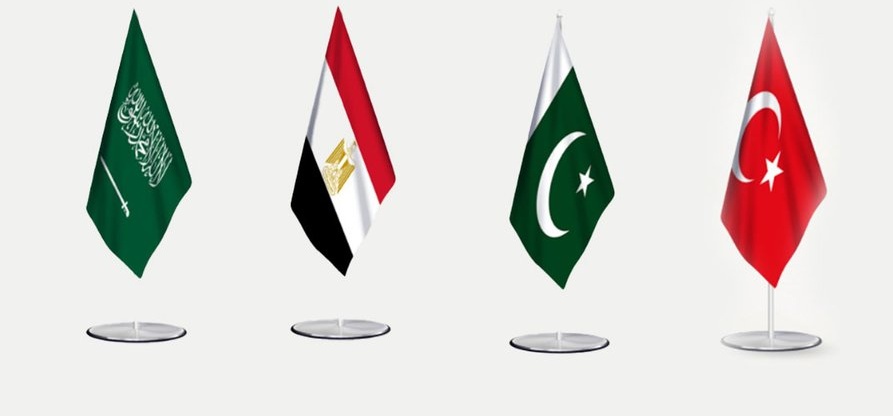
Bloomberg News reported last Friday that Türkiye is currently seeking to join the Strategic Defense Cooperation Agreement (SDA) signed by Pakistan and Saudi Arabia in September 2025.
Bloomberg News reported last Friday that Türkiye is currently seeking to join the Strategic Defense Cooperation Agreement (SDA) signed by Pakistan and Saudi Arabia in September 2025.
Mohammed Sabreen, from Cairo / Egypt
The Middle East appears poised for major alliances that will leave their mark on regional balances and the prospects for resolving long-standing issues in the region. Informed sources have revealed that Türkiye is seeking to become a member of a new defense agreement with Saudi Arabia and Pakistan. These sources also confirmed Türkiye’s imminent accession to the existing Saudi-Pakistani military alliance.
The question being raised is whether Egypt will be part of this alliance, or will it remain outside its sphere despite its strong ties with the three parties involved? Well-informed Arab sources have revealed that Egypt is strongly positioned to become the fourth party in this rapidly forming alliance, which has already established itself even before its official announcement. This is due to improved relations among its members, a shared vision of the nation-state, significant coordination on the Palestinian issue, Gaza, Sudan, Somalia, maritime security in the Red Sea, and security and military cooperation.
This tripartite Islamic alliance brings together influential countries in the Middle East and South Asia, including a nuclear power, raising questions about its impact on regional and international power dynamics. The potential alliance, which includes Pakistan as a nuclear state, along with Saudi Arabia and Türkiye, comes in the context of escalating geopolitical tensions and declining confidence in American guarantees, prompting these countries to strengthen their common defense ties.
Advanced Stages of Discussion
Bloomberg News reported last Friday that Türkiye is currently seeking to join the Strategic Defense Cooperation Agreement (SDA) signed by Pakistan and Saudi Arabia in September 2025.
According to a source familiar with the matter who requested anonymity, talks between the three parties have reached an advanced stage and are expected to conclude with a formal agreement that will enhance security cooperation.
Bloomberg also reported that Türkiye is considering joining the SDA, a move that could pave the way for a new regional security framework.
The agency quoted a source who preferred to remain anonymous as saying that the ongoing discussions between the parties involved have reached an advanced stage and are likely to culminate in the signing of a formal agreement in the near future. Riyadh and Islamabad signed the SDA in September 2025 during Pakistani Prime Minister Shehbaz Sharif’s visit to the Kingdom. The agreement stipulates that any external military aggression targeting one of the two countries will be considered a direct attack on both.
According to Bloomberg, Ankara’s potential accession to this agreement could pave the way for a new security alliance, potentially reshaping the balance of power in the Middle East and other strategically important regions.
The agency noted that Türkiye’s move comes amid growing doubts about the reliability of the US role in security matters, coupled with the increasing convergence of interests between Türkiye, Saudi Arabia, and Pakistan in South Asia, the Middle East, and Africa.
Ankara and Islamabad have enjoyed close military ties for many years, including cooperation on numerous defense projects. Türkiye supplies the Pakistani Navy with corvettes and has also upgraded several F-16 fighter jets belonging to the Pakistani Air Force.
This alliance is based on strong historical ties, with Pakistan and Türkiye having long-standing military relations that include joint defense projects, such as Ankara’s supply of corvettes to the Pakistani Navy.
Furthermore, Türkiye seeks to enhance cooperation in advanced military technologies. It currently shares drone technology with Pakistan and Saudi Arabia and plans to include them in its fifth-generation fighter jet program, the “Kan.”
Recently, Türkiye has intensified its efforts to share its latest military technologies with both Pakistan and Saudi Arabia, including drone technology and the development of fifth-generation fighter jets, as part of its endeavors to strengthen defense partnerships and expand the scope of joint military cooperation. The agreement signed between Pakistan and Saudi Arabia stipulates that any external armed attack on one country is considered an attack on both, reflecting a mutual commitment to joint defense.
Arab and Turkish experts indicate that Türkiye’s accession to this agreement will pave the way for the formation of a new security alliance capable of shifting the balance of power in the Middle East and beyond, especially given Pakistan’s nuclear capabilities, which add a tremendous strategic dimension.
This move comes amid growing questions about the credibility of the United States as a reliable ally, as well as the overlapping economic and security interests of Türkiye, Saudi Arabia, and Pakistan in regions such as South Asia, the Middle East, and Africa.
Egypt is a strong candidate
On the other hand, the question of whether Egypt will join this alliance is frequently raised. Egypt has strong military ties with Türkiye, Saudi Arabia, and Pakistan, making it one of the most qualified countries to join such an alliance.
Recent years have witnessed a strengthening of military cooperation between Cairo and Ankara, particularly in the areas of technical exchange and joint exercises, while ties with Riyadh remain strong through defense agreements and mutual economic support.
Pakistan and Egypt also share a history of military partnerships, including joint training programs, which opens the door for Egypt to join the alliance and enhance its regional role.
Egypt also possesses a massive military industrial base, primarily reliant on the Ministry of Military Production and the Arab Organization for Industrialization, which produce dozens of advanced military equipment items. It also has manufacturing partnerships with Türkiye, recently revealed at the EDEX Cairo 2025 arms exhibition. However, current reports do not mention any direct Egyptian participation, but its strategic location in the Middle East makes it a natural choice for future expansion. This cooperation reflects a shift toward greater defense independence for Islamic states in the face of regional challenges, such as tensions in the Gulf and conflicts in the Middle East, potentially reducing reliance on Western powers and strengthening regional balance.
At the same time, this new alliance represents a step toward reshaping Islamic alliances in light of global challenges and could lead to fundamental transformations in the Middle East.
Changing Geopolitical Positions
Many Arab and Turkish writers, including the Turkish journalist Kemal Öztürk, believe that the ongoing developments in the Middle East necessitate a shift in traditional geopolitical positions, and that every country must recognize this. He fears that if historical rivalries, competitions, and prejudices are not overcome, a period of instability will ensue.
He explains that two events prompted this line of thinking: first, Israel’s recognition of the self-declared Republic of Somaliland as an independent state; and second, the Southern Transitional Council’s takeover of Hadramawt and Al-Mahra, and the subsequent developments, including the Presidential Council’s demand for the withdrawal of Emirati forces, as well as the Saudi airstrike on an arms shipment arriving from Fujairah. Both are dangerous developments requiring deep reflection and concerted effort.
The Mediterranean and Africa
In the Middle East, Africa, and the territorial waters of the Mediterranean Sea, the fundamental problem lies with Israel and the countries that align with it. In Sudan, Yemen, and Somalia, Israeli interventions—whether direct or through regional proxies—constitute critical steps that fuel instability and lead to conflict. It is precisely for this reason that Saudi Arabia decided to put an end to this, forcing the UAE to withdraw from Yemen through military force.
Israel’s recognition of the self-declared Republic of Somaliland poses a threat not only to Mogadishu but also to Riyadh, Cairo, Sana’a, Nairobi, and Ankara.
Informed regional sources believe that the military cooperation agreements Israel signed with Greece and Southern Cyprus to assert its dominance in the Mediterranean should not be underestimated. Over six years, they conducted more than 35 joint military exercises and maneuvers, and sold billions of dollars’ worth of missiles and drones.This will severely restrict the freedom of movement of other countries in those waters, and could even prevent them from fishing.
Why new alliances?
Öztürk believes that due to the competition between the major powers in the region, foreign powers have become active in the region. Israel has already launched attacks on seven countries and has been able to act with such freedom because of these conflicts and divisions.
Conversely, the major powers in the region—such as Saudi Arabia, Egypt, Türkiye, and Iran—have lost much of their power due to their preoccupation with other issues, leaving a vacuum that Israel has filled with the support of the United States and Britain.
Some experts argue that there are problems these countries cannot solve, but at least the issues that are difficult to agree upon can be postponed.
If an agreement is reached, each country will be able to better protect its interests. These sources offer visions for cooperation and resolving the region’s issues, including a partnership between Türkiye and Egypt in Sudan, a Saudi-Turkish-Egyptian alliance in Somalia, and they say if Türkiye, with its historical ties, were to return to play an active role in Yemen, wouldn’t that be much better?
If Qatar, with its highly skilled diplomacy, were to enter the fray in these regions, would we lose or gain? Undoubtedly, we would gain.
The Alliance of Necessity
Many experts agree that the coming years will be marked by chaos, and that Israel has never desired stability in the region. Therefore, it will not forge a genuine alliance with any Islamic state. Turkish and Arab sources warn that countries not currently experiencing conflict with Israel will inevitably face it tomorrow. The only way forward is for Islamic states to unite around a minimum of common ground and adapt to the new geopolitical reality.
These sources caution that these countries are compelled to do so because the coming years will not be years of stability and calm. On the contrary, Europe will weaken further and be sidelined. In this context, the Mediterranean alliance will be reshaped.
At the same time, the rivalry between China and the United States carries the risk of spiraling into a vortex that could engulf Russia and India as well. Consequently, the resulting storm or earthquake would be extremely severe.
On the other hand, chaotic geopolitical shifts will have a serious impact on the economy and trade, and in such circumstances, it is natural for weaker states to be severely affected. Therefore, it is essential for the stronger states in the region to fortify themselves against future upheavals. It appears that Türkiye, Saudi Arabia, Egypt, Pakistan, and other countries are working towards this goal.
Neo-Ottomanism
Informed Arab sources stated that although relations between Türkiye, Saudi Arabia, and Egypt are no longer as bad as they once were, they are not as strong as desired. These sources question who benefits from this situation, arguing that, as seen in the breakaway region of Somaliland, Sudan, and Yemen, each country suffers geopolitical losses as a result of the actions of Israel and its proxies. They emphasize the necessity for the three countries to strengthen their relations and alliances as long as their interests are at stake. It is true that disagreements exist, most notably those concerning the Muslim Brotherhood and Hamas. Frankly, some parties fear that Türkiye’s growing role in the region is a form of expansionist “neo-Ottomanism.”
Netanyahu fueled this fear during his joint press conference with Greece and Southern Cyprus, aiming to create a rift between Türkiye and the countries of the region. However, the Turkish elite downplays these concerns, indicating that a return to the days of the Ottoman Empire is geographically and geopolitically impossible. Turkish sources revealed that Saudi Arabia and Egypt cooperated with Türkiye in supporting Ahmed al-Sharaa’s administration in Syria. Furthermore, Egypt and Türkiye now share a similar stance on the issues of Somalia and Sudan, and Türkiye has shifted its position on Libya to align more closely with Egypt’s. If these steps are feasible, why not apply them to other issues?
The Turkish sources maintain that the issues of the Muslim Brotherhood and Hamas are not insurmountable, provided there is a genuine will to reach an agreement. They believe that common ground is stronger than differences, and that such an alliance would also influence other countries with close ties to these three nations, unleashing tremendous potential. In this scenario, each country would stand to gain.
The Quad Alliance and the Danger of Iran’s Collapse
The Quad Alliance appears to be facing its most serious crisis yet, stemming from the rapidly escalating events in Iran, the risk of the Iranian regime’s collapse, and the country’s descent into chaos.
Fidan Warns of Netanyahu’s Attempts to Ignite a Regional Conflict
Turkish Foreign Minister Hakan Fidan accused the Israeli Mossad of exploiting the ongoing protests in Iran to destabilize the Islamic Republic. He asserted that Israel is using the economic challenges and internal unrest to deepen divisions within the country.
In an interview with Turkish television, Fidan stated, “The Mossad makes no secret of this. They are calling on the Iranian people to rise up against the regime through the internet and Twitter accounts.”
The Turkish minister explained that the absence of an effective military conflict presents an opportunity for Israel to exacerbate internal tensions and exploit the protests for its own benefit. He added that Israeli Prime Minister Benjamin Netanyahu is seeking to ignite a wider conflict in the region but will not act without the approval of the United States, relying on guarantees from his key allies. Fidan pointed out that the economic sanctions imposed on Iran for nearly three decades have significantly impacted the Iranian people, particularly the youth, who aspire to a better life and stable economic opportunities. He considered these conditions, along with foreign interference in some of the protests, to be among the reasons for the recurring demonstrations.
On the diplomatic front, Fidan emphasized that Türkiye seeks to protect Iranian civilians and support de-escalation between Iran, the United States, and Western countries through negotiations. He warned that certain external conditions aim to thwart any peaceful talks and provide a pretext for a potential Israeli military action. He stressed that reaching a negotiated agreement is key to regional stability and removing the “international cover” for any potential Israeli strikes.
What if the Iranian regime falls?
At a time of unprecedentedly rapid security and political transformations in the region, political analysts are posing a critical question: What if the Iranian regime collapses?.
An analytical reading of recent developments, including the strikes targeting Iranian nuclear and military infrastructure, escalating economic pressures, and the decline of Tehran’s regional influence, is presented. Within this context, the hypothesis of collapse—though considered low probability—is offered as a cornerstone for analyzing the potential repercussions on three key areas: Türkiye, the Gulf states, and the Palestinian issue.
Experts focus on the anticipated scenarios should the Iranian central state’s power decline, whether through gradual weakening or sudden collapse, along with the accompanying security, economic, and geopolitical shifts. They also examine the challenges and opportunities that might arise from such a transformation, given the overlapping projects of regional and international powers in Iran’s traditional spheres of influence.
The Consequences of Collapse
In recent months, particularly during the 12-day war, Iran has witnessed significant strikes targeting its nuclear infrastructure and its security and military leaders. This has exposed the fragility of its defense capabilities and led to strategic losses that have compounded with the fall of the Assad regime—its most prominent regional ally—and the elimination of Hezbollah’s top leadership in Lebanon, along with the crippling of its military capabilities and its unprecedented geopolitical and political isolation. These developments have undermined decades of Iranian investment in the region.
In this context, Israel, which does not appear to have abandoned its goal of regime change, has formulated an approach based on weakening the Iranian regime through the assassination of its prominent leaders and supporting minorities and separatist movements in a multi-ethnic state (Persians, Kurds, Turks, Arabs, Baloch). Armed groups are active in border regions such as Sistan and Baluchistan and Kurdistan. Israeli assessments, as noted by former security advisor Giora Eiland, suggest that the recent war represents only the beginning of “Iran’s wars,” reflecting growing expectations of repeated military escalations.
This coincides with escalating Western and American economic pressures, including stringent sanctions that have curtailed oil and gas revenues, leading to currency devaluation and soaring inflation. European countries (Britain, Germany, and France) have joined these efforts by activating the “snapback mechanism” and reimposing sanctions on Iran, while the negotiating agenda has expanded to include the missile program and Tehran’s relations with anti-Israel actors. These interactions threaten to further destabilize the regime and diminish its ability to manage its internal crises.
In assessing the repercussions, the collapse of the Iranian regime—which remains unlikely—represents a scenario far more dangerous than what transpired in Iraq or Syria, given its population exceeding 90 million and its pivotal location within the geopolitical network stretching from the Gulf to the Eastern Mediterranean. The potential paths to this collapse vary, ranging from the continuation of a weak central government that loses control over the peripheries, to a complete collapse leading to chaos and foreign intervention, or the rise of a political or military alternative more aligned with the West. These analyses aim to examine the repercussions of this collapse scenario, whether likely or not, on Türkiye and the Gulf states, especially Saudi Arabia.
First: Security Threats And Chaos on Türkiye’s Borders
The land border between Türkiye and Iran stretches for 534 kilometers, traversing rugged mountainous terrain, making it difficult to monitor. Historically, this border has served as a corridor for smuggling and irregular migration. The Syrian experience after 2011 demonstrated that the security vacuum resulting from state collapse or preoccupation with war makes borders more vulnerable to infiltration, whether through mass displacement or the growing activities of armed groups.
Therefore, a scenario of regime collapse in Iran could transform the border into a theater of security breakdown, placing Türkiye under new security pressures and forcing Ankara to deplete its resources on defensive measures, including bolstering military deployments and constructing new buffer zones. Furthermore, the influx of refugees from Iran would exacerbate existing pressures on Türkiye’s infrastructure and services, potentially leading to an internal crisis in Türkiye that could surpass the crisis resulting from the Syrian refugee crisis. The Resurgence of Kurdish Separatism
Lessons learned from the experiences of Iraq after 2003 and Syria after 2011 indicate that the weakness or collapse of central governments leads to the rise of ethnic separatist movements and armed groups. In northern Iraq, the Kurds gained significant autonomy in governing Iraqi Kurdistan, and the Kurdistan Regional Government even attempted to hold a referendum in 2017 on full independence from Iraq, a move rejected by Türkiye and Iran at the time. Meanwhile, the Syrian Democratic Forces (SDF) have grown into a military entity resembling a regular army, with a force and security apparatus numbering approximately 65,000 fighters, supported by the United States.
While Ankara is working to disarm the Kurdistan Workers’ Party (PKK) by supporting the initiative proposed by Abdullah Öcalan and is pressing for the dismantling of the SDF and its integration into the new Syrian government institutions, the scenario of regime collapse in Iran could propel the Party for a Free Life in Kurdistan (PJAK), the PKK’s branch in Iran, to the forefront. This means the potential for a new Kurdish front to erupt in northwestern Iran. The most dangerous aspect of this is that the PJAK party has close ties with Tel Aviv, and their coordination has been demonstrated by Mossad’s ability to carry out large-scale operations inside Iran using Kurdish opposition elements. Consequently, the issue of “Kurdish independence” is likely to be revived through multiple fronts, including Syria, Iraq, and Iran, adding a new layer to Türkiye’s chronic challenges regarding the Kurdish question.
The Spread of Armed Groups
Iranian threats against Türkiye have typically been linked to Tehran’s support for armed groups in Iraq and Syria that clash with Turkish interests. Should the Iranian regime collapse, these groups could transform from proxies of Iran into rogue forces seeking alternative funding or impulsively attacking Turkish interests in Iraq, such as the “Development Corridor” project. Furthermore, Iran’s arsenal of weapons could fall into the hands of armed groups and be used in unpredictable ways, similar to the proliferation of Libyan weapons after the fall of Gaddafi’s regime. This would place Ankara in a protracted confrontation with groups that would be difficult to contain.
Impact on Turkish Energy Security and the Economy
Iran is one of Türkiye’s most important suppliers of natural gas, providing approximately 10 billion cubic meters annually out of the 50 to 60 billion cubic meters that Ankara imports each year. Trade between the two countries reached more than $14 billion in 2024, according to statements by Mohammad Habibollahzadeh, the Iranian ambassador to Ankara. However, the Turkish Statistical Institute estimates it at around $5.86 billion for the same year, a discrepancy attributed to differences in calculation methods. In the event of the collapse of the Iranian regime, the disruption of gas supplies, the rise in energy prices, and the deterioration of bilateral trade will have a direct impact on the Turkish economy.
The Likelihood of a Direct Confrontation with Israel Increases
If Iran were to disintegrate, particularly given Israel’s policy of “removing threats at their source,” Turkish-Israeli relations would become increasingly strained. Tel Aviv would likely work to establish corridors stretching from southern Syria to northern Iraq, and potentially even reaching northwestern Iran. Areas of contact with Ankara would extend from northern Iraq to northern Syria, regions Türkiye considers vital to its security and fears could embolden separatist movements on its borders. Israeli Foreign Minister Gideon Sa’ar has described the Kurds as “natural allies,” reflecting Israel’s vision of an “alliance of minorities.”
Furthermore, the focus on Iran is already depleting a significant portion of Israel’s military and intelligence capabilities. Should the Iranian regime collapse, Türkiye could become Israel’s primary concern. Israeli pressure on the new Syrian government would intensify, and the likelihood of Syria’s fragmentation into four entities would increase. This scenario would directly cross Turkish red lines, thus raising the potential for violent clashes between Türkiye and Israel. Second: Opportunities for Türkiye
From Ankara’s perspective, the scenario of Iran’s disintegration holds strategic advantages. The erosion of Iranian influence in Iraq and Syria opens the door for Türkiye to expand its cross-border projects, from the “Development Corridor” to solidifying its partnership with the new Syrian government on security, energy, and reconstruction issues. In the South Caucasus, Iran’s disintegration would weaken its ability to disrupt the Zangezur Corridor, granting Ankara and Azerbaijan a geopolitical advantage in connecting Central Asia and Europe.
Expanding Influence in the South Caucasus
The Azerbaijani regions in northern Iran are ethnically linked to Azerbaijan, a strategic ally of Türkiye. Any instability there would lead to security and economic overlap between Ankara and Baku, as approximately 16% of Iran’s population are Azerbaijani Turks. Consequently, the Greater Azerbaijan project, which calls for the annexation of the Azerbaijani regions in Iran to Azerbaijan, could be revived. Furthermore, the collapse of Iran could potentially redraw the maps of vital corridors between Central Asia and Europe. Türkiye will seek to promote alternatives such as the “Middle Corridor” through the South Caucasus and the Caspian Sea. Ankara will get rid of the Iranian rejection of opening the Zangezur corridor south of Armenia between Azerbaijan and the Nakhichevan region, which allows Türkiye to communicate by land with Azerbaijan and Central Asia without passing through Iran, to become a gateway to expand Turkish influence in the Caucasus and in Central Asia. At the same time, it will cut off Iran’s direct land access to Armenia and the South Caucasus.
Power Reshaping in Iraq
The collapse of the Iranian regime would likely lead to a decline in the power of Tehran-backed militias in Iraq, which have previously attacked Turkish bases in northern Iraq. This could pave the way for a power reshaping in Baghdad and allow Ankara to strengthen its influence in Iraq. Turkish-Gulf cooperation in Iraq could also be enhanced to activate the “Development Corridor” and fill the vacuum left by Iran’s decline.
Implications for the Arab Gulf States
The collapse or disintegration of the Iranian regime presents a multiplier of challenges and opportunities for the Gulf states, particularly Saudi Arabia and the UAE. On the one hand, the disappearance of a historical regional rival opens a window for reshaping the Gulf security architecture, which has revolved since the early 1980s around confronting the “Iranian threat.” On the other hand, it could unleash chaotic dynamics beyond the Gulf’s control. Any gains remain contingent on the Gulf states’ ability to prevent other powers, especially Israel, from establishing an alternative security hegemony and filling the vacuum in a way that harms their interests. First: Immediate Gains
From an economic perspective, any disruption to Iranian energy supplies would raise global oil and gas prices, generating significant revenue for Gulf producers and bolstering their budgets in the short term.From a geopolitical perspective, the decline of Iranian influence in Iraq, Yemen, Syria, and Lebanon allows the Gulf states to reclaim their traditional spheres of influence, and gives Saudi Arabia, in particular, an advantage in shaping new security arrangements in the Arabian Peninsula.
First: Immediate Gains
From an economic perspective, any disruption to Iranian energy supplies would raise global oil and gas prices, generating significant revenue for Gulf producers and bolstering their budgets in the short term.
From a geopolitical perspective, the decline of Iranian influence in Iraq, Yemen, Syria, and Lebanon allows the Gulf states to reclaim their traditional spheres of influence, and gives Saudi Arabia, in particular, an advantage in shaping new security arrangements in the Arabian Peninsula.
Second: Immediate Risks
The security of navigation and vital installations appears to be at stake. The possibility of armed groups seizing control of Iranian coastlines or the fragmentation of the Revolutionary Guard into local factions could create a more dangerous version of the Houthi model on the opposite side of the Gulf, posing a direct threat to the Strait of Hormuz and oil and petrochemical facilities (similar to the 2019 Aramco attack).
Regarding the risk of regional instability, internal turmoil in Iran could generate large-scale displacement and socio-economic pressures on the Gulf states, in addition to the risk of weapons and militias flowing through Iraq or the Arabian Gulf.
Third: Long-Term Transformations
Undoubtedly, one of the most prominent transformations will be the reshaping of the security system. The United States will find itself under pressure to strengthen its defense umbrella in the Gulf and perhaps introduce new arrangements that include Türkiye and other Arab states.
At the same time, Tel Aviv will attempt to fill the vacuum from a position of strength, relying on a strategy of imposing a fait accompli based on military force rather than through diplomatic coordination mechanisms with the Gulf states. Regarding long-term investment opportunities, the reconstruction of Iran under international supervision could present a promising opportunity for Gulf capital, with expected competition from Türkiye, India, and China.
Implications for the Palestinian Cause
As with Türkiye and the Gulf states, the collapse of the Iranian regime would have a complex mix of potential negative and positive effects on the Palestinian cause. The degree to which either direction is more likely depends on the nature of the regime that might succeed the Islamic Republic, its security doctrine toward Israel and the West, and whether the old regime’s military and security infrastructure remains intact or disintegrates completely.
First: Direct Threats
Palestinian factions would lose their most prominent regional backer for their missile and technological development programs, and logistical support from Iran’s allied networks in Lebanon, Iraq, and Yemen would decline. This would limit the resistance’s ability to rebuild its strength after the recent Gaza war and significantly undermine the deterrence environment that has developed around Israel over the past two decades.
The collapse of Iran would serve as a deterrent to any power contemplating challenging Israeli military superiority. As major regional powers turn inward, international pressure and incentives to integrate Israel into regional security and economic arrangements from a position of strength would increase, further marginalizing the Palestinian cause and gradually transforming it into a humanitarian issue rather than a political one.
Second: Potential Opportunities
It is unlikely that the Iranian regime will collapse immediately and completely. The Revolutionary Guard and security apparatus will fight to defend the regime both within and beyond its borders. During this period, Tehran might seek to compensate for its losses through a direct escalation against Israel and through its proxies. This would allow the Palestinian resistance to rebuild its supply and armament lines and perhaps acquire new qualitative capabilities that were not possible under the pre-war balance of power.
On the other hand, targeting the overthrow of the Islamic Republic would be an open regional battle, with fronts such as Lebanon, Iraq, and Yemen directly involved, in addition to the potential use of the Syrian front, which remains fragile and vulnerable. In other words, the disintegration of Iran would not mean the immediate end of the resistance axis, but rather its transformation into decentralized networks that might be difficult to contain. It is not certain that Israel can sustain a prolonged war of attrition on multiple fronts, which could present an opportunity for the Palestinian resistance, especially if the dispersal of Israeli efforts results in a weakening of its military control over the West Bank, for example.
Anticipating an Explosion?
The intensified efforts we are witnessing from Türkiye, Saudi Arabia, and Egypt are far more than a traditional endeavor or an attempt to strengthen bilateral relations. They reflect complex regional pressures and difficult issues awaiting resolution.
This is part of an attempt to preempt a potential explosion or open a window for understanding on the Lebanese front, emphasizing that “Israeli expansion is the greatest threat to regional security.” Simultaneously, they affirm support for lifting sanctions on Iran within the framework of regional integration.
Currently, we are witnessing intensive efforts where the Turkish-Saudi initiative intersects with recent Egyptian efforts in Lebanon, and with a series of security and political meetings, some unannounced, along the Beirut-Ankara-Riyadh-Cairo axis. This coincides with the arrival of American delegations in Lebanon, as Washington monitors the outcomes of the talks held with Tehran.
The primary shared objective of Türkiye, Saudi Arabia, and Egypt is to prevent a new confrontation in southern Lebanon, amidst renewed discussions about the approaching deadline for establishing a political-security mechanism to address Hezbollah’s weapons, the extent of Tehran’s willingness to support these efforts, and the need to prevent Iran’s collapse and a new war with Israel. Therefore, the steps taken by this four-way alliance appear imminent, dictated by current necessities and impending upheavals.