


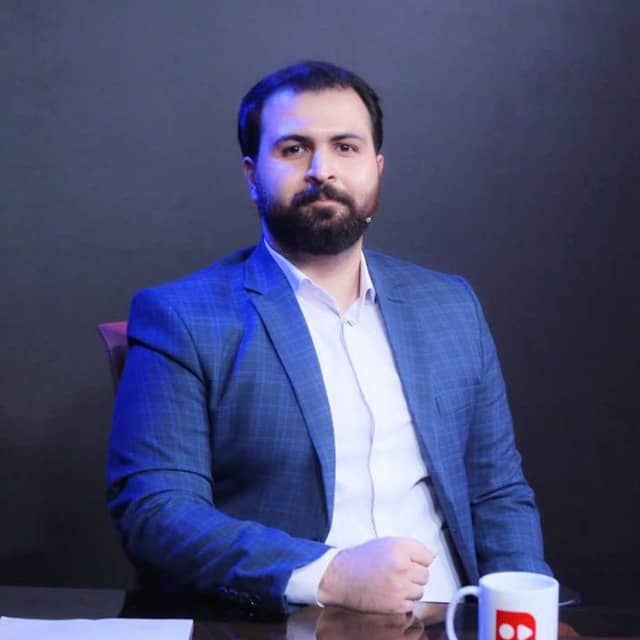
Interview with Dr. Mohammad Bayat, an expert in international relations.
Interview with Dr. Mohammad Bayat, an expert in international relations.
By Azar Mahdavan, from Tehran / Iran
Following sustained economic pressure, Iran’s domestic situation has now reached a sensitive point at which livelihood-based protests risk being transformed into engineered unrest. Existing analyses indicate that behind these efforts to create instability stand two main international actors: the United States and Israel. Their objective is to exploit the people’s genuine grievances as leverage and to prepare the ground for larger security-oriented scenarios.
A notable point is Donald Trump’s support for individuals who attempt to create unrest in the country, along with his statements directly threatening the Iranian government. This comes despite Trump portraying himself as a defender of the Iranian people, while at the same time having played a role in supporting Israel during the 12-day war, which resulted in the deaths of more than 1,000 Iranian citizens.
In order to examine the role of foreign actors in Iran’s developments, we conducted an interview with Dr. Mohammad Bayat, an expert in international relations, which follows below:
—
Based on what findings can it be concluded that American and Israeli elements are steering Iran’s economic protests in line with their own interests? What goals are Israel and the United States pursuing through these actions?
After the failure to achieve the three primary objectives of Israel and the United States during the 12-day war—namely the “complete destruction of Iran’s nuclear program,” the “serious weakening of its missile program,” and “changing Iran’s political structure”—the rapid reconstruction of Iran’s nuclear and missile programs over the past seven months has placed Netanyahu and the “neoconservatives” dominating the White House in a situation where the “window of opportunity” in the Iran dossier is rapidly closing.
According to reports published by mainstream media outlets such as *The Wall Street Journal*, the main objective of “Bibi’s” trip to Florida was not necessarily the geopolitical situation in Gaza or the future of Lebanon’s disarmament. Rather, the leader of the Likud Party sought to obtain a “green light” for renewed attacks on Iran’s sources of power. This was clearly observable during Trump’s official reception of Netanyahu and their joint press conference.
Accordingly, Washington and Tel Aviv—having drawn lessons from their previous war with Iran—now intend to exploit the activation of Iran’s economic, ethnic, and gender fault lines. By creating an atmosphere of “civil war,” they aim to pave the way for renewed aggression against Iranian territory, this time presenting themselves as the “heroes” and “saviors of the Iranian people.”
This approach is being pursued under the strategy of “Libyanizing Iran,” which would enable Israel to form a kind of “global consensus” for attacking nuclear facilities, IRGC bases, and popular mobilization forces. This objective is openly reflected in the recent tweet by the former U.S. Secretary of State, who not only congratulated the Iranian people on the New Year but also extended his greetings to Mossad agents allegedly present on the streets.
Why are Western media outlets attempting to portray protests by various segments of Iranian society over economic demands as a process leading to the collapse of the system? How do you assess the motives behind this media behavior?
Over the past week, a kind of “narrative war” has been underway regarding the current developments in Iran. A group of experts, adopting a realistic and precise perspective, point to the depreciation of Iran’s national currency against foreign currencies—especially the dollar—and the resulting 50 percent inflation rate on the eve of the year 2026, which has triggered “economic protests” in markets, universities, and other Iranian cities. On the other hand, think tanks, media outlets, and Iran’s expatriate opposition are attempting to portray these protests as a “national uprising” against the entirety of the Islamic Republic system. In this “fabricated narrative,” the Iranian people are depicted as demanding the overthrow of the ruling political system and the return of the eldest son of Iran’s exiled shah, Reza Pahlavi.
These claims are made despite the fact that both the number of participants and the geographical scope of the protests are far more limited than the protests that took place in Iran in 2019 and 2022. Such narrative construction indicates that Israel and the United States are seeking to use the recent protests as a pretext for a larger action—namely, a second round of military aggression against Iran.
What was the objective behind Trump’s interventionist message regarding Iran’s protests and his threat of attack? Is this action primarily psychological in nature? From an international law perspective, does this not constitute interference in the internal affairs of an independent country?
While the Iranian government and representatives of the protesters are engaged in negotiations to reach a genuine solution for managing the country’s economic crisis, Donald Trump suddenly wrote on the social media platform *Truth Social* about violent confrontations with protesters in Iran and promised that the United States was ready to support them.
These interventionist remarks were made despite the fact that the “MAGA” movement in the United States has been the main critic of Washington’s interventionist foreign policy and has called for an end to this failed approach within the U.S. foreign policy establishment. Nevertheless, Trump has openly violated Article 2 of the United Nations Charter by interfering in Iran’s internal affairs.
Such an action, occurring seven months before the U.S. midterm elections, sends a message to the Republican Party’s voter base that Trump–Vance were not true representatives of their will in the White House and that they once again handed control of U.S. Middle East policy to the Israeli lobby.