


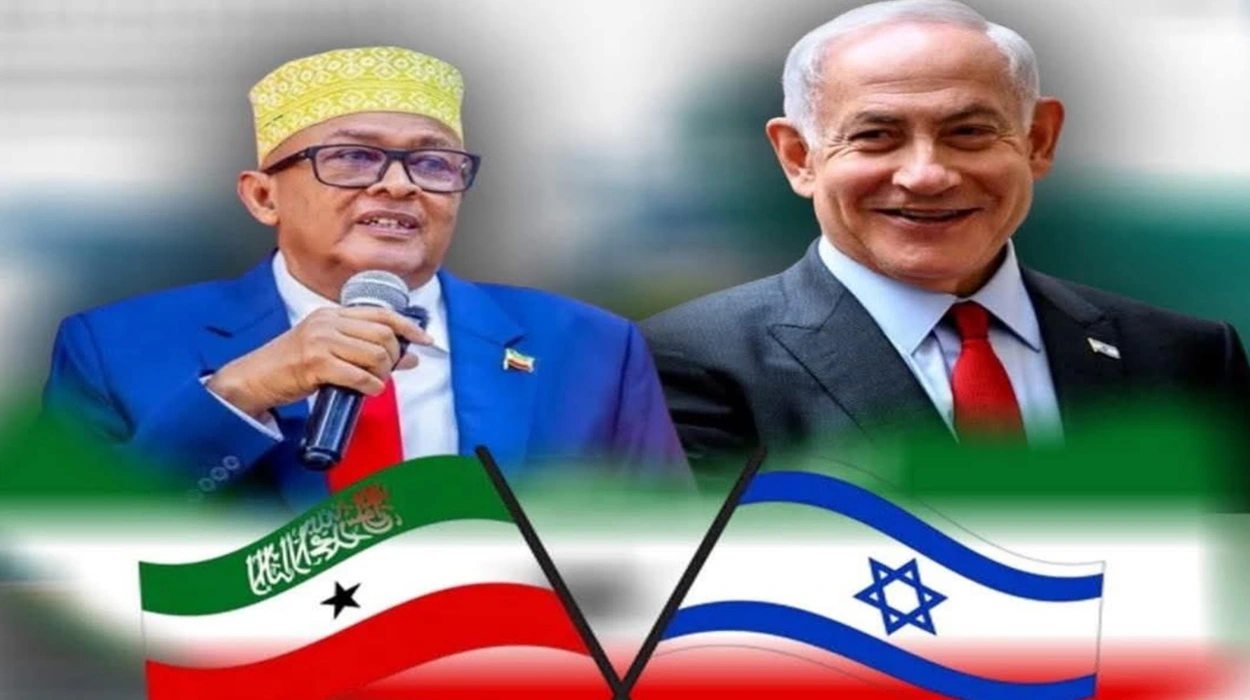
On Israel’s recognition of Somaliland’s independence.
On Israel’s recognition of Somaliland’s independence.
By Özgür Altınbaş
On December 26, Israeli Prime Minister Benjamin Netanyahu announced that he “recognizes Somaliland,” the separatist administration in Somalia, as an independent state. Netanyahu signed the recognition during a video call with Somaliland President Abdirahman Mohamed Abdillahi. Many organizations and countries, including the African Union (55 countries), reacted to the decision. Retired Naval Staff Colonel Halil Özsaraç and Sudanese researcher/author Dr. Ibrahim Nassir evaluated the issue. Experts stated that by recognizing Somaliland, Israel is targeting Türkiye’s political, military, and economic interests in the Horn of Africa.
Critical point: The port of Berbera
Özsaraç noted that Somalia, located on the Mediterranean-Indian Ocean trade route, is one of the African countries that imperialism tries to keep in an unstable environment.
“Somaliland, which constitutes Somalia’s closest territories to the Red Sea, has been acting independently of Somalia since 1991 due to the influence of the environment created by imperialists,” said Özsaraç, adding: “Prior to Israel’s attempt to recognize Somaliland, it was not recognized as an independent state in the world. Although Djibouti, to the north of Somaliland, is at the best point to control the entrance to the Bab-El-Mandeb Strait, Djibouti—with its limited coastline—has reached its limits in terms of hosting bases and has effectively reached saturation. For this reason, Somaliland’s coasts controlling the Bab-El-Mandeb Strait, especially the Port of Berbera, have recently attracted the close interest of imperialism and its proxies like Israel, the United Arab Emirates (UAE), and Saudi Arabia.”
‘They will establish bases more ambitiously’
The Retired Naval Staff Colonel said, “We should expect both Western and Eastern powers to engage in more ambitious efforts to establish bases on coasts like Somalia, Sudan, and Eritrea in the coming days.” Stating that “Since the 2010s, while Türkiye has expanded its sphere of influence from the Eastern Mediterranean to the shores of North Africa, East Africa, and the Persian Gulf, the trend of expanding its influence continues at an accelerating pace,” Özsaraç used the following expressions:

“This situation has led to clashes with Israel’s sphere of influence. Indeed, in parallel with Türkiye’s effort to expand its sphere of influence to the southern seas, Israel has a tendency to expand its sphere of influence to the Sea of Islands (Aegean). Türkiye has the ability to completely restrict Israel in the Eastern Mediterranean, where Türkiye is strong; however, Israel does not have the ability to limit the Turkish presence that pressures the Red Sea via Somalia. For this reason, by recognizing Somaliland’s independence, Israel has entered into an effort to show a military presence by gaining military privileges—that is, acquiring bases—especially around Berbera. Regarding Israel’s recognition of Somaliland, it should be expected that it will use its struggle with Houthi Yemen and Iran as a primary pretext, rather than the Turkish military presence in Somalia and Qatar. For Israel, the Turkish Naval Forces and Turkish Armed Forces, which are starting to overflow from semi-enclosed seas to the oceans and will become unmanageable for Israel in the future, are a much bigger problem than the Houthis and Iran, who have less maritime combat capability.”
‘Israel cannot cope with Türkiye’
Özsaraç emphasized that after maturing its military alliances with Greece, the Greek Cypriot Administration of Southern Cyprus (GCASC), and the YPG as its first measures against Türkiye, Israel is now engaging in medium- and long-term precautionary efforts against Türkiye through Somaliland. Stating that Israel lags far behind Türkiye in terms of geopolitical power and Naval Forces, the expert evaluated:
“Israel can venture into such bold initiatives by relying on its nuclear warheads, long-range air defense and attack capabilities, but most of all, the intensive support of imperialism. On the other hand, it is not possible for Israel to cope with Türkiye—which has entered a momentum of independence from imperialism—either in the Eastern Mediterranean, other West Asian seas, or even the Indian Ocean, even if it establishes a base in Somaliland. Furthermore, the number of political and military steps Türkiye can take against Israel in Africa, especially in the Horn of Africa, is very high, and potentially more are being prepared or are waiting ready.”
Taking control of trade routes
Özsaraç underlined that Türkiye’s grand strategy for the future depends on reclaiming control of trade routes from imperialism and its proxies. “The Red Sea is effectively Türkiye’s windpipe,” said Özsaraç. “The Red Sea is a logistics/trade channel that must be kept open and dynamic at all times. A closed Red Sea, meaning the Asian connection route, would be a matter that could collapse Türkiye’s economy. Therefore, Egypt, Sudan, Eritrea, Yemen, Djibouti, and Somalia are states that Türkiye approaches with vital importance and whose territorial integrity must be protected. However, the Red Sea and the Sea of Yemen (Gulf of Aden) are important for Israel for the same reasons and are areas of geopolitical competition. Because Israel has small but very critical shores and a port in the Gulf of Aqaba.”
Israel will try to establish military bases
Özsaraç said that Israel would have demands from Somaliland. He explained the demand as follows: “By recognizing Somaliland’s independence and assuming the role of its supporter and patron, Israel will have demands such as: ‘I recognized your independence; in order for me to ensure its continuity and your defense and security against military reactions from Somalia, I need to establish naval and air bases on your territory, send my soldiers, and have military privileges.’ I think the Somaliland administration may have to grant this opportunity to Israel, the only country that recognizes it. It should not be forgotten that the US may be behind this initiative of Israel, or it may have been done in consultation with the US. As you can see, Türkiye’s geopolitical struggle area is not limited only to the ‘Blue Homeland’ (Mavi Vatan). The defense of the Blue Homeland has already spilled over into the Indian Ocean.”
‘Rubin was the one who started this idea’
Dr. Ibrahim Nassir stated that the “founding father” of the developments regarding Somaliland is Michael Rubin. Nassir emphasized that Rubin’s recommendations, which particularly mobilized the Israel lobby in America, encouraged the Somaliland administration. Stating that the Somaliland administration determined a foreign policy accordingly after Rubin’s ideas, the expert said, “The first diplomatic move made by the Somaliland administration was to recognize Taiwan as an independent state and start diplomatic relations with Taiwan.”

‘Türkiye’s security starts from Bab-el-Mandeb’
Nassir drew attention to the importance of the Bab-el-Mandeb Strait, saying, “Türkiye’s national security starts from Bab-el-Mandeb.” Stating that Israel’s moves in East Africa damage Türkiye’s interests for this reason, Nassir evaluated: “Israel is uncomfortable with Türkiye’s increasing influence in the region. While Israel tries to encircle Türkiye in the Eastern Mediterranean, it also wants to break its influence in East Africa. In doing so, it tries to weaken the governments that form alliances with Türkiye. We saw this in Libya, and now we see it in Sudan and Somalia.”
‘Ankara intervened’
Nassir also drew attention to the relationship between Ethiopia and Somaliland. Emphasizing Ethiopia’s desire to reach the sea, Nassir said, “Ethiopia had made an agreement with Somaliland to use the operational capabilities of Israel and the United Arab Emirates. However, Türkiye intervened along with Egypt and Somalia to solve this issue, and Ethiopia gave up on this.”
‘A model for the terrorist organization YPG’
Nassir stated that Israel’s recognition of a separatist administration like Somaliland as a state constitutes a role model for the terrorist organization PKK/YPG in Syria and the Rapid Support Forces (RSF) terrorist organization in Sudan. Emphasizing that the goal here is to besiege the states in the region, Nassir said: “Türkiye, Egypt, Iran, and Saudi Arabia are intended to be besieged in this way. This is a plan of imperialism. This is why separatist movements in and around these countries are supported. In this way, a role model is being created for other separatists.”
Nassir added: “Türkiye is a country that wants stability. That is why it supports Somalia. Israel, on the other hand, is trying to hinder Türkiye by attempting to create instability. It does this by supporting separatist forces. This is the ‘Greater Israel Project’.”
‘Connected to the goal in Yemen’
Sudanese expert Nassir added that the recognition of Somaliland aligns with the separatist movement carried out in Yemen. Evaluating the initiative launched by the UAE-backed separatist Southern Transitional Council (STC), Nassir said: “There is a movement here to divide Yemen and encircle Saudi Arabia. Just as the UAE supports the RSF terrorist organization in Sudan, it also supports the STC in Yemen. You know that Israel and the US could not carry out operations against Yemen successfully because they could not get enough military and intelligence support from the countries in the region. In other words, they conducted ‘blind operations.’ This led to an unsuccessful operation against the Houthis in Yemen, and they did not get what they wanted.”