


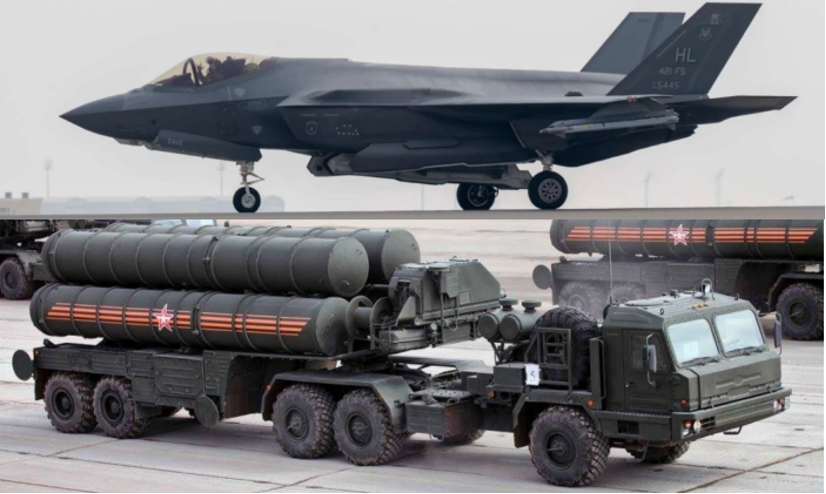
A comparison of the S-400 air defense system and the US F-35 planes.
A comparison of the S-400 air defense system and the US F-35 planes.
By Ceren Ceviz
Türkiye’s negotiations with the United States over the F-35 program remain complicated due to Ankara’s possession of the Russian S-400 Triumph air defense system. This article examines why Türkiye considers the S-400 essential and why it is unwilling to forgo it in exchange for the F-35 Lightning II.
The Republic of Türkiye continues its negotiations with the United States of America regarding Türkiye’s return to the F-35 program. Following President Recep Tayyip Erdoğan’s visit to the U.S. and his meeting with Donald Trump at the White House on 25 September this year, progress on the matter was anticipated. However, experience shows that the main obstacle to supplying F-35 aircraft to Türkiye is Ankara’s possession of the Russian S-400 air defense system.
Recently, the U.S. Ambassador to Türkiye, Tom Barrack, citing U.S. legislation, made another statement: for Türkiye to return to the F-35 program, it must give up the S-400. The day after this statement, Reuters published a declaration from the Turkish Ministry of Defense, asserting that Türkiye’s position regarding its possession of Russian S-400 surface-to-air missile systems remains unchanged.
Turkish Foreign Minister Hakan Fidan has repeatedly expressed confidence that Türkiye and the U.S. will soon find a way to lift sanctions on F-35 deliveries. However, at present, it seems that the issue of F-35 program membership is as important to the U.S. as Türkiye’s possession of the S-400 is to Ankara.
F-35 Lightning II: Specifications, Usage, and Alternatives
The F-35 Lightning II is a fifth-generation multirole fighter developed by the American company Lockheed Martin. The aircraft is designed to achieve air superiority, strike ground and naval targets, and conduct reconnaissance missions. It features stealth capabilities, advanced avionics, integrated detection systems, and high network interoperability.
It is in service with the United States, several European countries, Australia, Japan, the Republic of Korea, and Israel.
The aircraft has combat experience. Since 2018, the U.S. has deployed it in Afghanistan, Syria, Yemen, Iran, and Iraq for ground strikes, reconnaissance, observation, and network-centric operations. Israel has also actively employed the F-35 since 2018 in Syria, Gaza, Iran, Iraq, Lebanon, and Yemen.
Since its introduction, the F-35 has experienced around ten crashes due to various causes. There are no official records of F-35s being shot down in combat. Nevertheless, some media outlets reported that during Israeli strikes on Iran in June 2025, Iranian air defenses allegedly shot down two F-35I Adir aircraft, citing photographs of the downed planes. The Israeli side categorically denied these claims.
The primary alternative and competitor to the F-35 is Türkiye’s domestically produced fifth-generation fighter, KAAN, which completed its maiden flight in February 2024. Given that both aircraft are fifth-generation fighters with comparable main characteristics, KAAN demonstrates a significant advantage in terms of production costs. It is also noteworthy that a contract with Indonesia for the supply of 48 KAAN fighters was signed in July 2025.
The main reason Türkiye maintains interest in the F-35 is the absence of serial production for KAAN. Nevertheless, according to Yeni Şafak, full-scale serial production of KAAN will begin in 2026, and by the early 2030s, it is expected to form the foundation of the Turkish Air Force fighter fleet.
S-400 Triumph: Specifications, Usage, and Alternatives
The S-400 Triumph (NATO code name: SA-21 Growler) is a next-generation Russian-made surface-to-air missile system with short, medium, and long-range capabilities. It is designed to intercept aircraft, cruise and ballistic missiles, and other aerodynamic targets, including stealth technology targets, at distances up to 400 km. The system features a multi-layered radar network, the ability to simultaneously track up to 36 targets, and missiles of various ranges, enabling an echeloned air defense structure.
It is in service with Russia, Türkiye, China, and India. Deliveries to Saudi Arabia, Vietnam, and Belarus are also expected.
The S-400 has combat experience, primarily in Russia’s use of the systems to defend border territories against strikes from Ukraine. Russian media reported successful interceptions, including American ATACMS missiles. Verified reports indicate no more than five confirmed cases of S-400 systems being neutralized during combat operations between Russia and Ukraine.
According to Anadolu Ajansı, the U.S. did not respond positively to Türkiye’s request for a Patriot missile system from its ally. That is why Türkiye signed a contract to acquire the S-400 in November 2016 to respond to growing security needs.
Technically, the systems are comparable in many respects. However, while the S-400 can engage targets at altitudes as low as 10 meters, American Patriot missiles can engage targets only at a minimum altitude of 60 meters, which is a notable disadvantage against drones and low-flying cruise missiles.
Why Ankara Has Not Abandoned the S-400 in Favor of the F-35
Türkiye’s position on this issue is determined by several factors critical to national security.
It is necessary to highlight the destructive policies of Israel in recent years. Israel continued bombing civilians in Gaza over two years. Since the start of attacks on 7 October 2023, more than 70,000 people have been killed and over 170,000 injured. Beyond Palestine, Lebanon, Yemen, Iran, Syria, and Qatar were also targeted.
In Syria, even after the civil war ended, Israel carried out strikes on Damascus, supported SDF/YPG autonomy in the north, Druze autonomy in the south, and continues to occupy the Golan Heights, aiming to divide Syria. Additionally, the Jerusalem Post reported that Israeli Foreign Minister Gideon Sa’ar highlighted significant disagreements with the Syrian side over security agreement terms, further heightening tensions.
Israeli officials have repeatedly stated that an armed conflict with Türkiye in the near future is highly likely. Benjamin Netanyahu also lobbies for maintaining the U.S. arms embargo on Türkiye.
In the event of a military conflict between Israel and any other country, the U.S. is almost certain to side with Israel. A vivid example is the U.S.-supported Israeli attack on a Hamas delegation in Qatar. Despite the U.S. being aware of ongoing peace negotiations, the decision favored Israel. Moreover, the Patriot air defense systems deployed in Qatar were remotely disabled by the U.S. to ensure the success of the Israeli strike.
Therefore, at present, S-400 systems serve as a guarantee for Türkiye’s national security and the preservation of an independent policy. They act as a deterrent to Israel and provide aerial security for Türkiye, complementing the Iron Dome system. By choosing the S-400 over the F-35, Türkiye once again underscores that it does not seek aggression but is prepared to ensure its security and the safety of its citizens.