

Main political events in Türkiye in the last week.
Main political events in Türkiye in the last week.
Last week in Türkiye, President Recep Tayyip Erdoğan’s visit to Turkmenistan, new developments in the “Terror-Free Türkiye” process, and statements by Foreign Minister Hakan Fidan on international issues with a particular focus on Palestine, made up the top topics.
Erdoğan in Turkmenistan
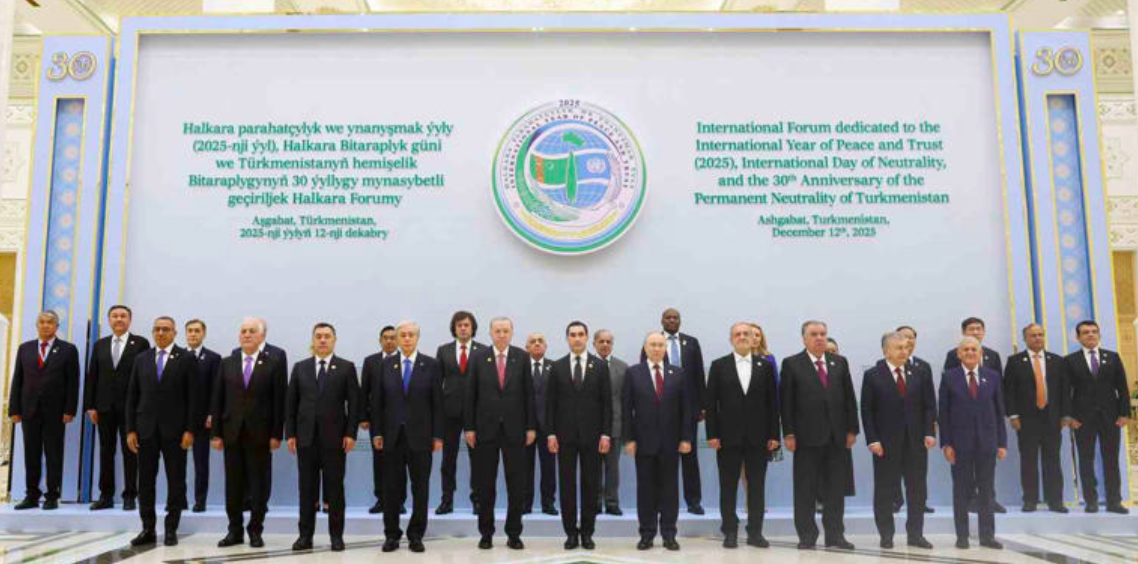
President Recep Tayyip Erdoğan attended the “International Forum of Peace and Trust”, organized to mark the 30th anniversary of Turkmenistan’s permanent neutrality status.
Speaking at the forum in Ashgabat, Erdoğan addressed ongoing global problems and conflicts and underlined Türkiye’s “commitment to promoting peace and dialogue”.
On the war between Russia and Ukraine, Erdoğan said Türkiye is ready to provide concrete support for diplomatic initiatives aimed at achieving a ceasefire and permanent peace.
Reiterating Türkiye’s support for a two-state solution in Palestine, Erdoğan noted that the ceasefire in Gaza remains fragile and that its sustainability depends on strong and continuous backing from the international community.
During his stay in Ashgabat, Erdoğan also held a series of bilateral meetings.
He met with Pakistani Prime Minister Shehbaz Sharif. Erdoğan said Türkiye is working to further strengthen its relations with Pakistan and would seek to expand cooperation in energy, trade, investment, and other fields in the period ahead. He also welcomed the extension of the ceasefire between Pakistan and Afghanistan and added that Türkiye is ready to contribute to the continuation of peace.
Another bilateral meeting took place between Erdoğan and Turkmen President Serdar Berdimuhamedov. Erdoğan stated that Türkiye aims to advance cooperation with Turkmenistan in all fields, particularly in trade, energy, defense industry, and cultural areas.
President Erdoğan also held a meeting with Russian President Putin in Ashgabat. The meeting covered bilateral relations as well as the ongoing war in Ukraine.
Erdoğan expressed Türkiye’s support for achieving a fair and permanent peace. He said that implementing a limited ceasefire in energy facilities and ports could be beneficial as a first step.
The talks also covered issues of Palestine, Syria and the peace process in the South Caucasus.
Erdoğan responded to journalists’ questions on the plane back to Türkiye.
Regarding the details of the meeting with Putin, he said the following:
“I specifically told him that he is always welcomed in Türkiye. We agreed that we need to meet as soon as possible. He said to me that he would keep his word. I hope we can arrange this visit very soon.
Our relations with Russia are not based on short-term interest calculations. It is built on a deep historical, strong diplomatic foundation, and mutual trust. We mainly discussed the war and peace efforts. President Putin, like all other actors, knows very well Türkiye’s stance on this issue. We believe this war should have ended long ago, and we express this openly to all our counterparts.
As you know, US President Donald Trump is involved in these efforts. We are also encouraging the US about it. Our Foreign Minister Hakan Fidan continues to maintain constant contact with the relevant authorities in the US. From time to time, we also engage in phone diplomacy with leaders. Following our meeting with Putin, we hope to have the opportunity to discuss the peace plan with President Trump as well. Peace is not far away; we can see it. All we need to do is direct our course toward where peace lies. The Black Sea should not be seen as an area of confrontation. Such a situation would harm Russia and Ukraine and bring no benefit to anyone. Everyone needs navigation security in the Black Sea. This must be ensured.”
Developments in the “Terror-Free Türkiye” process
The “Terror-Free Türkiye” process is ongoing.
The Nationalist Movement Party (MHP) and the Peoples’ Equality and Democracy Party (DEM) submitted reports on the process to the Grand National Assembly of Türkiye (TBMM).
MHP’s report included general assessments of the process and proposed roadmaps. The report also covered the meeting held by the National Solidarity, Brotherhood, and Democracy Commission (the Commission in the TBMM established in August 2025 to oversee the Terror-Free Türkiye process) with PKK leader Abdullah Öcalan. It reads:
“PKK Founder Abdullah Öcalan stated that he has stood by all the promises he made since the beginning of the process and that he has the theoretical and practical means to fulfill them when there is available ground. He recounted a historical background and, referring to Ziya Gökalp, emphasized the importance of Turkish-Kurdish brotherhood (…)
Abdullah Öcalan noted that he has abandoned armed methods, embraced political methods, and that, within the framework of his February 27, 2025, call, the announcement of the disbanding of all structures, all PKK branches, the surrender of their weapons has been well received by society and closely followed by the public, and he remains influential in Syria and Iraq.
At this point, when Feti Yıldız reminded that he was the lawyer for the families of martyrs in the case in which PKK Founder Abdullah Öcalan was convicted, Öcalan responded: ‘I stand by all the promises I made in the process that began the actions of Devlet Bahçeli (…)
He was told that “The process is being poisoned by the use of language dating back to the Lausanne and pre-1924 Constitution period”. It was also noted that, most recently, the presence of armed PKK members in the Zap region caused public outrage, and that the PKK did not fully comply with his call. He was told that adherence of the SDF in Syria to the March 10 agreement is essential, and that he needs to make a new statement regarding Syria.
When it was shared with him that observations indicated that the PKK transferred forces withdrawn from Iraq into Syria, which contradicts previous statements, Abdullah Öcalan stated that the PKK must lay down its arms not only physically but also mentally.
When reminded in his February 27 call that there is no separate state, no federation, no administrative autonomy, and no culturalist solutions, Öcalan confirmed by saying “Yes, that is correct”.
Another report on the process was submitted to the TBMM by the DEM. The report, which addressed the history of the issue and proposed a roadmap for the process, included statements that sparked debate.
The report, framing the process as “peace with the Kurds,” included proposals such as granting constitutional recognition to the Kurdish identity, establishing Kurdish as a second official language and using it in public space and education from pre-school to higher education, granting autonomy in local administrations, repealing the Anti-Terror Law, and facing up the state’s founding years and recent history.
The report contained some controversial statements:
“The Kurdish people must be recognized as a political and social subject, and Türkiye must achieve an equal, just, free, and democratic political-legal system based on the concept of a democratic nation (…) Ethnic, linguistic, cultural, class, and regional inequalities have deepened when combined with a security-oriented regime and mindset. The trustee regime, the usurpation of local administrative will, and not recognizing language rights, and economic exclusion are concrete manifestations of this.”
Meanwhile, journalist Saygı Öztürk’s article about the meeting between Commission members and Öcalan caused a public uproar.
According to Öztürk, Öcalan demanded changes in the Constitution, especially in the section of citizenship definition, and recognition of Kurdish as an official language in the Constitution. Öztürk also wrote that Öcalan opposed the disarmament of the SDF.
Öztürk further claimed that Öcalan requested Kurdish-language education in the East and Southeast regions based on ethnic and sectarian lines.
Another demand of Öcalan concerns local administrations and resource sharing. According to Öztürk, Öcalan demanded the application of the European Charter of Local Self-Government and the empowerment of local administrations. He requested that a portion of the revenue from oil extracted from Mount Gabar and electricity generated by dams in the Southeast be transferred to local governments.
Foreign Minister’s remarks
Foreign Minister Hakan Fidan delivered a speech at the Al Sharq Youth 9th International Conference 2025 held in Istanbul.
Fidan assessed that the world is going through “a period of conflicts in various regions and global strategic competition with wide-ranging influence”.
He emphasized that the Islamic world needs to demonstrate collective efforts in security alongside regional and economic cooperation. Calling for unity in the Islamic world, Fidan said: “The Islamic world needs a transformation and unity. Under the leadership of Recep Tayyip Erdoğan, the Republic of Türkiye is working hard for this cooperation”.
Fidan also addressed Palestine and Israel. He stated: “Palestine has always been our compass. It is the main objective for us in the Islamic world. We must take bold steps to repel Israel’s aggression and expansionism.”
Fidan stressed the destabilizing impacts of Israel’s attacks on Palestine and Syria: “In the face of this crisis, we called on the international community to act as a united front. At the same time, we are in communication with the Islamic world so that it could make its call with a single bold voice.”
On Türkiye’s efforts to achieve a ceasefire in Gaza, Fidan said, “We organized the Sharm El-Sheikh Peace Summit. Türkiye assumed a very active role in partnership with Qatar, Egypt, and the US”.
Fidan also addressed Syria, stating: “We stood with the Syrian people and shared in their longing for freedom. On December 8 last year, our Syrian brothers and sisters opened a new door to a new era. We cooperated with the US administration, the local authorities there, and international actors to establish a stable, unified Syria, free from terror and occupation.”