


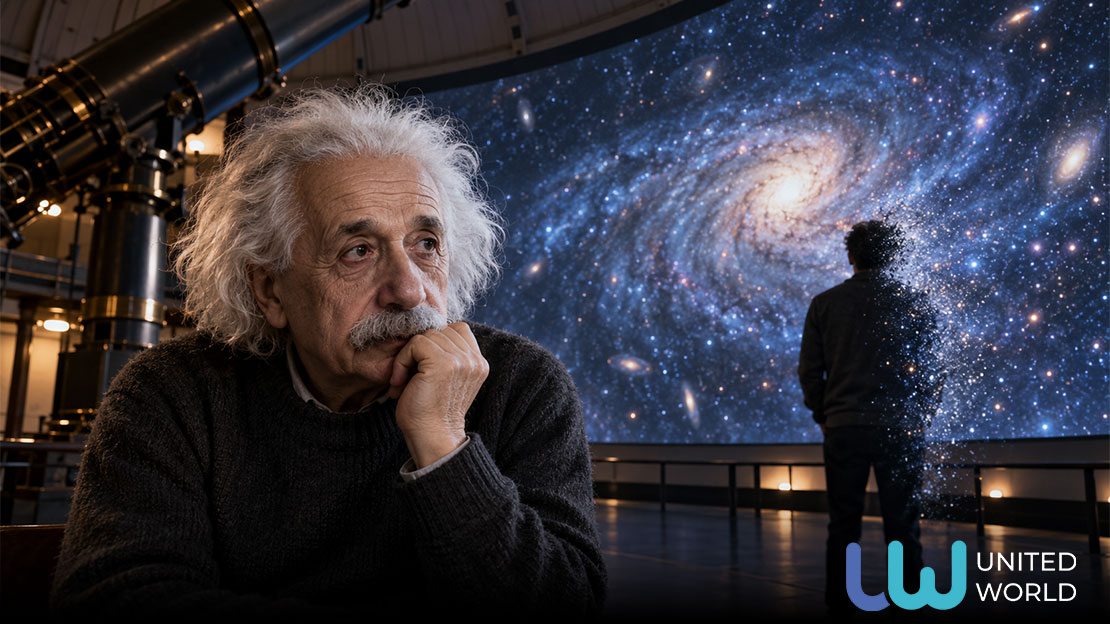
By Ljubodrag Simonovic, from Belgrade / Serbia
When one considers the public’s attitude toward Albert Einstein, one gets the impression that he is not a concrete human being but a mythological figure. Einstein is the embodiment of a mind that has a suprahistorical and superhuman character. His thoughts are not grounded in the cultural and libertarian heritage of humanity, but are the product of his “genius”, which has a cosmic source. Einstein is a modern Messiah, and as such, a cosmic emissary who reveals to people the meaning of their existence. His thoughts acquire a divine aura, and as such, become unquestionable truths. When the mythological veil is removed from Einstein’s image, it becomes clear that Einstein is not a cosmic being but a concrete social and historical figure.
Einstein’s thought has no historical self-consciousness. It is not conscious of its historical roots and the nature of the world in which it emerged. Einstein soared into the cosmos through his imagination and became the embodiment of consciousness that has a cosmic character. His thought is the bearer of a truth that does not have a secular and historical but a cosmic and timeless character. Indeed, Einstein’s cosmology is not an autonomous thought but is based on the development of science and other intellectual and spiritual spheres, which means on the creative powers and creative practice of people. His thought is not a tree of wisdom that has a superhuman and cosmic nature, but is a branch on the tree of knowledge that man planted and nurtured in the course of his historical existence.
Einstein does not speak of the cosmos as a scientist, but as a mystic who stepped off the emancipatory path of Enlightenment thought and wandered into an esoteric wilderness. With his cosmology, he abolished the progressive potentials of the scientific mind through an imagination based on cosmological mysticism. Instead of arguments and scientific hypotheses, Einstein offers esoteric speculations that have a metaphysical and subjective character. Instead of insisting on scientifically based arguments and evidence, Einstein, like a religious fanatic, invites people to surrender to “feelings” that lead them to the “truth”. Einstein deprived science of its libertarian and visionary essence and reduced it to a positivist discipline that serves to integrate man into a cosmic order in which there is no future. By abolishing man as a social being, Einstein abolishes creative sociability, which is the cornerstone of the historical development of humanity. Einstein does not realize that creative sociability is the source of his scientific discoveries. They are merely one of the stones of wisdom upon which the self- consciousness of man as a unique cosmic being is built.
For Einstein, man’s active relationship to cosmos does not have a creative and libertarian character, but an adaptive one. By overcoming the cosmic forces through science and technology, man neither realizes his creative powers nor frees himself from natural determinism, but plunges into cosmic processes and ceases to be a unique cosmic being who creates a humane world and thus a humane cosmos.
Instead of relying on a scientific mind, Einstein relies on a religious imagination. Terms such as “God” and “spirit” become an integral part of an illusory cosmic firmament in which the secret of eternity is hidden. Einstein’s cosmology is dominated by a holistic approach that has an absolutist and totalitarian character. Like the ancient mystics, Einstein creates a metaphysical idea of the cosmos that is the unquestionable starting point of his cosmology. Mystical speculations abolish the dialectical mind and visionary consciousness and bind man to the existing world.
Like the dominant religions, Einstein’s cosmology is based on the dualism of the material and spiritual worlds. The body is mortal, and consciousness, which has a cosmic origin, is immortal and indestructible. Death is the transition from temporary earthly to eternal cosmic existence. When the body dies, consciousness is freed from the constraints of the material world and becomes an organic part of the cosmic whole. Cosmic consciousness becomes a kind of “holy spirit” and as such a timeless entity that is older not only than man, but also the cosmos. Consciousness acquires the dimension that belongs to God in religions. Einstein follows Spinoza’s maxim deus sive natura: the cosmos becomes a rational being through God. Through the myth of the cosmic nature of consciousness, Einstein abolished the self-consciousness of man as a unique and unrepeatable cosmic being. In fact, human self-consciousness is the source of consciousness as a specific cosmic phenomenon. By depriving human society of historicity, Einstein could not understand that consciousness has a historical nature, which means that it is the result of the development of man as a creative and spiritual being. The self-consciousness of ancient man differs significantly from that of modern man. By abolishing people as concrete social and historical beings and thus as unique and unrepeatable personalities, Einstein could not even come to the conclusion that every man has a unique self-consciousness.
Einstein sought to determine the cosmic essence of man by abolishing man as a unique and unrepeatable human being and thus the humane world. Man is not a concrete social and historical being, but through consciousness is an organic part of the cosmos and as such is eternal. The concrete life of man as a social being is insignificant. His self-consciousness is not conditioned by the fact that he is an organic part of the world in which he lives, but by the fact that he is an organic part of the cosmos. The cosmos is man’s true home.
According to Einstein, the ideal of the humane earthly world should not be the source of human self-consciousness, but the idealized cosmic world. Man should not strive to create a humane world and, on that basis, humanize the cosmic forces; instead, he should see in a universe governed by perfect harmony the ideal of a world toward which he ought to strive. Einstein created a virtual cosmic world in which man will become eternal by being stripped of everything that makes him a man. The illusion of eternal life in the cosmos becomes the source of man’s self-consciousness as a concrete human being – on which his relationship to the world in which he lives and to the future should be based. Einstein has in mind the Hellenic cosmos in which Uranus established the order that became the source of self-consciousness of the Hellenic world and the governing political principle. By idealizing the cosmos as a sphere governed by perfect harmony, Einstein declared harmony to be the most important principle on which cosmic consciousness is based and thus the true self-consciousness of man. Being an organic part of the cosmic whole and being completely subordinate to the cosmic order constitute the basis of man’s self-consciousness and the foundation of eternal existence. According to Einstein, science indicates that everything in the universe is connected, that each segment of the universe is a harmonious part of the whole, and that the structure of the universe is unchanging and eternal. Cosmic pantheism is based on the principle of perfect harmony which has an absolute and totalitarian nature.
If there is perfect harmony in the cosmos and if man is the embodiment of cosmic consciousness that has absolute power, how is it possible that human self-consciousness does not correspond to cosmic consciousness? Likewise, if the cosmos is a perfect whole and as such an unchanging given, how did the human world arise, developing on the basis of the dialectical laws devised by Hegel – on the unity and struggle of opposites, the negation of the negation, the transition of quantity into quality…? The development of religious consciousness is an obvious example. On its historical path, humanity progressed from animism, totemism and polytheism to monotheism. The principle of disharmony, which has a dialectical character, is the basic principle on which the historical development of human society is based. It should also be noted here that Einstein refers to ancient Hellas but does not mention Heraclitus’ principle “war is the father of all” (polemos pater panton estin), which indicates that the struggle for dominance and survival is the essence of the Hellenic concept of cosmic harmony.
Einstein’s cosmology erases the concrete self-consciousness of man as a social and historical being. Cosmic consciousness acquires a divine character and as such is the unquestionable source of human self-consciousness. Einstein fails to understand that human society is the mediator between the universe and man, that is, that the nature of man as a social and historical being conditions the nature of man as a cosmic being and thus his understanding of the cosmos and his relationship to it. Einstein’s theory and his paternalistic attitude towards people indicate that his cosmology has an instrumental nature. If Einstein truly believed in what he preached, he would not address people. Here we encounter the hypocrisy that prevails in clerical circles. If God is “omnipresent and omnipotent” the existence of churches is meaningless. Einstein’s cosmology itself contradicts its basic intention. Its very emergence indicates that perfect harmony does not prevail in the universe and that man is not a slave to cosmic processes, but a unique cosmic being who by creating a humane world, creates a humane cosmos.
Is mysticism the answer to man’s inability to reasonably reach his cosmic essence? Does man inevitably fall into cosmological mysticism when he attempts to understand the essence of the universe? Is Einstein’s thought one of the indicators of the limitations of the human mind? Einstein’s cosmology is an example indicating that when man is deprived of his libertarian essence and human society of its historical essence, the endeavor to discover the meaning of human existence ends in the dark depths of cosmic mysticism.
Einstein abolished man as a creative and libertarian being and thus abolished the historical development of human society. In his cosmology, there is no past and future of humanity. Man is deprived of the visionary consciousness that makes him a unique cosmic being. Einstein deprived the world of historical authenticity and thus abolished the humane cosmos. Man is not a visionary being and, as such, a unique cosmic novum, but a cosmic given. By depriving the world of the future, Einstein was unable to understand that infinity is not a cosmic, but a historical phenomenon. For Einstein, time is a cosmic given and corresponds to the structure of the cosmos. Indeed, man creates historical time that has a human nature. In this way, man, as a libertarian and creative being, transcends the framework of mechanical time and creates qualitatively new criteria for determining time.
By depriving the world of worldliness and man of humanity, Einstein deprives man of the consciousness that the planet Earth is the only true cosmic home of man, and that life-creativeness is the most important feature of man as a cosmic being. Man is a cosmic being as an emancipated natural being. He does not merely create new life, as animals do, but creates a new world. Einstein speaks of the integrative quantum structure of the cosmos, but says nothing about the development of interpersonal relationships, or about the erotic and poetic nature of man… In Einstein’s cosmos, there are no young people embracing one another, nor can the cries and laughter of children be heard…
What does Einstein’s cosmology mean in the contemporary world, which is confronted with the increasingly real possibility of extinction? Why should man struggle against an order that can instantly destroy humanity if man, as an organic part of the universe, is indestructible and if the universe is man’s true home? Einstein does not address people as concrete social beings who are on the edge of the abyss but addresses an abstract man who is deprived of humanity and who is not an organic part of the human community, but appears as an organic part of the illusory cosmos. Having in mind the fact that man’s struggle for freedom and the survival of life on Earth contradict the ruling cosmic order, Einstein has expelled Prometheus out of the cosmos and devalued millions of young people who are fighting against the prevailing capitalist order, which has become a totalitarian order of destruction. Bearing in mind the prevailing tendency in the development of the world, it can be concluded that Einstein’s cosmology represents a contribution to the development of escapist consciousness that leads humanity toward annihilation.
Translated from Serbian by Vanja Zakanji
* Lubodrag Simonovic (74) was a member of the Yugoslav national basketball team, which won the world championship in 1970. Several times he played for the national team along with Sergei and Alexander Belov. He was a participant in the Olympic Games in Munich. In protest against the cover-up of a doping scam with Puerto Rico, he left the Games, after which he was expelled from the national team. The author is a Master of Laws and a Doctor of Philosophy. He has published ten books in the fields of philosophy, sociology and historiography. His texts have been translated into English, Russian, Italian, Spanish, Turkish. He taught at domestic and foreign universities. He is married and has three children and six grandchildren. Simonovic lives in Belgrade.