

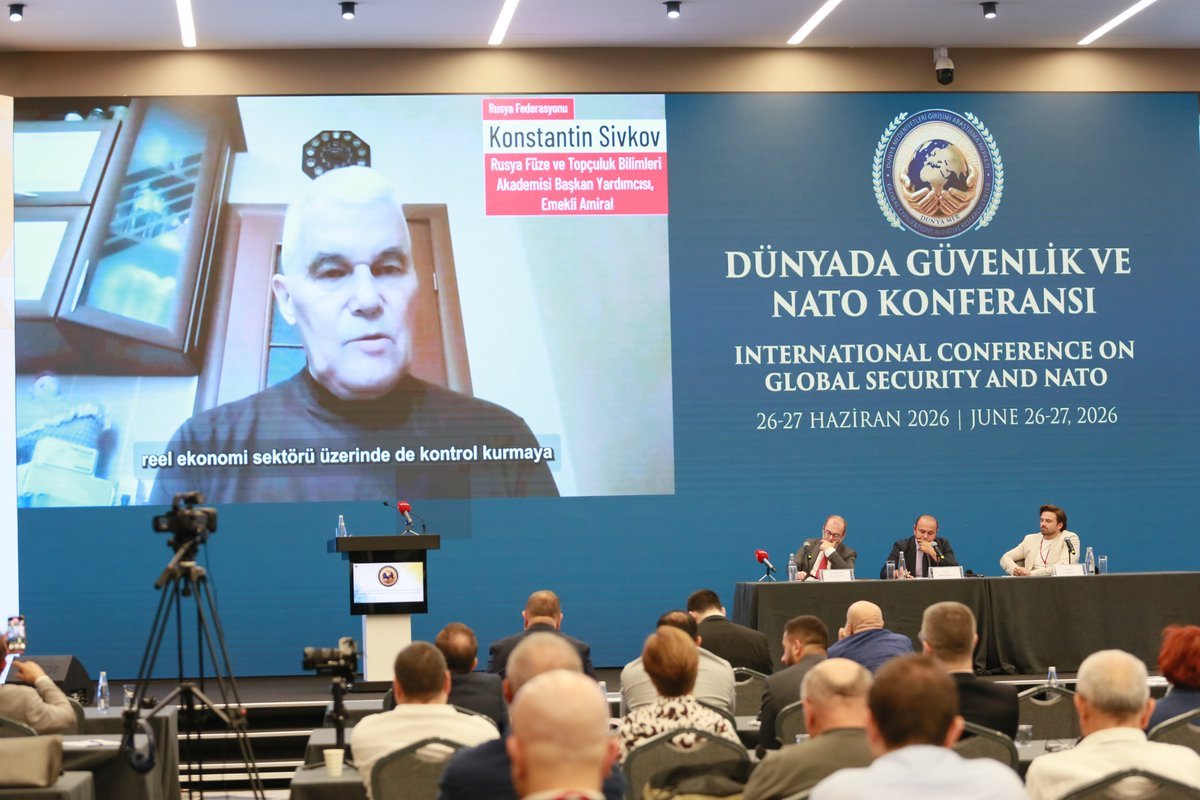
Speech of Konstantin Sivkov, retired Russian Admiral and Vice Chairman of the Russian Academy of Missile and Artillery Sciences, at the conference on NATO and Global Security.
Speech of Konstantin Sivkov, retired Russian Admiral and Vice Chairman of the Russian Academy of Missile and Artillery Sciences, at the conference on NATO and Global Security.
By Konstantin Sivkov, retired Russian Admiral and Vice Chairman of the Russian Academy of Missile and Artillery Sciences
The World Civilizations Initiative Research Center organized an international conference on Global Security and NATO on June 26-27, 2026, in Istanbul, Türkiye, ahead of the NATO summit scheduled for 7 and 8th of July in Ankara. One of the speakers was Konstantin Sivkov, retired Russian Admiral and Vice Chairman of the Russian Academy of Missile and Artillery Sciences. Below we present Sivkov’s speech. The title was set by UWI.
Ladies and gentlemen, as a representative of Russia, a country opposing NATO, I consider it inappropriate to speak about the future of NATO. I will focus on the contradictions and the trends they generate, which may determine the future of this bloc.
If we talk about the nature of these contradictions, two types can be distinguished here: external and internal. These contradictions are closely interconnected. The external contradictions that determine the development trends of the NATO bloc are, of course, global in nature. Because the NATO bloc itself is a global organization with global influence. Therefore, it is precisely the global contradictions that have a decisive impact on the development of the NATO bloc and are external to it.
The first contradiction I would like to note, which is of enormous importance for the development trends of the NATO bloc, is the contradiction between the global financial elite—which controls 70 to 80 percent of global financial flows according to various estimates—and the real sector of the economy of the countries that make up the NATO bloc, primarily, of course, Western civilization. So, this contradiction has very serious foundations, and in its time it manifested itself quite sharply in the early 20th century; it led to the emergence of the well-known Depression of the 1930s in the United States of America, from which the country emerged with great difficulty. In Europe, this contradiction was one of the driving forces behind the outbreak of the Second World War.
Today, this contradiction is also one of the key factors shaping the trends currently being experienced by the NATO bloc. The essence of this contradiction lies in the fact that the financial elites, controlling 70 to 80 percent of global financial flows, strive to gain access to and establish their control over the real sector of the economy not only in European countries but also in other countries around the world. The reason is very simple. Just as any business strives to create favorable conditions for its existence, global business strives to create favorable conditions for its existence on a global scale. And the key prerequisite for creating such favorable conditions is the formation of political structures within states that are friendly to these elites and taking control of the real sector of the economy. Through this, they aim to eliminate the main opponent of the financial elites—the so-called large, medium, and small industrial bourgeoisie.
Naturally, these forces from the real sector of the economy offer serious resistance to the attempts to neutralize them. This generates the internal conflict that is taking shape within European countries, and in the United States of America, it has essentially led to what I would not hesitate to call a revolution. Because Trump’s rise to power was a truly revolutionary event, marking the first time in the United States that elites who had been unquestioning executors of the global elites’ will were replaced by elites representing the interests of the national economic sector. The leader of these elites, of this political structure that came to power, is, of course, Mr. Trump. Trump is precisely the representative of these elites who oppose the global financial sector of the economy.
Applied to NATO, this contradiction leads, first of all, to the fact that this bloc is currently split, fractured into two parts. On one hand, there are the Europeans, led by the British elite, who currently personify and serve as the proxies of the large global financial elites, the globalists; whereas Trump is, in essence, an anti-globalist in the sense that he opposes these financial elites. And he defends the interests of his national capital, which also claims a role of global dominance. But this global dominance implies putting the current global elites, who dominate the world today in these financial spheres, into the background. This is where the main contradiction lies between them.
As a result of this contradiction, we have seen a split in the Western bloc into two parts—the European and the American—and, consequently, this leads to a further exacerbation of this conflict. It drives a desire on the part of the global elites and European elites to influence the development of political processes in the United States in order to facilitate the rise to power of their proxies, meaning the proxies of the global elites, an example of which was, for instance, Mr. Biden before Trump.
Another contradiction that is currently of enormous importance to the NATO bloc is the contradiction with the Global South, which significantly surpasses the NATO bloc in terms of its industrial potential, demographic potential, and resource potential. The military potential of the Global South—especially the Chinese armed forces, the North Korean army, the Indian armed forces, the Pakistani armed forces combined surpasses, naturally, and I forgot to mention Iran—altogether, their combined potential surpasses the potential of the general-purpose, non-nuclear armed forces of Western civilization, that is, the entire NATO bloc. And under these conditions, NATO must somehow resolve the issue of how to ensure the preservation of Western civilization’s dominance over the rest of the planet when the South possesses such potential.
Meanwhile, there is another contradiction that can partly be attributed to the internal NATO bloc, or perhaps external. The essence of this contradiction lies in the fact that the bulk of NATO countries—these are the countries of Europe, the United States of America, and Britain—are all heavily dependent on supplies of cheap raw materials from countries that were previously their colonies. If they cannot resolve the task of establishing control, of restoring control over these countries, the internal living conditions in these NATO countries will change drastically. Under these conditions, the countries of NATO, Europe, and the United States of America will experience very serious economic problems. They are already experiencing very serious economic problems today. And moving forward, as the sovereignty of the South strengthens relative to NATO countries, these problems will mount, ultimately and inevitably leading to serious socio-political upheavals in these NATO countries, up to a major change of elites within them.
This, naturally, forces the NATO countries, primarily, and the entire bloc as a whole—including, by the way, the United States of America—to tackle the task of restoring and maintaining their control over those countries that previously formed part of their colonial empires, in order to ensure their own survival.
Therefore, taking these external contradictions into account, we can say that they impact the NATO bloc very seriously in terms of generating internal problems, disrupting the integrity of the bloc as a unified system, and thereby reducing its operational capability and military potential, despite the numerical increase in the countries comprising the bloc. At the same time, it forces these countries to look for ways—currently, the military path is essentially the only one being considered—to achieve the goals of restoring their control and building up their military potential to solve these problems.
Regarding internal contradictions, the internal issues within NATO countries are also quite serious. First of all, the conflict between representatives of national capital—primarily those forces representing the real sector of the economy—and global financial systems is projected onto these contradictions. This leads to the emergence of fairly influential political parties in the domestic arenas of these countries, reflecting the interests of these socio-political strata, which can roughly be called the industrial bourgeoisie. They are conventionally referred to as the far-right. They are well-represented in Germany and France. In the United States of America, these forces managed to secure a political victory by bringing Trump to power.
In other European countries, the exact same conflicts are taking place. Because of this, a number of European political figures—such as the leader of Italy—are forced to maneuver between the interests of their national elite and the globalists who helped them come to power. In other countries, outspoken representatives of these forces have come to power, reflecting the national interests of the real sector of the economy. A clear example of this is Viktor Orbán in Hungary, and even his counterpart in Slovakia, Robert Fico, who seriously oppose the globalist agenda of the NATO bloc.
At the same time, this forces the elites oriented toward the globalist agenda in Europe to increase pressure on society, stepping outside the bounds of democratic norms. Naturally, this weakens their positions within the NATO bloc itself. Consequently, this factor exerts a very serious negative impact on the readiness of these countries to engage in external military conflicts—for example, with Russia.
Another major problem for the NATO bloc is that, under these conditions, the preparation for large-scale military operations and the deployment of sufficiently large armies within Europe itself faces a significant hurdle: the readiness of European citizens. Having grown accustomed to over 70 years of living under the reliable umbrella of the American military system, they are unprepared to mobilize themselves and their societies to build up their own armed forces. In moral and psychological terms, Europeans are not ready for such actions, nor are they willing to participate in modern wars similar to the one currently taking place between Russia and Ukraine in the zone of the special military operation. This creates a severe contradiction between the necessity to increase the size of NATO’s armed forces and the unwillingness of the peoples of Europe to participate in such hostilities or serve in the military.
A crucial contradiction also lies between the need for a radical, massive buildup in the production of armaments and the actual capabilities of modern industry in Western Europe. Following the collapse of the Soviet Union, European states largely converted their military industries to civilian use. Today, they are unable to ensure a sharp, rapid increase in the production of the most modern and highly technological weapon systems.
Therefore, they are forced to take the path of increasing the production of the simplest weapon systems that can be manufactured by enterprises producing civilian goods—particularly drones and light armored vehicles. The production of heavy equipment hinges on the need to essentially create new enterprises and train new personnel, which takes a significant amount of time. They certainly will not be able to complete these transformations and produce the necessary amount of modern weapons within the tight three-year timeframe leading up to 2030.
Another critical point that cannot be overlooked is the growing conflict within Europe regarding who will lead if a war with Russia begins. The strange actions of Warsaw, aimed at conflicting with Ukraine, clearly indicate that Europeans—specifically the Poles and Eastern Europeans—are not ready to become the first echelon in a war against Russia. Meanwhile, Germany and France are clashing over who will be the military leader of Europe. Germany traditionally possesses a higher spiritual potential among its people regarding the readiness to fight, whereas the French possess nuclear capabilities. The British stand somewhat apart; they have distanced themselves from Europe and clearly have no desire to participate in military operations on the side of the Europeans should a conflict with Russia begin. Thus, a whole series of contradictions arises: who will lead in Europe, and who will actually fight.
This severely weakens NATO and creates serious problems regarding the possibility of establishing a European army that could take over the organizing functions previously handled by the American military.
Finally, it must be noted that within the NATO structure, the United States of America held the key position. Even during the most difficult periods of the Cold War, they took on 70 to 80 percent of the military potential burden, with the remaining 20 to 30 percent falling to Europe. After the end of the Cold War and the collapse of the Soviet Union, this imbalance grew even further. Therefore, the prospect of the USA withdrawing from such close contact with Europe generates severe panic among Europeans, who understand they cannot manage without American support. However, while European elites remain globalist, the American elite is increasingly anti-globalist, generating further internal friction.
Based on all of this, it is clear that at present, the NATO bloc is experiencing very serious centrifugal tendencies. The risk of the bloc weakening is exceptionally high. One of the main reasons for this was the inclusion of a number of former Warsaw Pact countries; this quantitatively expanded the bloc but severely weakened it internally and organizationally. The growing split between the Europeans and the Americans has further weakened NATO and essentially placed the issue of its potential dissolution on the agenda.
However, it is still premature to talk about the total collapse of the bloc. I assume there will be a continued struggle by representatives of globalist elites to replace figures like Trump and attempt to halt NATO’s disintegration. Nevertheless, there are grave doubts that the Americans, in the event of a serious war breaking out, would be ready to fully enter the conflict and face the threat of a nuclear strike from Russia. It is highly unlikely that the United States would agree to that risk. Therefore, based on the contradictions outlined, the prospects for the NATO bloc are not particularly bright. Thank you for your attention.