


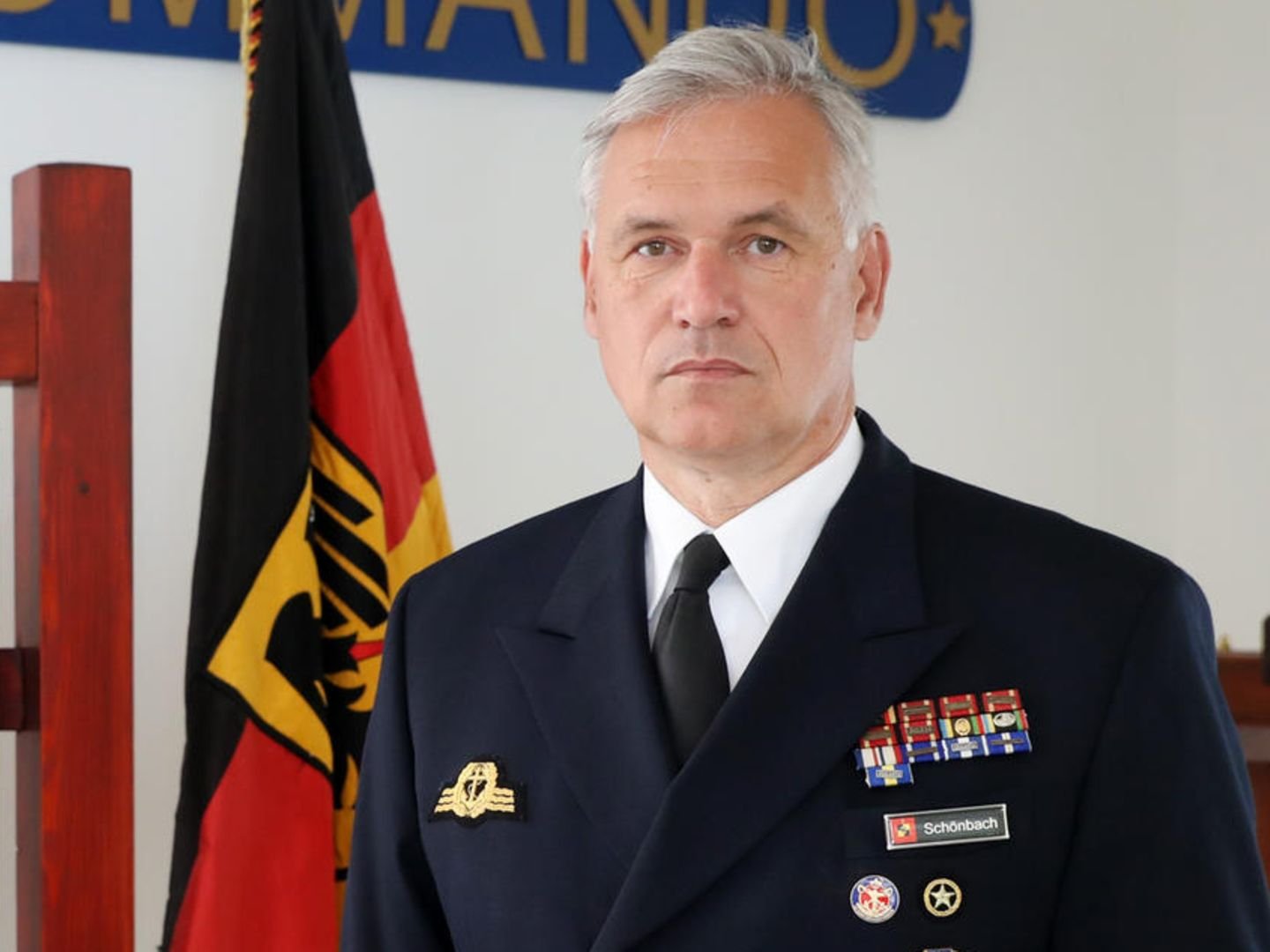
The speech of Kay-Achim Schönbach, former commander of the German Navy, at the conference on NATO and Global Security.
The speech of Kay-Achim Schönbach, former commander of the German Navy, at the conference on NATO and Global Security.
The World Civilizations Initiative Research Center organized an international conference on Global Security and NATO on June 26-27, 2026, in Istanbul, Türkiye, ahead of the NATO summit scheduled for 7 and 8th of July in Ankara. One of the speakers was Kay-Achim Schönbach, the former commander of the German Navy (Deutsche Marine) and a retired vice admiral. He came to the attention of the international public in January 2022 when he was forced to resign from his post due to controversial statements he made regarding the war in Ukraine, Crimea, and Russian President Vladimir Putin.
UWI presents below the speech of Schönbach. The title was set by UWI.
Dear ladies and gentlemen,
I’m delighted and deeply honored to have the opportunity to at least offer a few words of greeting on the occasion of your conference in Istanbul over the coming days. I was also honored to have been invited to the conference in Istanbul by the organizers. Unfortunately, I’m unable to be there with you in person. Please believe me when I say that I’m most disappointed not to have the opportunity to exchange ideas with you.
For those who don’t know me, allow me to briefly introduce myself. My name is Kai-Achim Schönbach. I’m a retired Vice Admiral of the German Navy and I served in my last post as Chief of the German Navy until 2022. Since then, I’ve been working for various political platforms. I’m involved in different book projects and host a political podcast together with like-minded individuals and I’m active in political associations and parties of the Federal Republic of Germany. The organizers have asked me to send a brief greeting from far away Spain to you in Istanbul in order to at least make a small, if very modest, contribution to the success of the event.
It would be stating the obvious if I were to say at this point that we are not only living in turbulent times, but especially from my personal German perspective, are witnessing a history marked by significant shifts in power and realignments in foreign and security policy, geopolitics and foreign trade policy. But I dare say that the distinguished group of experts, politicians, military officers and specialists in these important political fields who have gathered here in Istanbul is well aware of this. Therefore, drawing on my own many years of experience in security policy within the Armed Forces, the Ministry of Defence and the German Parliament, I would like to emphasize right here how important and I think, indeed, of existential significance, it is that you have come together in this distinguished forum.
As I certainly do not wish to beat around the bush, as we say in German, or stir up a hornet’s nest of arguments, you, in particular, distinguished ladies and gentlemen attending this event, are of immense importance for the cause of history, especially of the European and Eurasian continents. I am, as I say with a frank wink, out of reach of those who might throw apples and rotten eggs, for in light of what I see—my personal opinion, as I see it—the declining quality and excellence of many active politicians in our time, the importance of experts from a wide variety of fields whom you represent today and in the coming days is increasing considerably. It is you who largely behind the scenes or sometimes invisibly must prepare the right decisions and the right choice of words for your political masters or political leaders.
The days are apparently or evidently over when our peoples and nations could trust that, so to say, virtual geniuses were elected to office and with somnambulistic certainty always put into practice what was right and good for their nations.
As a German citizen in Europe, I can only express my deepest concern at this point, that since the unspeakable days of the Cuban Missile Crisis, we have never been so close to an escalation into a major war in Europe. And I don’t think I’m the only one in your circle who has come to this conclusion. Since I don’t know how the work is organized in Istanbul, perhaps in working groups or other structures, I’ll nevertheless assume that beyond general discussions, the focus will primarily be on the major conflicts currently preoccupying us. I don’t think I’m wrong in assuming that regardless of which regions of the world you have gathered from in Istanbul, the conflicts in the Middle East and the war in Eastern Ukraine will be the primary drivers of the discussions.
Since I do not have the opportunity in this brief welcoming address to dwell too long on the details, I will focus on what I, as a German and European, consider the most significant conflict, the war in Eastern Europe and Ukraine. My personal circumstances have tied me very closely to the war between Ukraine and the Russian Federation. In fact, for many years, I had to deal specifically during my active time—and now, of course, as well—with the conflicts in Eastern Europe, the Russian Federation and Ukraine in particular. And I was also tasked with providing political-military advice to senior political leadership at the Ministry of Defense in the German Federal Republic.
But if we learned one thing from all these conflicts, it is this: we in the West, and above all, in the Federal Republic of Germany, have forgotten just how significantly the respective histories of the affected countries, or rather the political interpretation of history, influence day-to-day politics.
I would like to emphasize once again that for many participants at the conference in Istanbul, this is more of a truism. But we Germans in particular have suppressed these simple truths and still believe that history came to an end on May 8, 1945, the end of the Second World War. Furthermore, we believe… I think so… we believe that in typical German fashion, we know best how to deal with history, how to process it, and how to come to terms with it. Specifically, the war in the Donbass region has shown that ignoring historical contexts and refusing to engage more deeply, and above all, neutrally, with the causes of the conflict, is what made this armed conflict possible in the first place. The war in Eastern Europe could have been prevented. We know this. We all know this.
Drawing on my personal history, I can say today, and I’m for sure not the only one, that mutual respect and diplomacy on equal footing offered every opportunity to prevent this smoldering conflict from escalating into a full-scale war. The blame for the outbreak of the war, as well as responsibility for conflicts around the world, can rarely be attributed to just one party. It takes two to make a dispute. And in saying this, I’m in no way taking sides, just as I did in the spring of 2022. But we must all acknowledge that powerful players within the system had every opportunity to resolve this conflict, even if not done to the last detail. Ignorance, ignorance, a failure to learn from history, the pursuit of power, and flawed risk analysis have turned this cold conflict into a hard one.
My personal concern, and I believe this concern must also weigh heavily on all of you, is that the actors involved, due to a lack of insight and overestimation of their own capabilities, could cause the already dangerous situation to escalate further. Specifically, we must recognize that we are all caught in a dilemma. On the one side, Article 51 of the UN Charter mandates support for a country under attack. In this case, Ukraine, no doubt about it. On the other hand, we must… and I strongly believe that we must also have the courage to assess the situation correctly, and for the sake of everyone in Europe, and possibly the world as a whole as well, take the right steps to end this war as quickly as possible, even if justice cannot be fully served for one side of the conflict.
And you know what I mean. The danger that, driven by moralism and misguided idealism, the West is preparing to allow itself to be drawn into this war is immense. As much as I understand the position of the attacked nation on the Kyiv side, I emphasize this once again: the overall well-being of the continent is greater and more important than the endless continuation of this war, which apparently at the moment neither side can win.
Without venturing too far into political philosophy, allow me to emphasize once again very strongly at this point that we all need to learn once more to analyze and assess conflicts in the world objectively, soberly, and with a sense of proportion. Some of you are closer to decision-makers. Some, like me, work for political platforms and operate more in the background. And some are in the public eye giving speeches and publishing articles. But what unites us all is the genuine desire for peace, the realization that only mutual respect and negotiation on equal footing constitute the essence of diplomacy, and a sincere wish for reconciliation and understanding.
Here in Istanbul, too, we certainly do not agree on every point, I am sure about this. Nor do we need to, for we come from different worlds of experiences, different cultural circles, and different nations with vastly different histories. But that is what makes foreign and security policy so fascinating. And even if you probably remember this, if presidential candidate Clinton’s former slogan was, “it’s the economy, stupid,” it is once again becoming clear worldwide just how important diplomatic exchange at all levels between our nations is. I already miss this very exchange of experiences in Istanbul, intellectual engagement, and the will to understand one another.
I hope and wish for you that by the end of your time together in Istanbul on Sunday, you will once again have taken a small or perhaps even a larger step toward a better atmosphere among the nations represented here in Istanbul. I also hope that everyone had the opportunity not only to contribute their own ideas, but also to reflect on their own views. And thus, in the best dialectical sense of the German philosopher Hegel, to have elevated their ideas and proper problem-solving strategies to a higher, better, and more effective level. And as I hinted at above, may you return home and serve as a strong source of support and assistance to the so-called political leaders.
I wish you every success, fruitful discussions, resolutions of misunderstandings, and that you have found not only new conversation partners, but perhaps also friends. All the best. God bless you.